
The Pottery Barn Rule
Posted: January 3, 2026 Filed under: Uncategorized | Tags: Donald Trump, Drug Interdiction, Monroe Doctrine, Nicolas Maduro, Oil, Policy Strategy Mismatch, Regime Change, Venezuela Leave a comment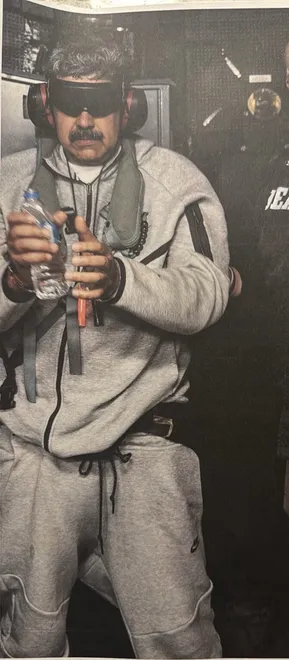
Venezuelan leader Nicolás Maduro, aboard the USS Iwo Jima after his capture, is seen in this handout image posted by U.S. President Donald Trump on Truth Social Jan. 3, 2026.
The Pottery Barn Rule is that “if you break it, you own it.” The saying was popularized by then Secretary of State Colin Powell in advising President George W. Bush in 2002 prior to the military invasion of Iraq. It originated, according to Bob Woodward, then with the Washington Post, when the Secretary told the President that, “You are going to be the proud owner of 25 million people. You will own all their hopes, aspirations, and problems. You’ll own it all.” As of today, we now have the same situation in Venezuela.
Early this morning, U.S. forces “arrested” Venezuelan president Nicolas Maduro and his wife Cilia Flores in a coordinated joint force operation in Caracas. Technically, the U.S. military was supporting the FBI, also on the raid, who made the actual arrest. Maduro was first indicted in March 2020. A new superseding indictment was unsealed this year. The complicated raid went off very well and the women and men of the U.S. Armed Forces should be congratulated and praised for their professionalism, bravery and ability to pull it off without the loss of personnel or equipment. It was a great tactical success. The Venezuelan president and first lady will be taken to the United States later today and held on drug trafficking and weapons charges.
Unfortunately, a great tactical success may turn out to be a strategic disaster.
Every senior military officer is taught about a “policy-strategy match.” In dealing with Venezuela there was and is a huge policy-strategy mismatch. For months the Trump administration has been arguing that the reason for their attacks on fishing boats is to stop drugs from getting to the U.S. The policy was to stop the flow of drugs. The strategy — blowing up small fishing boats, whether or not drugs were on board — would never stop that flow. It is a complete mismatch. Fifteen thousand uniformed Americans and a carrier strike group were not there to interdict drugs. As we have all come to know, most lethal drugs such as fentanyl come from Mexico. Few drugs are actually created in Venezuela, it is more of a transit station for cocaine headed to Europe. Indeed, Trump pardoned a convicted drug king pin, the former president of Honduras Juan Fernando Hernandez, who was sentenced to forty-five years in prison. It was never about drugs.
Then there were rumblings about “regime change.” From a military perspective, what does that mean? It is way too vague of a concept to build a strategy to accomplish it. Regime change is more than just removing the head of government. The regime consists of countless government officials, military officers and units, police, intelligence services, bank officials and on and on. To carry out regime change means a whole of government response. It includes political and economic forces and officials, not just the military. Today Trump administration officials tried to put the arrest of Maduro in the compartment labeled “narco-terrorism.” It is not about that. (Please do not misunderstand me. Maduro is a bad guy. I have no sympathy for him at all. But there are lots of bad guys around the world. Why this one? Let’s look at the larger implications.)
It is about oil and Trump setting himself up as the king of the Western Hemisphere. That was clear from his “speech” and answers to questions at Mar-A-Lago today. It is about power and riches and our profound “right” to both, even at the expense of the sovereignty of other nations. As he explained today, “All the way back, it dated to the Monroe Doctrines and the Monroe Doctrine is a big deal. But we’ve superseded it by a lot, by a real lot. They now call it the Monroe Doctrine. I don’t know, it’s Don-roe Doctrine. We sort of forgot about it. It was very important, but we forgot about it. We don’t forget about it anymore.”
The first rule of strategic planning is defining the end state. Trump set out vague guidelines today that to put into coherent terms means the U.S. will take Venezuelan oil. That is his desired end state. But as anyone that has planned anything knows, one also needs to think through the steps to get there and do the cost benefit analysis as to whether it is worth it. None of that appears to have been done in this case.
Oh. Oh.
The flawless military plan was fantastic. Now what? What we got today was a vague assurance that “we” — the United States — would “run” Venezuela until we transition to a new government that can take over. That could be a year or more, according to Trump. Meanwhile, when asked specifically who the “we” are and did that mean U.S. military forces would occupy the country, all I could figure out that he said was “maybe.” Clearly, no one — at least no one at the top — has thought much about what comes next. That is dangerous.
Maduro may be gone but his regime remains intact. The paramilitary enforcers remain intact. The drug lords remain intact. The corrupt officials that bankrupted the country remain intact. And so on. The country is 353,841 square miles in size (roughly twice the size of California) with a population of about 30 million people. Most of the population lives north of the Orinoco River and 88 percent live in urban areas. How is the U.S. going to run that with bureaucrats sitting in Washington D.C.? Trump promises the Venezuelans a wonderful new life of prosperity using oil money. How does that work on a day to day basis? Especially since he also said that the oil money would go to the companies that had their oil and land “stolen” in the 1970s. (They did not have it stolen. They never owned it.) Who supplies medical treatment, groceries, sanitation and all the other things we now take for granted in modern cities? There are significant humanitarian needs that must be met when running another country.
From the way Trump talked today, he was only interested in the oil. Perhaps they will put troops into the oil region to guard the workers employed by the American oil companies that he promises will have everything up and running in no time. What about the rest of the country? Even if he is only interested in the oil areas, massive amounts of troops, far more than are in the Caribbean right now, will be needed to provide security. Those troops will need logistical support. That means getting ports and airfields working and moving supplies efficiently which means even more troops.
We learned some hard lessons in the early part of this century in Iraq. We learned some in Afghanistan as well. It is hard to convert a foreign country into a working democracy. We gave up in both Iraq and Afghanistan because it was too hard, but only after we had lost a lot of lives and treasure. Here is another secret from those experiences — civilian planners thought the U.S. military would be welcomed as heroes because they got rid of the dictators. While they were glad that they were gone, they did not want foreigners in their country. Who pays the police and Venezuelan military when things start to fall apart? Will we disarm them? What if they do not want to be disarmed? In Iraq the police and military units were suddenly without any income, but they still had weapons and were mad as hell. That is not a good combination.
Not once today did Trump, or Rubio or Hegseth mention anything about elections and the transition of power except in passing in response to a question. The Venezuelan opposition leader and Nobel Peace Prize winner Maria Corina Machado was not consulted or informed of the pending arrest of Maduro. She would be the logical choice for a new government to coalesce around but today Trump said about her, “I think it would be very tough for her to be the leader. She doesn’t have the support within or the respect within the country. A very nice woman, but she doesn’t have the respect.” Maybe he is just jealous that she won the prize and he did not.
It is also necessary to point out that no one in the House or Senate was notified of the impending raid. They were only told about it afterwards. Once more, the branch of the government responsible for declaring war was left out in the cold.
Equally troubling is the impact that this action had on our friends, allies and adversaries around the world. From many of their viewpoints, the U.S. declared open season to hunt down anyone in any country if they are deemed a criminal. Sovereignty went out the window as the U.S. demonstrated that anything goes. Further, in his remarks, Trump vaguely threatened the presidents of Colombia and Mexico. Apparently, if Trump wants it he will take it. So much for the rule of law.
We now own Venezuela. I have no idea how that will play out. It could be all talk and no action after nabbing Maduro Trump may forget all about taking over and running Venezuela. He does have an extremely short attention span. We will see.
Happy New Year.
 Tom
Tom Into The Fray
Recent Comments