
Don’t Believe Your Lying Eyes
Posted: January 10, 2026 Filed under: Uncategorized | Tags: 6 January Insurrection, Donald Trump, Greenland, Immigration Customs Enforcement (ICE), International Law, NATO, Oil, Renee Nicole Good, Russia, Stephen Miller, Venezuela Leave a comment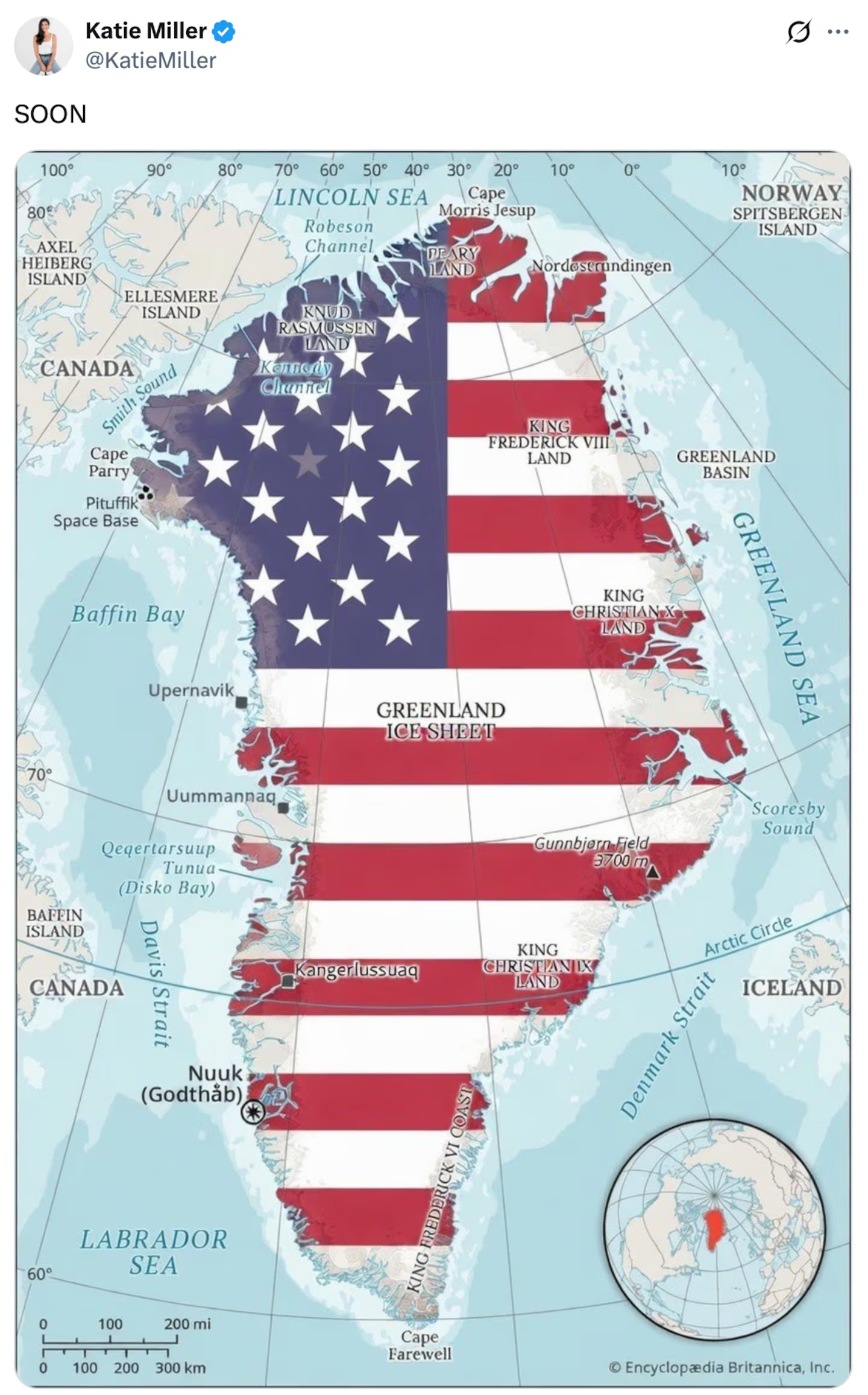
An “X” post by Katie Miller, White House staffer and wife of Stephen Miller Deputy Chief of Staff, regarding questions about the U.S. taking over Greenland.
The new year is only ten days old and already I am exhausted by all of the shenanigans pulled by the Trump regime. Trump and his advisers are dropping any pretense of trying to persuade us, as citizens, that their actions are in our best interests. From Venezuela to Minnesota we now know that they have only their own best interests guiding them. International, national or local laws are only guidelines. If the law is not convenient to get what they want, then damn the law, they will do it anyway. Am I exaggerating? No. Let Stephen Miller, the power behind Trump’s throne explain the world view of Trump and his advisers. In an interview earlier this week with Jake Tapper of CNN he explained (actually he shouted, as he does in every interview I have seen) how they will act towards Greenland.
“The United States should have Greenland as part of the United States. There’s no need to even think or talk about this in the context that you’re asking, of a military operation. Nobody’s going to fight the United States militarily over the future of Greenland.” Then he added more.“We live in a world in which you can talk all you want about international niceties and everything else, but we live in a world, in the real world, Jake, that is governed by strength, that is governed by force, that is governed by power. These are the iron laws of the world that have existed since the beginning of time.”
Will we really invade Greenland? I have no idea. There is no strategic reason to do so, despite the lies coming from the administration. Greenland is a semi-independent Danish territory. The Danes are, perhaps, our strongest and most supportive ally in NATO. There are treaties and agreements that go back to the early 1950’s about the use of Greenland for military activity. If the U.S. wanted to build another base there (we have one already called Pituffik Space Base formerly known as Thule Air Force Base) we could and the Danes and Greenlanders would welcome it. Greenland is on the western flank of the Greenland, Iceland, U.K. Gap (GIUK Gap). That gap is the avenue used by Russian naval forces, especially their ballistic missile submarines, to get from the ice free year-round port in Murmansk to the open waters of the Atlantic Ocean. NATO has significant anti-submarine warfare (ASW) assets monitoring the gap. There is no military reason for the U.S. to occupy Greenland or to take it away from Denmark.
There is only one real reason and it is the same as for our incursion into Venezuela. Trump wants it. He wants to dominate the Western Hemisphere and he wants to demonstrate his domination. He also wants to make money off any endeavor that the U.S, undertakes, but that is almost a given after nearly a year of watching his policy decisions from tariffs to oil to the rare earth elements believed to be in large deposits in Greenland. Trump has no desire to be a part of, or abide by any international treaty. Last week he withdrew the U.S. from sixty-six international organizations.
Everything that Trump and his minions said about Venezuela were lies. Many of us knew it at the time, but now the whole world knows it. It was never about drugs, or democracy or giving Venezuelans a better life, it was simply another grab for money in the form of oil. We sent our sons and daughters and husbands and wives into full-fledged combat so that Trump can look tough and steal oil. Does that make our military forces mercenaries? Fighting for money? Of course, as usual, he did not know what he was talking about because either none of his Cabinet members did their homework, or because Trump did not listen, but the truth remains, U.S. oil companies have mostly moved on from Venezuela and have no intention of going back.
As usual, as multiple oil executives explained to him yesterday as to why they were not interested, Trump waved his hand and promised to make the real world problems go away. As one of my favorite sayings goes, “nothing is impossible for the person that doesn’t have to do it.” (I am no geologist or oil industry expert, but even I know that Venezuelan oil is hard to extract, hard to refine, the infrastructure would have to be rebuilt costing at least 100 billion dollars and the government and internal unrest are not conducive to safe operations any time in the near future. Not to mention that the cost of oil right now is low and therefore barely profitable and U.S. producers use a lot of U.S. and Canadian shale oil.)
Here is the real “tell.” At last count we have already seized five “ghost” tankers that are headed to the U.S. worth hundreds of millions of dollars. Trump announced that Venezuela will “give” us the oil now in storage in Venezuela because of the embargo. All together, that oil could be worth several billion dollars. Earlier he announced on Truth Social, “this oil will be sold at its market price, and that money will be controlled by me, as President of the United States of America, to ensure it is used to benefit the people of Venezuela and the United States!” CNN reports that the money will not go into the U.S. Treasury. Instead it will “utilize a collection of international oil traders and offshore bank accounts to sell the oil and manage the resulting cash.” A billion dollar slush fund for Trump! What could go wrong? Does anyone still doubt what the real purpose of the incursion into Venezuela was all about? Does Congress remember that we have a Constitution? Article I gives control of the purse strings to Congress, but I have little hope of anything coming from them to check his power.
This same lawless exercise of raw power is evident in our domestic policies as well. One example is ignoring the law — not a request, not a subpoena, not a committee hearing — to turn over the Epstein files. They were to be turned over by 19 December and now the Department of Justice (DOJ) is saying that they have released less than one percent of the documents in the file. We should not expect to see any real progress on that front anytime soon, if at all. Stonewall. Deflect. Ignore. We know the routine by now.
More tragically are the efforts to remove immigrants from our country. Many, not all, that are being rounded up and hunted down are here legally, either through the Temporary Protective Status (TPS) program or because they followed the rules and officially applied for asylum. A mere fraction are “the worst of the worst.” As reported in the New Republic, on New Year’s Eve the Immigration and Customs Enforcement (ICE) Agency announced a new 100 million dollar recruitment effort that ICE called “a wartime recruitment” strategy that will target people “who have attended UFC fights, listened to patriotic podcasts, or shown an interest in guns and tactical gear.” Starting last summer, they used social media to advertise the hiring of more agents as a chance to “Serve your country! Defend your culture! No undergraduate degree required!” Since then they have reportedly hired 12,000 new agents, more than doubling the size of the agency. I will not speculate on the quality of the hires, or the extremely shortened training they receive, but when it is all put together, there is a troubling theme to the recruitment effort. Think about the term “defend your culture.” Do you honestly believe that they are appealing to Jews, Muslims, Latinos or any other minority group in our country? There is a very specific type of person they are hiring and while the horrific killing of Renee Nicole Good in Minneapolis has sparked protests around the country, we can probably expect more killing. Our highest government officials lied about the situation before her body was removed from the scene. The ICE agent that shot her is on tape after he shot her and as she crashed saying “f***ing b*itch.” As if she deserved to get shot in the face three times for trying to help her neighbors. There is a sense for those within this administration that they are untouchable. No one is held accountable. If there was any doubt that a cover-up would ensue, that doubt was erased when the FBI announced that no Minnesota or Minneapolis law enforcement agencies would be included in the investigation of the murder of Renee or be allowed access to evidence.
We need to protest, peacefully but clearly. This is not the America I love and served for twenty eight years. It is important to remain calm but resolute. My gut tells me that Trump is hoping that these various confrontations result in a major escalation of violence so that he can declare martial law and cancel the upcoming elections, or at least severely inhibit them, under the guise of national security, their go to explanation for everything illegal that they do. But, don’t take my word for it. Here is Trump talking to a gathering of Republicans. “You gotta win the midterms ’cause, if we don’t win the midterms, it’s just gonna be – I mean, they’ll find a reason to impeach me, I’ll get impeached.”
He is weaponizing the government and his supporters. When his administration tells ICE and other instruments of repression that “we’ve got your backs” he is telling them that anything goes. For proof, look no further than pardoning all of those that tried to overthrow our government. Then, last week on 6 January, the fifth anniversary of the coup, an official website of the United States of America went up that repeated every lie ever told about that day. (You can find it here. Be ready to be disgusted.) According to the official government website, “peaceful patriots” were framed that day. The attempted coup was really staged by Democrats with the help of the law enforcement officers at the capitol.
There are no limits. Trump believes that he can do whatever he wants and take whatever he wants. Or as he said in response to a New York Times question about obeying international laws and treaties, “I don’t need international law, I’m not looking to hurt people.” He was asked if there were limits to what he could do and he replied, “Yeah, there is one thing. My own morality. My own mind. It’s the only thing that can stop me.”
Stay vigilant.
The Pottery Barn Rule
Posted: January 3, 2026 Filed under: Uncategorized | Tags: Donald Trump, Drug Interdiction, Monroe Doctrine, Nicolas Maduro, Oil, Policy Strategy Mismatch, Regime Change, Venezuela Leave a comment
Venezuelan leader Nicolás Maduro, aboard the USS Iwo Jima after his capture, is seen in this handout image posted by U.S. President Donald Trump on Truth Social Jan. 3, 2026.
The Pottery Barn Rule is that “if you break it, you own it.” The saying was popularized by then Secretary of State Colin Powell in advising President George W. Bush in 2002 prior to the military invasion of Iraq. It originated, according to Bob Woodward, then with the Washington Post, when the Secretary told the President that, “You are going to be the proud owner of 25 million people. You will own all their hopes, aspirations, and problems. You’ll own it all.” As of today, we now have the same situation in Venezuela.
Early this morning, U.S. forces “arrested” Venezuelan president Nicolas Maduro and his wife Cilia Flores in a coordinated joint force operation in Caracas. Technically, the U.S. military was supporting the FBI, also on the raid, who made the actual arrest. Maduro was first indicted in March 2020. A new superseding indictment was unsealed this year. The complicated raid went off very well and the women and men of the U.S. Armed Forces should be congratulated and praised for their professionalism, bravery and ability to pull it off without the loss of personnel or equipment. It was a great tactical success. The Venezuelan president and first lady will be taken to the United States later today and held on drug trafficking and weapons charges.
Unfortunately, a great tactical success may turn out to be a strategic disaster.
Every senior military officer is taught about a “policy-strategy match.” In dealing with Venezuela there was and is a huge policy-strategy mismatch. For months the Trump administration has been arguing that the reason for their attacks on fishing boats is to stop drugs from getting to the U.S. The policy was to stop the flow of drugs. The strategy — blowing up small fishing boats, whether or not drugs were on board — would never stop that flow. It is a complete mismatch. Fifteen thousand uniformed Americans and a carrier strike group were not there to interdict drugs. As we have all come to know, most lethal drugs such as fentanyl come from Mexico. Few drugs are actually created in Venezuela, it is more of a transit station for cocaine headed to Europe. Indeed, Trump pardoned a convicted drug king pin, the former president of Honduras Juan Fernando Hernandez, who was sentenced to forty-five years in prison. It was never about drugs.
Then there were rumblings about “regime change.” From a military perspective, what does that mean? It is way too vague of a concept to build a strategy to accomplish it. Regime change is more than just removing the head of government. The regime consists of countless government officials, military officers and units, police, intelligence services, bank officials and on and on. To carry out regime change means a whole of government response. It includes political and economic forces and officials, not just the military. Today Trump administration officials tried to put the arrest of Maduro in the compartment labeled “narco-terrorism.” It is not about that. (Please do not misunderstand me. Maduro is a bad guy. I have no sympathy for him at all. But there are lots of bad guys around the world. Why this one? Let’s look at the larger implications.)
It is about oil and Trump setting himself up as the king of the Western Hemisphere. That was clear from his “speech” and answers to questions at Mar-A-Lago today. It is about power and riches and our profound “right” to both, even at the expense of the sovereignty of other nations. As he explained today, “All the way back, it dated to the Monroe Doctrines and the Monroe Doctrine is a big deal. But we’ve superseded it by a lot, by a real lot. They now call it the Monroe Doctrine. I don’t know, it’s Don-roe Doctrine. We sort of forgot about it. It was very important, but we forgot about it. We don’t forget about it anymore.”
The first rule of strategic planning is defining the end state. Trump set out vague guidelines today that to put into coherent terms means the U.S. will take Venezuelan oil. That is his desired end state. But as anyone that has planned anything knows, one also needs to think through the steps to get there and do the cost benefit analysis as to whether it is worth it. None of that appears to have been done in this case.
Oh. Oh.
The flawless military plan was fantastic. Now what? What we got today was a vague assurance that “we” — the United States — would “run” Venezuela until we transition to a new government that can take over. That could be a year or more, according to Trump. Meanwhile, when asked specifically who the “we” are and did that mean U.S. military forces would occupy the country, all I could figure out that he said was “maybe.” Clearly, no one — at least no one at the top — has thought much about what comes next. That is dangerous.
Maduro may be gone but his regime remains intact. The paramilitary enforcers remain intact. The drug lords remain intact. The corrupt officials that bankrupted the country remain intact. And so on. The country is 353,841 square miles in size (roughly twice the size of California) with a population of about 30 million people. Most of the population lives north of the Orinoco River and 88 percent live in urban areas. How is the U.S. going to run that with bureaucrats sitting in Washington D.C.? Trump promises the Venezuelans a wonderful new life of prosperity using oil money. How does that work on a day to day basis? Especially since he also said that the oil money would go to the companies that had their oil and land “stolen” in the 1970s. (They did not have it stolen. They never owned it.) Who supplies medical treatment, groceries, sanitation and all the other things we now take for granted in modern cities? There are significant humanitarian needs that must be met when running another country.
From the way Trump talked today, he was only interested in the oil. Perhaps they will put troops into the oil region to guard the workers employed by the American oil companies that he promises will have everything up and running in no time. What about the rest of the country? Even if he is only interested in the oil areas, massive amounts of troops, far more than are in the Caribbean right now, will be needed to provide security. Those troops will need logistical support. That means getting ports and airfields working and moving supplies efficiently which means even more troops.
We learned some hard lessons in the early part of this century in Iraq. We learned some in Afghanistan as well. It is hard to convert a foreign country into a working democracy. We gave up in both Iraq and Afghanistan because it was too hard, but only after we had lost a lot of lives and treasure. Here is another secret from those experiences — civilian planners thought the U.S. military would be welcomed as heroes because they got rid of the dictators. While they were glad that they were gone, they did not want foreigners in their country. Who pays the police and Venezuelan military when things start to fall apart? Will we disarm them? What if they do not want to be disarmed? In Iraq the police and military units were suddenly without any income, but they still had weapons and were mad as hell. That is not a good combination.
Not once today did Trump, or Rubio or Hegseth mention anything about elections and the transition of power except in passing in response to a question. The Venezuelan opposition leader and Nobel Peace Prize winner Maria Corina Machado was not consulted or informed of the pending arrest of Maduro. She would be the logical choice for a new government to coalesce around but today Trump said about her, “I think it would be very tough for her to be the leader. She doesn’t have the support within or the respect within the country. A very nice woman, but she doesn’t have the respect.” Maybe he is just jealous that she won the prize and he did not.
It is also necessary to point out that no one in the House or Senate was notified of the impending raid. They were only told about it afterwards. Once more, the branch of the government responsible for declaring war was left out in the cold.
Equally troubling is the impact that this action had on our friends, allies and adversaries around the world. From many of their viewpoints, the U.S. declared open season to hunt down anyone in any country if they are deemed a criminal. Sovereignty went out the window as the U.S. demonstrated that anything goes. Further, in his remarks, Trump vaguely threatened the presidents of Colombia and Mexico. Apparently, if Trump wants it he will take it. So much for the rule of law.
We now own Venezuela. I have no idea how that will play out. It could be all talk and no action after nabbing Maduro Trump may forget all about taking over and running Venezuela. He does have an extremely short attention span. We will see.
Happy New Year.
The Iranian Strategy – Policy Mismatch
Posted: June 25, 2019 Filed under: Uncategorized | Tags: Deterrence, Iran, Joint Comprehensive Plan of Action, Oil, Persian Gulf, Sanctions, Terrorism Leave a commentOne has to wonder where the Trump Administration is headed with their policy towards Iran. There are, to say the least, a number of contradictions. However, before I get too far into this, I would like to make three comments.
- For almost forty years the Iranians have been nothing but trouble-makers. The government is the number one source of state sponsored terrorism in the world. The leadership continues to try and export the revolution and to thwart U.S. interests in the Middle East.
- I am glad that Mr. Trump called off last week’s planned strikes into Iran. Unfortunately, like so many of his decisions, he did so for the wrong reasons.
- While on active naval service, I made two port calls in the 1970’s to Iran. One to Bandar Abbas and one to Khorramshahr. Interesting places, but maybe not too relevant to this piece. Since then I made several trips through the Strait of Hormuz on U.S. Navy ships in and out of the Persian Gulf, and every time we were tested by Iranian Revolutionary Guard Corps (IRGC) armed boats. No shots fired.
As you know, Iran is responsible for a series of attacks on tankers in the Gulf of Oman, near the Strait of Hormuz, in recent weeks. Five total as of this writing. Additionally, they launched surface-to-air missiles against U.S. military drones, missing once and hitting two including the most controversial last week. Why?
The most obvious reason is that their economy is being crushed by sanctions imposed by the U.S. It is having a direct and profound impact on daily life inside Iran. The sanctions are succeeding in that respect. While the United States is demonstrating its ability to succeed in this effort, it forces the Iranians to respond in order to demonstrate their own resolve, show their citizens that they will not bow to the U.S., and to attempt to get relief from the sanctions. In other words, they are demonstrating that they can have an impact on the world’s economy by stopping all Persian Gulf oil, not just Iranian oil, from reaching the market, thus having a direct impact on countries such as Japan and others that rely on that oil for their own economic well-being. If they cannot totally stop the flow of oil, then they can make it so costly — insurance rates, the price of oil, military requirements to protect tankers, etc. — that it will still have an impact unacceptable to many countries. (As a side note, when I worked Middle East issues in the Pentagon, insurance rates for shipping in the Gulf was one of our measures of effectiveness (MOE). If they went up, we needed more resources. When they went down, we as a military were being effective in keeping the sea lanes open and secure.) The point is, the Iranians are not going to stop meddling with the shipping lanes in and out of the Gulf until they feel some sanctions relief.
Here is the mismatch. The Trump Administration claims that the sanctions will be eased when the Iranians come to the table to renegotiate the Joint Comprehensive Plan of Action (JCPOA) also known as the Iran Nuclear Deal. Mr. Trump pulled us out of it in May of 2018. One may claim that the JCPOA was a good deal or a bad deal, but in the short term at least it did stop Iran from developing a nuclear weapon. It opened Iran up to verification of its compliance and the International Atomic Energy Agency (IAEA) conducts regular inspections to ensure continued compliance. The other members of the agreement besides the U.S. (the U.K, Russia, China, France, Germany, and European Union) agree that Iran is abiding by the terms of the agreement and all remain in the agreement while working with Iran to keep them from violating its terms. Even the U.S. intelligence agencies as late as this spring testified in open hearings to Congress that the Iranians continue to abide by it.
So why would Iran return to negotiate a deal that they had already agreed to but from which the United States withdrew and is now punishing Iran for complying with that treaty? To be fair, one of the main criticisms of the JCPOA is that it addresses only nuclear weapons and not the development of ballistic missiles or Iran’s continued support of terrorism throughout the region. Fair enough. The original idea behind the negotiations was to take it one step at a time. Solve nuclear weapons and then address missiles in another treaty. Solve missiles and then address stopping terrorist activities. A building block approach that would instill trust as each step takes effect and allows for continued negotiations. It may or may not have worked, but now we will likely never know. More to the current point, why would the Iranians trust the U.S? And if this president can tear up a treaty with malice of forethought then what would keep the next president — elections are in 18 months and we may have a new one — from tearing up the Trump Treaty? There is no trust.
Making matters worse for our current strategy is that our trusted allies and friends no longer trust us either. Some, especially Japan and Germany and France, are not even sure that they can trust us when we say that the Iranians are definitely behind the recent attacks. And if they don’t support us now, they will certainly not support us in an armed conflict in the region. The U.S. does not want to go it alone in this arena.
Making it worse, even it if it sounds logical on one level, is Mr. Trump’s tweet that maybe the U.S. would not protect shipping without being compensated.
“China gets 91% of its Oil from the [Strait of Hormuz], Japan 62%, & many other countries likewise. So why are we protecting the shipping lanes for other countries (many years) for zero compensation. All of these countries should be protecting their own ships on what has always been a dangerous journey. We don’t even need to be there in that the U.S. has just become (by far) the largest producer of Energy anywhere in the world!”
While on one level it is imperative for a coalition effort to thwart Iranian attempts to disrupt the shipping lanes, on another it ignores the number one maritime objective of the United States — to protect shipping lanes around the world to ensure the free flow of commerce at sea. Did that just change because “we don’t even need to be there”?
While Mr. Trump once again made himself the hero of a soon to be catastrophe by fixing the crisis he created, still, calling off the strikes last week was the right call. He made himself into some kind of humanitarian savior by implying that no one told him about possible loss of human life. I find that insulting to the U.S. military. He implies that they aren’t doing the job because he didn’t find out about the number of casualties until 10 minutes before the strikes. Hogwash! The president, any president, is offered a series of options for him to choose. Included in the “pros and cons” of any option is the potential loss of life to Americans and to those under attack when the situation is not all out combat but rather a “message” as these were intended to be. He is either lying or cannot comprehend basic information. (By the way, in that series of tweets Mr. Trump tries to sound tough by saying that “we were cocked and loaded” to attack. Anyone that has served in the military would know that no one talks that way in senior, serious discussions and that besides, the expression is “locked and loaded.”)
But I digress.
The best reason for calling off the strikes is that, according to reports from senior, unnamed officials in the Pentagon but thought to be the Chairman of the Joint Chiefs of Staff, is that there was no second step. There was no consideration for what is called branches and sequels — what happens and what steps do we take when the Iranians inevitably respond. There was no clear understanding of what those strikes would do to enhance our strategy of getting the Iranians to the table. It would in fact, have made that much harder as the Iranians would likely have escalated their attacks and there were no follow-on U.S. plans. Fundamentally, Mr. Trump and his advisers lost sight of the fact that the enemy gets a vote on how things unfold. Without thinking through the next steps, having those strikes go forward would have opened up a potential Pandora’s Box of serious trouble in the Gulf.
Remember this. There is a reason we have fought in Iraq and Syria. They are not Iran. Iran has been a bigger trouble-maker in the region and a bigger counter to our policy goals than the other two ever were or could be. Why haven’t we gone after the Iranians in the same way? Because it will be hard.
In the 1987-88 Operation Earnest Will, the U.S. and other nations escorted tankers to protect them from the Iranians. During the Iran-Iraq War, the Iranians tried to cut off Iraqi oil shipments through the Gulf. Besides escorting tankers, the U.S. and coalition forces fought the “tanker wars” to punish the Iranians for placing mines in shipping lanes and other hostile acts. U.S. Navy ships were hit by mines (none sank) and other Iranian actions resulted in SEAL raids, and attacks on Iranian warships. Operation Praying Mantis resulted in a number of Iranian ships going to the bottom or being put out of action. The point is, the Iranian harassment of shipping quickly came to a stop. The Iranians also learned some valuable lessons in how to combat U.S. forces through asymmetric means.
The Iranian Navy is basically a professional navy built along the lines of most in the world with a recognizable command and control structure. The real bad guys are the Iranian Revolutionary Guard Corps (IRGC) that have their own forces, ashore and afloat, and do not answer to anyone in the Iranian government other than the Supreme Leader. Those are the ones to keep an eye on.
So now what? The Iranians probably think that Mr. Trump is all bluster and no action. Will that encourage more dangerous provocations on their side? How will the U.S. respond? If our policy is to corral Iranian nuclear and ballistic missile ambitions than how do we do that? No easy answers.
Whether we are officially in or out of the JCPOA, along with the other members of the agreement, it would seem to provide the best frame work for re-engaging with the Iranians. As far as practical, without losing our advantage in the region, talking is better than fighting. Should it come to war, we will prevail. But keep in mind that we are not talking about a few cruise missile strikes into empty air fields in Syria. It will be messy and we will take casualties. They will not be pushovers and they will test our capabilities. Right now, the rest of the world may not be with us. Most importantly, what is the end game? What do we want from the fighting? In 1988 it was for them to quit interfering with shipping lanes. It worked. Today we say it is guarantees about no nuclear weapons. How do we achieve that when everything the Iranians see around them (hello, North Korea) indicates that Mr. Trump responds with love letters to those with the weapons who test them, fire ballistic missiles and threaten the U.S. main land?
The Iranians tried negotiations through the JCPOA and feel like they were tricked. It will not be easy to get them back to the table, no matter how grim their economy. The Trump Administration needs to re-engage with the Iranians, without preconditions, but without easing sanctions until talks resume. Then a measured give and take — known in diplomatic circles as “compromise” — can result in the easing of some sanctions in return for specific Iranian actions. This may be the best way to ease us out of this growing crisis. Without it, expect the Iranians to continue to act out until they find the limit of U.S. patience.
 Tom
Tom Into The Fray
Recent Comments