
WILL JIM CROW RIDE AGAIN?
Posted: May 11, 2026 Filed under: Uncategorized | Tags: Divisiveness, Elections, Gerrymander, gerrymandering, history, Jim Crow, Louisiana v Callais, Partisan, Politics, Poll Tax, Project 2025, United States Constitution, Voting Rights Act of 1965 Leave a comment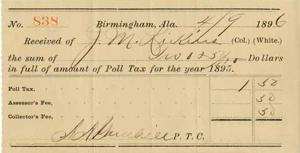
A receipt for $2.50 paid by a black man in Alabama for the poll tax during the Jim Crow era. When the average worker was making only about three hundred dollars a year, this was a significant amount. Additionally, black voters were often required to take a literacy test with questions such as reciting specific phrases in the Constitution or answering “how many windows are in the White House?” Other “tests” involved guessing specifically how many jelly beans were in a jar.
Last month the Supreme Court of the United States (SCOTUS) handed down a 6-3 decision in the case of Louisiana v Callais. The decision eviscerates Section 2 of the 1965 Voting Rights Act created by Congress to protect minority voters from poll taxes, literacy tests or any other effort to undermine their ability to vote. The law was aimed at the parts of the country where racism was rampant and where there were concerted efforts to suppress or eliminate the vote of non-white citizens. The Voting Rights Act was renewed numerous times over the years with solid bi-partisan support. The last vote in Congress in 2006 renewed it for twenty five years with both the Senate (98-0) and the House (390-33) overwhelming voting for it. What happened since then to cause its effective demise? President Obama was twice elected president. The court severely weakened the Act in 2013 by eliminating a key provision of the law in the case of Shelby County v Holder which required states in certain areas to get permission from the Department of Justice before making changes to voting requirements. The most recent case finished off the effectiveness of the law by deciding that race could not be taken into account when drawing districts and that in fact, gerrymandering — altering the districts so that the political parties are choosing elected officials rather than the people choosing their representatives — was perfectly permissible. The provision protecting against gerrymandering designed to divide minority (non-white) voters in order to limit their ability to elect minority officials was deemed unconstitutional.
[Note: The word gerrymander comes from 1812 Massachusetts where Governor Elbridge Gerry approved a voting map with a salamander shaped district. The name stuck. It means purposely drawing voting district lines in anyway possible, even if the result on paper looks ridiculous, to give an incumbent or a particular group of people a significantly unfair advantage in determining the results of an election.]
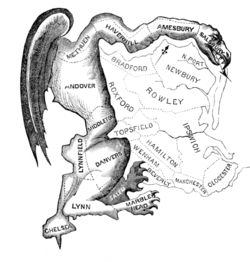
An 1812 political cartoon demonstrating the appearance of the gerrymandered election district of South Essex in Massachusetts. Editors satirized the shape of the new district as that of a monster.
Republicans were jubilant over the new interpretation of the law. Take a look at the video of state legislators in Tennessee as they eliminated the only remaining minority-majority district in the state by dividing it into parts and reassigning them to strong Republican districts. They were giddy. To me, their reaction and subsequent actions demonstrates exactly why the Voting Rights Act is still needed. SCOTUS cherry-picked the Obama election results — and only those results — to declare that it proved that there were no longer impediments to minority voting. According to Justice Alito writing for the majority, racism in U.S. elections is gone.
Despite the claim that the provisions are no longer needed, the actions of several southern state legislatures show exactly why it is needed. Louisiana’s governor immediately canceled an election (the mid-term primaries) that was already underway. He declared a state of emergency and then canceled the election so that the map could be redrawn in an attempt to eliminate two districts that were represented by minorities. Absentee ballots and mail-in ballots had already been distributed and roughly 40,000 votes were already returned. Now the process is going to start again with new districts and new candidates in some areas. Surely no one will be confused by that. After the SCOTUS ruling, Tennessee acted immediately to redraw their map. Florida, North Carolina and Georgia are also gerrymandering the map to eliminate minority districts. Alabama, South Carolina and Missouri have plans to do the same. Texas gerrymandered their districts last summer at the direction of Trump.
Two other states decided to do the same after the Texas effort. California redrew their map last fall and this spring, Virginia did the same. Both states did so after the voters approved the measures. After the votes were counted and the issue settled, the Virginia Supreme Court rendered the vote void on a technicality. It is unclear as I write whether the voice of the citizens of the Commonwealth of Virginia will have their voices heard or have to live by the result of the 4-3 decision.
States with “blue” governors held elections to see if their citizens wanted to fight back against the attempts to rig the elections. “Red” states changed theirs by fiat from their MAGA dominated legislatures — no ordinary voters allowed. Normally voting maps — even gerrymandered ones — are drawn up after the census every ten years. To change them now is highly unusual if not downright outrageous.
Chief Justice John Roberts has been working to overturn the Voting Rights Act since he was a young lawyer in the Department of Justice during the Reagan Administration in the early 1980s. The intent of the 1965 law was to put in the mechanisms necessary to actually enforce the 15th Amendment to the Constitution which opened up voting beyond the white land owning men that controlled elections until the Civil War. Ratified in 1870, it prohibited the federal government or any state from denying or abridging a citizen’s right to vote “on account of race, color, or previous condition of servitude.” The now Chief Justice has been arguing for decades that some states are treated to far greater scrutiny than others under the law which he considered unfair under the concept of equal sovereignty. He also holds a strict interpretation of the Constitution and believes that the Voting Rights Act is not impartial. He has argued that “the way to stop discrimination on the basis of race is to stop discriminating on the basis of race.” Unfortunately, that is not the reality of life for minorities in this country.
Now states can defend against virtually any claim of racially discriminatory map-drawing by claiming they instead discriminated based on political parties — even though race and partisanship are often intermingled.
I am against gerrymandering and voted against gerrymandered districts in my home state. There should be bi-partisan or non-partisan commissions to draw equitable voting districts. But unfortunately there are also no unicorns. Therefore “blue” states have an obligation to counter “red” states with gerrymandered districts to try and recoup the increased number of Republican districts.
This effort is only a part of a larger effort to restrict voter protections and the push to limit turnout in the 2026 and 2028 elections. The effort is already underway to protect MAGA Republicans in Congress and in state legislatures following the deeply unpopular policies and actions of the Trump regime. The SCOTUS decision provides a roadmap for states to return to pre-1965 race discrimination in redistricting, despite Congress’s repeated and overwhelming reauthorization of the Voting Rights Act for decades.
This is the same plan that gave us the Safeguard American Voters Eligibility (SAVE) Act which I have written about in this space before. Among other provisions, it comes dangerously close to mandating that U.S. citizens must show their papers in order to prove that they are citizens. To register to vote, one must produce a valid passport or birth certificate. If passed, as it already has in the House but is facing a fierce uphill battle in the Senate, millions of people will be disenfranchised. Allegedly, it is supposed to prevent voter fraud — a phantom menace that does not exist in any meaningful way. In practice, it is voter suppression. Yesterday Trump promised to deploy an “Election Integrity Army in every single State.” There have already been discussions about placing ICE and Border Patrol forces near polling places. These are the first steps in a larger plan to interfere with the upcoming elections.
Some of these efforts are reminiscent of post-Reconstruction days from the late 1890s to 1965 where Jim Crow efforts terrorized mainly black citizens. In particular the effort was aimed at preventing Black citizens from voting through systemic, state-level legal efforts in spite of the 15th Amendment. Literacy tests, poll taxes, grandfather clauses, and violence drastically reduced Black voter registration. For example, in Louisiana Black voter registration plummeted from 44% in 1896 to 4% by 1904. By 1940, only 3% of eligible African Americans in the South were registered to vote. There are legitimate fears in our minority communities that our country is headed back to the bad old days. Since the last campaign many voices have been raising the alarm about the blueprint for significant changes outlined and explained in detail in the Trump Administration’s Project 2025 designed to limit or intimidate voters. Additionally, earlier this spring, Trump signed an Executive Order that if allowed, (it is currently being litigated in court) would significantly alter elections. It is an attempt to federalize key elements of the process with an eye towards the federal government determining who is qualified to vote. The Constitution puts the mechanics of voting in the hands of the states.
In the short term there will be real battles over election results and who was or was not allowed to vote. Longer term Congress can pass laws that provide national protections against discrimination of any kind in determining voting districts. It is possible to craft those laws in ways that the current objections from certain SCOTUS justices — who will control the court for years to come — can be overcome. Additionally, states can pass laws that provide their own voting protections as a back up to ensure free and fair elections.
To date Trump has made no secret of his intent to interfere in multiple ways with the upcoming election. We should believe him. Do not ever forget that he already tried to overturn a free and fair election, including inciting violence. There is every reason to believe that he will do it again.
 Tom
Tom

Recent Comments