
Our Alleged “Stable Genius”
Posted: April 29, 2026 Filed under: Uncategorized | Tags: Department of Defense, Donald Trump, IAEA, Iran, Iran Deal, Iran Nuclear Deal, Israel, JCPOA, Middle East, Strait of Hormuz, Truth Social Leave a comment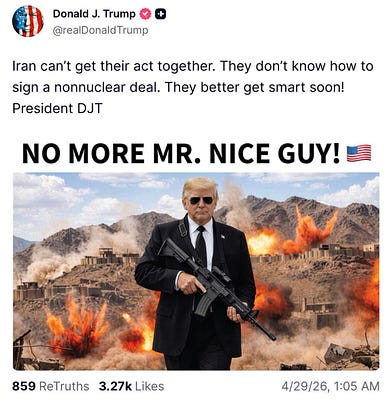
A Truth Social meme posted, when most of us were asleep, by the President. Of the United States. When I first saw it I thought it was a joke put up by a fake account. Sadly, it is real.
With all of the talk about ballrooms and sea shells on North Carolina beaches and the continued stonewalling about the Epstein files, one may forget that we are still at war with Iran. The Strait of Hormuz remains closed, gas is now averaging $4.23 a gallon nationally, farmers are having trouble finding fertilizer for the planting season and our Commander-in-Chief knows only how to use AI to try and make himself look tough. Emphasis on “try.” Trump thinks that he can bully Iran into giving up its “nuclear dust” (as he calls it, and I’m not really sure what he means but probably he means enriched uranium). This is the very same guy that claimed it was “obliterated” last summer. I could fill several pages in this space recounting all of the lies that he and his administration have told about this war of choice, but since most of them are preposterous and easily debunked, I won’t waste your time. Simply ask yourself if you, and indeed the world, are better off, safer and more financially secure as a result of this war than you were two months ago.
We still do not know what the reason for the attacks on Iran are all about. Our service men and women have performed professionally and with skill. They are tremendous. But what are they risking their lives to do? Tactical brilliance does not translate to strategic success without a well thought out rationale for war with clear goals set at the beginning. Trump and his man servant Hegseth continue to change their story with each passing day and cannot articulate any strategic goals, only tactical successes. Military planning is based on, and in this order, delineating the ends (strategic goal — when do you know you won?), ways (the operational use of force — attack from the air, the sea, direct assault, hit command and control?) and the means (tactical application of force — what armaments and forces are available?). All three must be in alignment.
Currently, we are in a stalemate with Iran. Both the Iranians and the Trump Administration think that they can wait out the other side and that they can force the other guy to give up. Among the many factors that this administration overlooked or underestimated is the steadfast will of the Iranian culture. Couple that with a government that does not answer to the population but is only interested in its own survival, and it gives the Iranians an advantage. They are suffering, without a doubt, but most regional experts assess that they can hold out much longer than expected. The rest of the world is already beginning to suffer and will be experiencing real economic and quality of life hardships in the very near future. It is unclear whether or not our friends and allies (a different topic as Trump works overtime to alienate every single one of them — except his best buddy Putin) can bring pressure to bear for Trump to settle with the Iranians.
As it stands now, and Trump could change it all in the next five minutes with a Truth Social post, the Iranians have offered to reopen the Strait and then come to the negotiating table to discuss other issues, such as what to do about their enriched uranium. In exchange, the U.S. must lift its blockade of Iran. Trump refuses to discuss it and is increasing the strength of the blockade and ordering the seizure of Iranian ships worldwide.
In recent days it became clear that the U.S. and our regional supporters suffered more damage than previously understood. It is estimated that the U.S. suffered about five billion dollars in damages to equipment such as missile defense radars in Qatar, Jordan and UAE, the Navy’s Fifth Fleet headquarters in Bahrain, air bases in Jordan, Kuwait and Saudi Arabia and numerous high end aircraft and drones, to name a few. All of the Gulf state countries plus Jordan suffered damage to their infrastructure and some oil and natural gas facilities. Of course most importantly, human beings were killed and injured including thirteen U.S. service members killed and around three hundred and fifty wounded.
Trump is in a bind. He has lost interest in the war but cannot look weak. If he withdraws U.S. forces without some concessions from the Iranians the world will consider it a defeat. If he stays indefinitely he looks weak because Iran gets stronger everyday and will have survived our best shot and lived to fight another day. Continuing direct combat operations weakens our ability to defend our interests in other hotspots around the world. The U.S. has already used up thousands of cruise missiles and air defense missiles that could take three to five years to replenish. According to the Department of Defense, the war cost us 25 billion dollars to date. Most analysts put the total costs at a much higher level, as much as 65 billion dollars. Today Hegseth testified before Congress that the DOD requested budget for the next fiscal year is 1.5 trillion dollars, a forty-four percent increase over the current budget.
To settle his war of choice, Trump must get serious about the negotiations. Sending two real estate tycoons to negotiate a meaningful settlement is ridiculous, not to mention that the last two times the Iranians met with these same individuals — thinking that they were making meaningful progress — their country was attacked. There can be no “take it or leave it” agreement forced on the Iranians. Bullying will not work — it only makes them more determined. It will take a team of experts and seasoned negotiators to spend a lot of time with great patience to reach a negotiated settlement. Trump should set the process in motion, shut up, and see what happens over time. Pakistan showed that it can be a helpful and effective mediator. Let them try.
In the end, Trump is likely to end up with an agreement that is barely as good as the one that the U.S. negotiated during the Obama Administration that Trump tore up. The 2015 Joint Comprehensive Plan of Action (JCPOA) between Iran and the “P-5+1” (the five permanent members of the U.N. Security Council US, UK, France, China, Russia, plus Germany along with the EU) limited Iran’s capability to enrich uranium. The agreement limited the number of Iranian centrifuges, the level of enrichment and the size of their stockpiles. As part of the agreement, intrusive monitoring was conducted by the International Atomic Energy Agency (IAEA). In exchange, Iran got some sanctions relief, some frozen assets were released and a timetable for other future provisions. Sanctions remained in place for Iran’s missile program, support for terrorist groups and efforts to improve Iran’s human rights record. It was not perfect but it was working, it was building trust for future agreements, and it kept Iran in relative check. Israel opposed the deal. It took twenty months of detailed negotiations using technical experts as well as diplomatic experts. The negotiations were slow going with ups and downs as each side sounded out the other and built trust. No such expertise accompanied Trump’s recent negotiating teams. I suppose that as a very stable genius he did not need any other experts working on the issues.
Trump is likely to declare victory once the Strait of Hormuz is reopened. The very Strait that was open to free flowing ship traffic before the war. He will continue to make noises about the Iranian nuclear program but will not seriously negotiate a settlement. The wild card in ending the war is Benjamin Netanyahu of Israel. He is determined to turn southern Lebanon into another Gaza strip by destroying it in his fight with Hezbollah. He is also not satisfied with the status quo in Iran. The next step may not be Trump’s to take. Remember that initially Secretary of State Marco Rubio stated that the U.S. attacked Iran because Israel was about to do so and since Iran would retaliate, the U.S. decided to strike first. One wonders who has their hand on the wheel driving us to who knows where.
 Tom
Tom Into The Fray
Recent Comments