
Wag The Dog
Posted: February 25, 2026 Filed under: Uncategorized | Tags: Aircraft Carriers, Ballistic Missile Defense, Iran, Iran Nuclear Deal, IRGC, Israel, Middle East, State of the Union, Strait of Hormuz, The Epstein Files, War Powers Act 1 Comment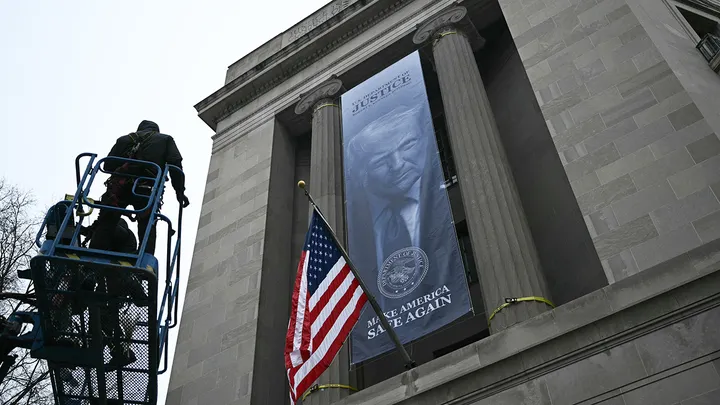
On 19 February 2026, a banner displaying the face of Trump and a slogan appeared over the entrance to the Department of Justice (DOJ) building in Washington D.C. It appears that he is emulating his good friend Kim Jong Un. “Big Brother is watching you.” (Picture from Brendan Smialowski for Getty Images)
The president that campaigned on putting America first and criticized his predecessors for their military involvement around the world is preparing to use the military for the second time against Iran. So far, in the first year of his second term he has used military force in seven countries and threatened it in two more. The House of Representatives and the Senate have yet to approve any of his military actions despite the fact that Article I Section 8 of the U.S. Constitution gives Congress the exclusive power to declare war. The War Powers Act of 1973 requires the president to notify Congress within 48 hours of deploying troops and limits their involvement to 60 days unless approved for longer by Congress. Trump refuses to meet even that bare minimum.
Trump thought he could bully the Iranians by massing the most combat power in the region since 2003 during the Second Gulf War. The Iranians have other ideas. Trump wants total elimination of their ability to stockpile “nuclear fuel” and they say it is for domestic power generation. Obama had a deal limiting the Iranians’ ability to process uranium which included on site inspections. Trump tore up that agreement in 2018 and is now asking for essentially the same thing as was previously settled. As always, he creates a problem, returns to the status quo ante, and then claims that he solved a crisis. Why would the Iranians or any other country trust anything that he promises?
Indeed, the U.K. (in particular Diego Garcia in the Indian Ocean), the UAE, and Saudi Arabia refuse to allow the U.S. to launch attacks from their countries against Iran. Others, such as Qatar, Egypt and other Middle East countries are extremely hesitant to allow it. Some are refusing to allow US military aircraft to fly over their territory which makes for some very long flights to reach targets in Iran.
This will not be Venezuela. Iranian air defenses are in disarray following last year’s attack on their nuclear facilities, but they still have a strong military capability.
The first step in military planning is to determine the desired end state. What do we want to see happen? How do we know we won and can go home? Everything else flows from that. So far the Trump regime has been unable to articulate their specific goals in attacking Iran. In recent weeks they have been all over the map as to what they intend to accomplish. Last night’s State Of The Union address to Congress would have been the logical opportunity to explain to the American public why we are going to send our sons and daughters, husbands and wives into harms way. He barely mentioned Iran and then in only very vague terms.
Therefore the mission is not clear to me and without a clear mission, it is difficult to plan. Is it to knock out all nuclear capabilities? Supposedly, we already did that. Special Envoy Steve Witkoff, Trump’s primary international negotiator for everything (Calling Marco Rubio! Anyone seen the Secretary of State actually doing anything having to do with diplomacy?) said last week that “they’re probably a week away from having industrial-grade bomb-making material. And that’s really dangerous. So they can’t have that.” Where that analysis came from, no one knows. Trump himself continues to say that last year’s bombing attack on Iran by the U.S. and Israel “totally obliterated” all of their capabilities. Additionally, it is known that the Iranians currently have no weapons program to build a delivery system for a nuclear weapon even if they wanted to make one.
Is the mission to knock out the Iranians ballistic missile capability? Their missiles certainly pose a threat to our friends and allies in the region. However, it would be next to impossible to destroy all of their missile capability in one attack. It could only be done through a sustained campaign. The missiles are stationed all around the country and some are mobile. During the course of our campaign the Iranians could use them to retaliate against U.S. bases in the region or to attack infrastructure valuable to our friends in the area. Last summer they launched missiles against our base in Qatar in retaliation, however they provided advanced warning and precautions were taken to limit their impact. There is no guarantee the Iranians would only go for a face saving measure the second time around.
Is the mission regime change? Trump continually talks about knocking out Iran’s Supreme Leader Ayatollah Ali Khamenei. Sometimes he talks about destroying the Iranian Revolutionary Guard Corps (IRGC), the roughly 175,000 member branch of their Armed Forces that protect the regime and that is the real power supporting the Ayatollah in the country. To attempt that would result in a very long campaign, the kind of “forever war” that Trump swore he would never instigate. As we learned the hard way in Iraq and elsewhere, the people may want a change in leadership, but they do not want it replaced by the U.S. We are not “liberators” in their eyes, we are invaders.
How will we accomplish any of those potential missions? With an air campaign only? Sending troops into the country? Iran is a very large land mass with rugged terrain. It has a large and diverse population. Any ground attacks would be very costly in lives and treasure. Whatever the reasons or methods — and the president should explain why it is suddenly necessary to do something we have not seriously contemplated for decades — there is always the danger of planes getting shot down, or having mechanical issues or a dozen other things that could go wrong resulting in the death or capture of Americans. “Just because” is not good enough.
As it stands now, our aims are not clear and we should never commit military force when we do not know what we want them to do. Reports from several reputable news organizations indicate that senior military officers in the Pentagon are reluctant to use force against Iran. They understand that it will be no easy task. In retaliation Iran will create mischief (terrorism and missile attacks) in the region. They will try to close the Strait of Hormuz through which twenty percent of the world’s oil flows on ships. (Oil is a fungible commodity with a world-wide market so the impact on the price of oil will be felt everywhere.)
There are other human and practical costs. One of the carriers on its way to the region is the USS Gerald R Ford (CVN-78) — the other one now on station is the USS Abraham Lincoln (CVN-72) – which has been deployed for eight months already, much longer than the traditional six month deployment. The Ford is the same carrier that was pulled away from the Mediterranean Sea last fall to go to the Caribbean Sea, and now it is back to where it started without going home. It is a practical matter that people can only be stretched so far — not to mention the impact on their families — and maintenance on ship systems and aircraft can only be postponed for a limited time before things start to break. Additionally, our military is running low on certain types of ammunition. Missiles cannot be built in a day, a week, or a month. Think in terms of years to rebuild the stockpiles. Some we have given to Ukraine and Israel. A lot is expended to shoot down drones and ballistic missiles, especially in the Red Sea, that are constantly being fired by the Houthis in Yemen, which are themselves proxies for Iran. Surface to air missiles on the ships and those utilized by Army forces throughout the region such as Terminal High Altitude Air Defense (THAAD) and Patriot ballistic missile defense systems are in short supply. Similarly, we have a finite number of Tomahawk surface to surface missiles.
There may be another reason that Trump is threatening Iran. Despite his best efforts, he cannot make questions concerning the Epstein files go away. The net is getting ever wider and coming closer to him each day. The Epstein Files are not going away. They are like his shadow. They follow him everywhere and he cannot get away from them. When the king’s brother gets arrested, along with the British Ambassador to the U.S. he knows more fallout is coming. He is getting desperate to distract and turn our attention elsewhere. Iran anyone?
War In Iran
Posted: June 18, 2025 Filed under: Uncategorized | Tags: Benjamin Netanyahu, Bunker Buster Bomb, Fordo iran, Iran, Iran Nuclear Deal, Israel, Middle East, National Intelligence, Nuclear Weapons, Policy Strategy Mismatch Leave a commentFor almost a week, Israel and Iran have exchanged bombs, missiles and drones causing damage and casualties, military and civilian, on both sides. Israel initiated the conflict when it attacked Iranian nuclear facilities and took out most of the leadership in the Iranian military and Iranian Revolutionary Guard Corps (IRGC) as well as many of the leading scientists working in their nuclear program. According to Israeli Prime Minister Benjamin Netanyahu, Israeli intelligence agencies believe that the Iranian nuclear program was on the brink of producing one to fifteen nuclear weapons. Since Iranian leaders vow to erase Israel from the face of the earth, the Prime Minister viewed these developments as an existential threat and attacked. (Some politico-military analysts are debating whether it was a “preemptive” strike — meaning an Iranian attack was imminent — or whether it was a “preventive” strike — meaning there was no immediate danger but the Israelis wanted to make sure there was no chance of Iran developing a nuclear weapon. For most of us, that matters little, but under international law, it has significance.)
There is a long history behind the current conflict. For many years, Israel, the United States, and indeed the world worried about the religious zealots in Iran obtaining nuclear weapons. Presidents of both parties have vowed that they would prevent it from happening. Additionally, Iran was the main supporter of terrorism in the world. (They are still a supporter of terrorism, but their proxies in Hamas, Hezbollah and the Houthis have been greatly diminished and Syria is no longer in Iran’s sphere of influence, limiting their reach, but not their ability to strike.) In 2015, President Obama negotiated the Joint Comprehensive Plan of Action (JCPOA) with Iran along with support from China, France, Russia, the United Kingdom, and Germany (known as the P5+1). In brief, the JCPOA limited Iran’s nuclear weapon program as verified by the International Atomic Energy Agency (IAEA) in exchange for sanctions relief. Trump withdrew from the plan in 2018, re-imposing sanctions and Iran has been ramping up its nuclear efforts since then. Trump was negotiating a “new” agreement with Iran that looks very much like the one that he withdrew from in 2018. Prime Minister Netanyahu denounced the JCPOA from the beginning and lobbied the current administration not to strike any agreements with Iran.
Israel continues to insist that the Iranian nuclear weapon capability was imminent. U.S. and U,K. intelligence sources, according to open press reports, assess that Iran is still not able to produce a weapon. Interestingly, the U.S. Director of National Intelligence (DNI) Tulsi Gabard testified before Congress in March that our intelligence agencies assessed that Iran was not capable of building a nuclear weapon. Yesterday, when asked about that assessment, Trump publicly contradicted his DNI, saying “I don’t care what she said” and avowing that he believed Mr. Netanyahu. (As a side note, if I were the DNI my resignation would be on the president’s desk about five minutes later. But we all know how this administration works. She is still in office.)
It is hard to know exactly what brought us to this point as both the Trump and Netanyahu administrations are not very forthcoming nor particularly truthful, and of course, military operations should remain classified until executed — unless you are Pete Hegseth — so it is only in retrospect that things look clearer. That said, from where I sit, it appears Prime Minister Netanyahu boxed Trump in before he could produce a “deal” with Iran. Emboldened by their successes in Gaza, Lebanon and Syria, Mr. Netanyahu saw that he had an opportunity to attack, had the forces to execute it, and wanted the world to be confronted with a fait accompli. There was no turning back. To date, the Israelis have inflicted significantly more damage on the Iranians than the other way around.
As yet, the U.S. is not involved. As yet. At least publicly.
There are some hard choices ahead for a president that campaigned by saying that he would keep us out of new wars in the Middle East. “America First” is interpreted by many MAGA voters as meaning no foreign wars in support of other nation’s interests. It is doubtful that Israel can continue to pursue its objectives without U.S. support. There are several reasons for that. Israel uses primarily U.S. weapons systems, aircraft, anti-ballistic missile defense systems, ammunition and other equipment. They do not have an unlimited supply. Giving more support to their efforts could get the U.S. involved whether by design or by accident. It also further diminishes our support to Ukraine as supplies are directed away from the Ukrainians and to the Israelis. Which is something that really does not bother Vladimir Putin even though Russia supports Iran — tough choices. Sorry Ayatollah.
Always looming on the horizon is direct U.S. military action against Iran. While prepared, no military planner that I know about relishes that idea. The reality is that Israel cannot completely destroy the Iranian nuclear program without destroying the main Iranian nuclear facility in Fordo, a small community near Qom. The facility is built in to a mountain and is considered extremely difficult to destroy. Current Israeli Air Force and missile capabilities cannot seriously damage it, unless they use one or more of their own nuclear weapons. That is an entirely different discussion. It is conceivable that Israeli special forces could attack it on the ground, but that is highly risky and is probably not on the table right now, especially because there is another option. The U.S. Air Force could deliver a “bunker buster” bomb — properly known as the GBU-57 Massive Ordnance Penetrator (MOP). It is a 30,000 pound GPS guided bomb launched from a B-2 Stealth Bomber that is believed to be able to penetrate at least 200 feet against concrete, rock or earth before it explodes. Multiple MOPs can be used to go even deeper, if necessary. The only aircraft capable of delivering the bomb is the U.S. B-2. We cannot just supply Israel with it. There are 19 B-2s in the inventory and they are based at Whiteman Air Force Base in Missouri. They have demonstrated their world-wide ability to strike during previous conflicts having flown 34 hour combat missions from Missouri to Libya and back in 2017 using in flight refueling, for one example.
It is a cliche to say that we go to war with the president we have — good, bad or indifferent. Trump has a big decision to make, although it seems hard to believe that he totally understands what is going on. For example, his social media post yesterday directed at Iran said only “UNCONDITIONAL SURRENDER!” Which raises many serious questions about his state of mind. For the record, there are extremely few historical examples of “unconditional surrender” with the last one being Japan at the end of World War II.
There is a case to be made for the U.S. to bomb Iran. From where Iran sits, they now see that they are in dire need of a credible deterrent. Without a nuclear capability they have been exposed as defenseless. Should the bombing stop short of a significant impact on their nuclear program, they have every incentive to accelerate the program and procure one as quickly as possible. One could argue that now is the time to finish the job. Kick them while they are down, so to speak, so that no one has to come back later to finish what could have been done now.
The danger inherent in such U.S. involvement is extreme. Not in the short run, the U.S. could take casualties in any operation but given the current state of Iran’s air defenses, the risk would be assessed as acceptable. The real danger is long term. How does Iran retaliate against us — for they will retaliate in some form or another. What are our strategic goals? Simply to destroy or significantly delay the nuclear program? Trump has been speculating on social media about regime change — assassinating the Ayatollah and other Iranian leaders. Iran is a country of over 90 million people, many of whom resent the regime that has been in place since 1979. However, that does not mean that they want the U.S. or Israel to eliminate their government. Who takes charge? Under President George W. Bush the U.S. thought that bringing down Saddam would be easy and result in a free and democratic Iraq. While most Iraqis were glad to see Saddam gone, they were just as unhappy to see U.S. forces do it and remain in their country. We know what happened there. What to do in Iran?
This is where it gets tricky. It is one thing to bomb Iran, it is another to deal with the aftermath. It seems that Mr. Netanyahu knows how to play to Trump’s biases and ego. He has him nearly ready to provide support to the Israeli mission to destroy Iran. But what does that really mean and what is the long term commitment? Take a look at Gaza. Mr. Netanyahu’s objective there was to eliminate Hamas. That conflict has turned into what appears to be a long term goal to destroy everything in Gaza. Apparently the only way to eliminate Hamas is to eliminate every Palestinian that lives there — either kill them or move them. That campaign has gone on much longer than what was militarily necessary. What are the plans for Iran?
Wars are easy to start but hard to end. We need look only at our own history. I do not trust our president or his senior advisers to think through the totality of their actions. Looking tough seems to be their only goal. That is not good enough. There are sound strategic, geo-political and military arguments to use our forces to decimate Iran’s nuclear program. It is the “what’s next” question that I have not seen anyone in the administration thinking about. How does this all end?
Iran
Posted: January 6, 2020 Filed under: Uncategorized | Tags: Donald Trump, Iran, Iran Nuclear Deal, Iraq, Middle East, NATO, Persian Gulf, Policy Strategy Mismatch, Soleimani, Terrorism Leave a commentWhile you were enjoying the holidays with friends and family, you may have missed that the United States conducted a drone strike killing five people including Iranian General Qasem Soleimani. The strike took place at the Baghdad Airport as the general was reportedly on his way to a meeting with Iraqi officials. It was done without the knowledge of the Iraqis.
Killing General Soleimani, and the U.S. and world reaction in the aftermath, shows a real Policy-Strategy mismatch in the stated goals of the Trump Administration.
Mr. Donald J. Trump campaigned on a policy, and continues to reiterate it on the 2020 campaign trail, of pulling our troops out of the Middle East and to not pursue what he calls “endless wars.” His administration’s stated policy for the future is to focus on realigning our military forces and deployments to get away from the War on Terror and to instead focus on near competitors such as China and Russia. This action in Iraq furthers none of these goals.
Killing General Soleimani was in itself not a bad thing. On one important level, the world is much better off without him. He was, in the vernacular, a “bad guy.” No tears are shed in this space for his demise. The question is whether it was wise or not. The problem is that I suspect the Trump Administration had no long-term plan. No next steps. No branches and sequels that anticipated the understanding of, or planning for, probable Iranian retaliation. When taking such an action, proper planning requires thinking through the consequences and preparing for the inevitable reaction. I don’t see that that was done. An old military saying is that no plan survives contact with the enemy. They get a vote on what happens next. It is imperative that before taking such a drastic action that planners think through the probable consequences and prepare for them.
They should know that the Iranians will retaliate. Period. They must in order to keep their position as a power broker in the region. Most likely they will do so in an asymmetrical way. Cyber attacks. Terrorist attacks. Surrogates attacking US interests in third countries. Interfering with shipping in the Persian Gulf through rocket or mine attacks. Probably in a way that allows for plausible deniability that makes it more difficult for the U.S. to respond. The Iranians know that they cannot go toe to toe with the US military, but they also know that they can do a lot of damage — especially psychologically and economically. And Americans are likely to die.
There is a reason that over the last thirty years we attacked Iraq rather than Iran. Iran has always been a bad actor — by far much worse than Iraq under Saddam Hussein. Iran is the main source of terrorism in the Middle East and has been since their revolution in the late 1970’s as they try to export that revolution. Not unlike the Soviet Union in their heyday. We attacked Iraq twice because they were bad actors, but more importantly, it was doable. Iran is a completely different ball game. Despite stereotypes, Iran is a modern, technologically savvy nation with a large and capable military. Not in the US league, but good, and probably the best of those in the region.
When analyzing the attack, the evidence given by the Administration for carrying out the killing does not make sense. Secretary of State Mike Pompeo argues that it was in response to intelligence that indicated an “imminent threat” to U.S. forces. This is important if one is considering the legal reasons for the killing. The President continually states that it is retribution for past actions by Iran, directed by General Soleimani. Not a legal reason for the undertaking under either U.S. or international law.
I don’t want to get hung up on the legality of the attack as in some ways, it is a distraction. It is important in another way if we want international support for our actions. The attack could be easily considered an assassination. Killing him was roughly equivalent to taking out our Director of the CIA or the Chairman of the Joint Chiefs. General Soleimani was an official of the sovereign nation of Iran. Additionally, the killing took place on the sovereign territory of Iraq, without their knowledge. In international law, and in practical support, this has consequences. It is definitely not the same as taking out Osama bin Laden or any other terrorist leader. He was an official with diplomatic standing in a sovereign government conducting official business in another sovereign nation. More importantly to the follow-on actions by Iran, the general was in all practicality the number two official in Iran and a national and regional hero.
Despite Mr. Trump’s pronouncements, we are considerably less safe in the Middle East now than before his death. Thousands of U.S. forces are being deployed to protect US bases, embassies, and civilians throughout the region. The forces already deployed to fight ISIS in Iraq and Syria have ceased all operations against the terrorists in order to focus on self-protection, known in military parlance as force protection. NATO forces in the region stopped training Iraqi forces and have departed or hunkered down. The State Department warned all US citizens to depart Iraq. The Iraqi parliament voted to demand the departure of all US military personnel. The US military in Iraq informed their counterparts that they are “re-positioning troops” in Iraq In preparation for withdrawing all or part of the force.
Today, the Iranians officially declared they will no longer adhere to the Joint Comprehensive Plan of Action (JCPOA) which eliminated the near-term pursuit of their nuclear weapons program. Expect them to start building nuclear weapons.
The list goes on. We are definitely not safer. It doesn’t help when the world knows and documents that Trump has told over 15,000 lies since taking office. The support for this action from allies and friends is either non-existent or extremely muted. His reasons for attacking now lack credibility on the world stage. There have been imminent threats in that region for decades. It is a dangerous place. To date, the administration offers no evidence of any new or significant change to the situation.
Additionally, while General Soleimani was charismatic, there are other qualified generals to take his place. He personally did not carry out attacks. The troops and covert assets under Iranian control do. They still exist and are in place. Killing him will not tactically or operationally stop any attacks.
To me, concerns of an all out war are premature. But Trump’s decision was immature. It was a feel good, “aren’t I tough” move rather than a thought out strategic decision. Although I do not think that all out war is imminent, there is clearly a great opportunity for a miscalculation on each side which could lead to a larger conflict. There will be a series of tit-for-tat measures taken by both sides. If the military responses are not proportional and relevant, then the chance for escalation is high. Unfortunately, since Mr. Trump has tripled down on threats to purposefully and deliberately destroy Iranian cultural sites (a war crime under the Geneva Convention) the indications are not ones of restraint by the president. As Mr. Trump threatens to destroy 52 targets (one for each American hostage in 1979) the Iranians have indicated that they could hit 290 targets (one for each passenger and crew killed by the 1988 shootdown of an Iranian civilian Airbus by the USS Vincennes).
There is another scenario, however. The Iranians under General Soleimani, with the concurrence of the Ayatollah, was conducting an escalating campaign against American interests to test the limits of what they could get away with. Since there was no US response, to numerous provocations (shooting down a U.S. drone, mine attacks on tankers, a missile attack on Saudi oil fields, etc.) they were slowly ratcheting up their activities. They thought that Mr. Trump was afraid of conflict in the Gulf region. They were trying to get the president to accelerate his promise to withdraw U.S. forces from Iraq by making it painful to stay. They were trying to do so without crossing the line into provoking an all out American response. Since their economy is in dire straits, they desperately want to have sanctions lifted. This attack on the second most important man in Iran may cause them to recalibrate their thinking, even to the point of starting back channel negotiations with the U.S. The danger is, that even if such negotiations come to pass, it will literally go up in smoke if the US or Iran miscalculates on its military response.
It is well known in international relations that one cannot deter an opponent if they don’t know what it is they are supposed to be deterred from doing. With the, at best, uneven, at worst, ignorant, Trump foreign policy, it is difficult for friends, enemies and allies to know what is expected of them. Surprises and unpredictability are assets in actual combat. They are a detriment in trying to implement a strategy to fulfill any policy, especially in the Middle East.
We are in dangerous times. All out war is not inevitable. However, current events are disconcerting given the context that there seems to be no clear strategy to implement our policy, should it be a possible to discern a clear U.S, policy in the region in the first place.
Careening from tweet to tweet does not help us with our allies, our friends or deter our enemies. Mr. Trump and his advisers need to step back, but not step down, and think through exactly what they are trying to achieve. They need to think five or six steps ahead and not just react to day to day developments.
I know that there are still conscientious and professional people in the intelligence community, the State Department and the Department of Defense. The question is whether decision makers will understand what they are being told and will they listen?
The Iranian Conundrum
Posted: July 19, 2015 Filed under: Uncategorized | Tags: Iran, Iran Nuclear Deal, Joint Comprehensive Plan of Action Leave a commentMuch has been written, and will continue to be written, about the recently concluded agreement with Iran on behalf of the P5+1 (U.S., U.K., France, Russia, China plus Germany) (also participating was the High Representative of the European Union) concerning curtailment of Iran’s nuclear weapons program. Most of the talk is whether or not it is a “good deal” or a “bad deal.” I do not think that such a simplistic approach does anyone any good and certainly does not lead to an understanding of the complexities of this pact — and it is indeed complex. (You may read the entire original text here.) Most of the agreement, or Joint Comprehensive Plan of Action (JPCOA), consists of annexes of a highly technical nature. I am not a nuclear physicist so I cannot authoritatively comment on its intricacies, but many, many, many (emphasis on purpose) nuclear physicists and other arms control experts call it the most comprehensive arms control agreement ever. There is very little — no agreement is perfect — technical wiggle room.
According to the signatories, the deal increases Iran’s “break out” time (how long until they could produce a nuclear bomb) from about three months to at least one year. It also significantly reduces their stockpiles of enriched uranium (needed to make a bomb), cuts Iran’s centrifuges by two-thirds (needed to make more enriched uranium), precludes the production of plutonium (for really big bombs) and opens up existing facilities for international inspection.
The agreement also puts the restrictions and inspections in place for ten to twenty-five years and allows for re-imposing sanctions at any time for any violation. Note that the inspections in some forms are in place for twenty-five years and in other cases, since Iran is a signatory of the Nuclear Non-proliferation Treaty, forever. Please note that Israel has nuclear weapons and is not a signatory nation of the Nuclear Non-proliferation Treaty, along with India, Pakistan and North Korea.
To me, as I understand them, the technical details of the JPCOA are sound. I have heard very little criticism of the actual technical aspects of the agreement. They were after all, primarily negotiated by the world’s foremost experts, including our own Secretary of Energy Ernest Moniz, a world recognized expert and MIT professor.
The real question to ask is this — is the JPCOA good policy? That is a more difficult question to answer. I happen to think that it is, but it needs to be taken in context. Before explaining that context, I must express my disappointment that many of our leaders in Congress had a knee jerk reaction to the agreement before they even knew the details of what was in it. Coincident with the announcement of an agreement, criticism rained down on the president. Typical of that reaction was Speaker of the House John Boehner (R-Ohio) who said within minutes of the conclusion of the negotiations, “Given everything I’ve seen so far, this is a bad deal. It paves the way for a nuclear Iran.” By his own admission he had not reviewed the details of the agreement. His reaction was mild compared to some others, and all paled in comparison to those of Prime Minister Benjamin Netanyahu (R-Israel) who said, “From the initial reports we can already conclude that this agreement is a historic mistake.” He made that statement before the text was released and later he admitted that he had not yet read it.
Some in Congress oppose the JPCOA only because Israel opposes it. As I’ve written before, Israel is a close ally and friend of the United States. We need to protect and support Israel. However, the United States should put its interests first, and not undermine them only because Israel is opposed. I guarantee that Israel would, and has, put its interests above those of the United States and taken actions that were in their best interests, but opposed to those of the United States. Do not oppose the JPCOA “just because” Prime Minister Netanyahu says it is a bad deal.
It is entirely conceivable that policy makers in the United States and elsewhere legitimately do not think that the JPCOA is good policy. But I sure wish they would at least read it and understand it before going public with blanket statements that it is historically bad. Many of the critics of the negotiations said that “a bad deal is worse than no deal.” What they really meant to say was that “any deal is worse than no deal.” I disagree.
The hard part is to put the JPCOA in the total context of Middle East policy. The focus for the P5+1 was eliminating the ability of Iran to produce a nuclear weapon this year. At worst, they delayed it for ten to twenty years. At best, they delayed it forever. Iran’s focus was lifting the sanctions. They got that assuming that they comply with the JPCOA. They were not negotiating the end to terrorism, national ambitions, the recognition of Israel by Iran or the host of other criticisms aimed at the negotiations because those things were not achieved. They were not on the table and arguably we would not have any agreement if they were.
Likewise no P5+1 participant is “trusting” the Iranians. There are very strict inspection regimes with very dire consequences for Iran should they be found in violation. We need to be realistic about what can and cannot be achieved at the negotiating table. And the U.S. Congress needs to recognize that these were not bi-lateral negotiations. If the rest of the world wants to lift sanctions against Iran (and both Russia and China cannot wait to enter the Iranian market), we will have little leverage to stop it.
That said, many of you have heard me say for many years that Iran is one of the baddest actors in the world. Prior to ISIS, the vast majority of terrorist acts in the Middle East and elsewhere can be directly or indirectly traced to Iran. Currently, they are working hard to establish themselves as a regional power in the Middle East with thoughts of domination in that part of the world. We need to stop them and we need to keep up the pressure on other nations to stop them. We must. That, however, is a different issue than stopping their nuclear weapons program.
The JPCAO only makes sense in the context of a comprehensive step-by-step plan in the Middle East to box in Iran and turn it back towards being a productive member of the world society. The JPCOA is, in my mind, only the first of many steps. There was no magic wand that could solve all of the problems with and about Iran in one fell swoop. Just not going to happen. However, as a first step, it is important. As we have seen with China, Russia and other previous foes of the west, slow and steady is the answer. Constant pressure needs to be applied and we must be relentless in our pursuit of national policy. However, just as we have seen with China and Russia, we will make progress on some fronts and we will have conflict on others. The United States needs to take the long view and put in place policies that bolster our friends and allies, oppose Iranian adventurism and exploitation, and enhance our national security. The JPCOA helps to do that by taking the threat of nuclear weapons out of the calculus.
When one takes a step back, it is entirely possible that the world may not know the ramifications of the JPCOA for many years. That is a tough gamble to take. However, from all that I have read, it is a gamble worth taking because it is not irreversible and it has large dividends when it succeeds.
Iran is and will remain a conundrum. We will only make head way in the area by engaging them.
 Tom
Tom Into The Fray
Recent Comments