
The Epstein Class Carries On
Posted: August 9, 2026 Filed under: Uncategorized | Tags: Attorney General, Board of Peace, Donald Trump, Iran, Iran War, Israel, Jeffrey Epstein, Lincoln Reflecting Pool, Todd Blanche, Truth Social, USS Abraham Lincoln Leave a comment
Once again Donald J. Trump disparages our military by putting himself in the same category as those that won World War II. Remember that President “Bone Spurs” got numerous mysterious medical waivers to avoid the draft during the Viet Nam War. He is using borrowed valor to try and make himself seem like a great leader which is directly out of the Dictator’s Handbook (see Stalin, Kim Jong Un, Mussolini, Franco, Pinochet, etc.). He could not even get the details correct, probably out of ignorance. The uniforms are incorrect, the ranks are incorrect, the covers (headgear) are incorrect, just about everything about the image is historically incorrect. Note, however, that he gives himself more stars (higher rank) than either of those next to him that actually earned them. Somehow he also ends up with better hair and no headgear — doesn’t want to mess up his “do”. To say nothing about the fact that one would think the president could better spend his time doing something other than posting AI memes. (Image courtesy of @realDonaldTrump, accessed via Truth Social)
“Found an imaginary problem, said only they could fix it, didn’t listen to experts, hired buddies who grifted millions, failed miserably, bragged how great it went. The entire Trump presidency in a nutshell.” — Minnesota Governor Tim Walz on 18 June 2026 via an “X” post commenting on the fiasco at the Lincoln Memorial Reflecting Pool in Washington D.C.
We live in scary and exhausting times. It is hard enough to live ones own life but knowing at the same time that the Trump regime, along with his buddies in the Epstein Class, are trying daily to enhance their own power and wealth makes it down right discouraging. Nothing seems to be going well for the country, unless you are a billionaire or a Trump insider. The war in Iran is a total debacle at the expense of our fine military men and women. Jobs are being lost in record numbers. Inflation is increasing. Food is not safe as diseases spread. Measles, once thought statistically eliminated in the U.S. is roaring back as the number of cases soars. Federal aid for disasters is tied to how your state’s Electoral College votes were assigned. Supplemental Nutrition Assistance Program (SNAP — colloquially called food stamps) funds are being drastically cut and children are going hungry. Health care funds are being slashed. One of the most successful programs in the history of the federal government — Head Start which helps get kids off to a good start in their lives and in school — is changing the criteria for regulating what is taught and who can go with the loss of nearly two billion dollars from the program.
The list goes on and on. Meanwhile, Trump and his family get richer and richer. This is the same man that cheated on his wife with an adult film star, bragged on tape about sexually assaulting women, was adjudicated to be held civilly liable for sexual assault, was convicted on thirty-four felony counts, attempted to overthrow a free and fair election, is the only man to be impeached twice as president, and who was best friends with Jeffrey Epstein, to just name a few highlights. I know life isn’t fair, but really?
His administration is using the Department of Justice (DOJ) to go after everyone on Trump’s “enemies list.” Primarily people that tried to hold him accountable or criticized him. The spineless United States Senate, once the embodiment of collegial work for the good of our country, is a laughing stock. They just confirmed Todd “Carte” Blanche as the Attorney General. Senator John Cornyn (R-TX) said that “Well, there’s nothing we can do to rein in the president.” Umm, here’s an idea. How about voting “no” on the nomination of a guy that is going to end up creating a nearly two billion dollar slush fund to pay convicted criminals and who gave the president and his family the promise that they would never be audited for their tax shenanigans in perpetuity. A provision that is estimated to mean a profit to Trump of anywhere from 100 million to one billion dollars in taxes he will never have to pay. Other Republican Senators opined that they voted for him because Trump might nominate someone worse. I doubt it, but could one not still vote “no” on all unqualified or corrupt nominees? Why is the architect of the Epstein Files cover up the best choice for Attorney General?
The worst part? Trump is so embarrassed by his Reflecting Pool screw up — and to prove he can never be wrong — he ordered the arrest of innocent bystanders to have them charged with felonies for “vandalizing” his decrepit pool. This should be a five alarm warning bell to all of us. Essentially, Trump and his goons picked up people at random off the street to charge them with crimes that could result in ten years in prison. Our fellow citizens were rounded up for no reason other than merely to please Trump. Incredibly, the cooler head that prevailed was the Attorney General of the District of Columbia Jeanine Pirro of Fox News fame. She dismissed the charges based on evidence that the contractor totally botched the entire job. Still, Trump will not leave it alone and is threatening to arrest more people for “cutting” the liner on his vanity project. That the members of the regime do not honor their oaths to the Constitution does not surprise me anymore. What concerns me is that rank and file prosecutors, law enforcement officers, National Guardsmen and others at the working levels are doing whatever they are told to do in violation of their oaths. “Just obeying orders” is not a legal nor a moral excuse.
The total incompetence of this Administration can best be seen in the total disaster unfolding in the war of choice against Iran. All is not well as Iran currently holds all the cards — to put it in Trumpian terms. It turns out that this not the “little excursion” that he claimed it to be. Trump and his minion Hegseth do not know how to honorably end the war. Both are searching frantically for a way out while still declaring “victory.” According to multiple media reports, Trump is looking for something, anything, that he can declare proves that he won the war. The latest scheme is to find a way to get the Strait of Hormuz open and then go home. Recall that the Strait was open to ships of all nations under international law and freedom of navigation. Trump will not care if the Iranians charge a “service fee” or a “tax” or an “environmental fee” as long as they do not use the word “toll.” Iran and Oman are reported to be negotiating the terms for re-opening the Strait without U.S. involvement, even as Trump keeps saying he has solved the issue. Gone is any talk of a nuclear deal.
Evidence of Trump’s and Hegseth’s total lack of understanding of warfare, strategy or the consequences of armed conflict is the widely reported lack of long range precision offensive and defensive munitions. As we used to say “prior proper planning prevents piss poor performance.” Reports indicate that the Chairman of the Joint Chiefs of Staff General Dan Caine briefed the president and Secretary of Defense on the dangers of this type of operation in terms of geo-political consequences and the impact it would have on the future readiness of the Armed Forces. He was ignored and here we are. It turns out that “lethality” — Hegseth’s favorite word — is insufficient to win wars. On a small scale — in the greater scheme of things but not small to those involved — one can see the lack of logistical or operational planning in the plight of the USS Abraham Lincoln (CVN-72). Family members of those aboard are raising holy hell about the reported conditions on board. No soap. Very little food. “Care packages” from home take months to be delivered, if at all, by which time cakes, cookies, the little day-to-day brighteners from home are ruined. Broken equipment. Falling morale. A total nightmare for a front line asset conducting combat operations every day and night. They have been deployed for over nine months. They set a record with over 200 consecutive days at sea. That is unsustainable. Equipment breaks, people get exhausted, mistakes start to happen. The flight deck on a carrier is inherently dangerous. It is an accident waiting to happen. When people are tired their concentration lapses. It is a miracle that no major accident has yet to occur. But, here is what is telling. Why is it there for so long? Why was there no rotation plan for ships and other units to come in and out of theater at specified times? Where are the supply ships to deliver the soap, the mail, the little things that keep the Sailors and Marines going day and night? None of that is happening because of their piss poor planning. Hegseth said it would be over in four weeks, six at the most. We are now approaching six months. There was no long range plan. I still have no idea what the original strategic goal was. It was never explained or articulated. Trump and Hegseth attacked because they thought it would be easy and fun.
This weekend Aramco, the Saudi Arabian Oil Company, had a facility hit in Jubail, in eastern Saudi Arabia. The war continues whether or not Trump wants it to. Meanwhile, even though seemingly everyday Trump tells us there will be a “deal” in a day or two, Iran’s Supreme National Security Council laid out six conditions for reopening the Strait, which realistically is about all Trump can expect to get out of any “deal.” The terms specify that the U.S. must cease all threats against Iran, permanently end all military operations against Iran and its allies, end the U.S. blockade of Iranian ports, provide compensation for damage inflicted during the war, remove all sanctions and release all frozen Iranian assets. All of which was not part of the Joint Comprehensive Plan Of Action (JCPOA), the agreement reached with the Iranians during the Obama Administration that limited Iran’s capability to produce enriched uranium. Trump tore it up because he could do better. He absolutely did not do better. And here we are.
Meanwhile this weekend, Trump’s other signature deal, the so-called “Board of Peace” plan for Gaza that Trump claims has solved all of the problems in the Middle East and that he boasted was agreed to by Israel and Hamas just got blown up. Israeli Prime Minister Benjamin Netanyahu publicly rejected the entire fifteen point plan.
Stand by for Trump to act out in some way. Or maybe he will not care because he is too busy with his vanity projects and shaking down corporations and ordinary citizens for yet more money. He even has a staffer that he calls “The Princess of Darkness” that calls CEOs of company’s and corporations and tells them how much protection money they must ante up to do business that “the boss” would like a contribution of certain millions of dollars for his political campaign fund, presidential library or a D.C. monument, thank you very much. They pay. He has 800 million dollars in his campaign fund, which in an interview yesterday Trump said he may or may not use to help re-elect Republicans because it is “his” money to do with it as he sees fit. We still do not know where the billions in Venezuelan oil money is going. But, for 100,000 dollars a month, you can sign up to get Truth Social posts before the rest of the public gets them so that you can conduct insider trading sound business deals before anyone else knows what is happening.
Have a nice day.
The Destruction of Our Military
Posted: July 23, 2026 Filed under: Uncategorized | Tags: Bab el-Mandeb Strait, Dignified Transfer Ceremony, Iran, Iran War, Israel, Persian Gulf, Saudi Nuclear Deal, Signalgate, Strait of Hormuz, Strategy - Policy Match, War Crimes Leave a comment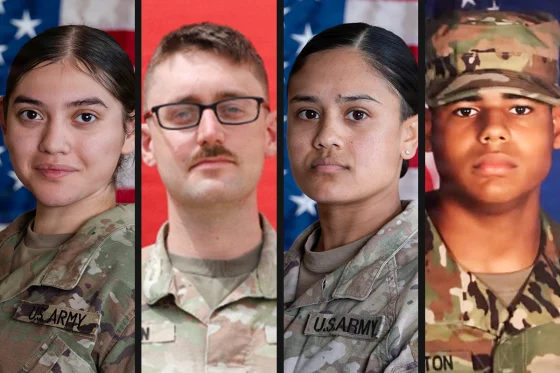
Pvt. Isabella Gonzales; 1st Lt. Tyler James Feehan; Sgt. Angel Rampersad; Sgt. Michael Emmanuel Swinton. The latest Americans killed in combat in the Middle East.
Secretary of Defense Pete Hegseth is the least qualified person to lead the military since the creation of that position and it shows. He first came to Trump’s attention as a Fox News weekend host who advocated for the pardoning of three convicted or indicted war criminals. Trump obliged Hegseth’s request opining that “You know, we teach them how to be great fighters, and then when they fight sometimes they get really treated very unfairly.” Perhaps in his mind the convicted felon president thought that he was providing a lift to the morale of the military members. In fact, he was undermining the discipline and spirit of our warfighters. The actions of the three individuals pardoned were reported by uniformed personnel in their own units that saw what happened and knew it was wrong. Thus, the beginning of the demise of our professional military. It continues today on many fronts, not the least of which is Trump’s War in the Middle East.
There is so much un-American activity afoot under this administration that it is difficult to know what to worry about and where to focus. To me, it is incredibly dispiriting. Whether Trump is embarrassing us at the World Cup, stealing Venezuelan oil, putting a fifty percent tariff on Canada for invading our country with wildfire smoke or using his Truth Social account to sell information for insider trading to other members of the Epstein Class, the level of disregard for traditional American values, ethics and morality is truly astounding. One thing is clear however, Trump and his hand-picked flunky in the Pentagon are driving our much admired and truly spectacular Armed Forces into dangerous territory. Put plainly, Trump’s War against Iran is not going well. Additionally, Hegseth is systematically replacing respected senior officers that have real world experience with officers that seem to be chosen for their allegiance to Trump and Hegseth. Some top ranking officials have been fired, others have resigned, presumably because they did not agree with the direction that Hegseth was taking the institution.
So far, over two dozen generals and admirals have been fired. Additionally, one of the true institutions run as a meritocracy has been poisoned by Hegseth’s involvement in promotions for senior officers. Traditionally, the Secretary of Defense does not interfere with the selection process unless some new information comes to light after the selection boards make their choices — such as criminality or other major disqualifying activities. Hegseth routinely strikes officers from the list. Media accounts report that sixty percent of those taken off of the lists were women or minorities. For the first time in over a decade, no woman will be promoted to admiral in the U.S. Navy. All were de-listed by Hegseth. These actions have a direct impact on readiness, morale, and the stability of the force. Women and minorities are being shown that their service does not count. The message is simple. Pete Hegseth does not want you in his military. No matter how hard you work or the experience you have demonstrated in the most demanding of circumstances, you will not be rewarded with a leadership position. Go home.
Hegseth is, however, apparently in favor of gender affirming care. He announced that all service members aged thirty or over must undergo annual testing for “testosterone deficiency.” If the results are too low, testosterone treatments are available so that the troops can operate at their “absolute best.” Apparently, Hegseth wants to fire up his “warriors.” It is also part of his response to the “manosphere” that touts macho, macho men. I am not a physician, but I do understand that in some cases testosterone treatments are medically recommended. But for the whole force? It also does not take a physician to know that the process for testing for testosterone deficiency is spread over time as testosterone levels vary based on a number of daily factors. A quick look on the internet also reveals that treatment can have dangerous side effects such as blood clots, increased cardiovascular problems, accelerated prostrate cancer, mood swings and increased irritability, to name a few.
Hegseth began his tenure in the Pentagon’s top spot by giving away sensitive military operational details classified “SECRET” over a “Signal” group chat using his personal device. Included in the chat, by accident, was the civilian editor for the The Atlantic magazine. The information included the specifics of a pending attack by U.S. forces. He did a similar group chat on a commercial app with his wife, brother and personal lawyer, none of whom had any clearances for classified information. His leadership skills were evidenced by his lying about the whole thing and claiming that it was a “media smear.” Thankfully, the mission went off without any Americans killed or wounded.
Meanwhile, our troops are fighting in the Middle East and Trump and Hegseth continue to lie about the course of the war and the impact that it is having on our troops, our economy, and the people that live in the region. Until today, the Defense Department had not given a press briefing on the war since early May. Sadly, our troops are now under fire daily. Eighteen have died and almost 500 have been wounded, that we know about. We get more information from foreign sources and foreign media, including verified commercial satellite imagery used by the New York Times, than we do from our own government. That imagery shows wide-spread damage to U.S. bases and equipment throughout the region. Iranian strikes have hit Kuwait and the King Faisal Air Base in Jordan. Yesterday Iran hit Bahrain, homeport to the U.S. Navy’s Fifth Fleet and launched the first ever Iranian ballistic missile to hit Saudi Arabia. Media reports indicate that the U.S. is departing some bases in the Persian Gulf region and consolidating forces in Israel to receive protection from drones and ballistic missiles under the Israeli Iron Dome air defense system. Hegseth confirmed to Congress this week that Russia and China are aiding the Iranians with new weapons systems and providing targeting data from their satellites. Yet, we take no action to pressure them to stop. Indeed, Trump calls their leaders good friends and openly admires them.
Meanwhile, the Iranians continue to control the Strait of Hormuz which is shutdown for all practical purposes. The Houthi forces in Yemen, under the encouragement of Iran, are threatening shipping in the Bab el-Mandeb Strait which is the southern exit from the Red Sea. Several tankers have already turned around rather than run that gauntlet. A barrel of oil is back over 100 dollars.
All is not well despite the stream of lies coming from the administration. I do not put that on the backs of our forces in theater. I put it directly on the backs of the leadership in Washington D.C. who have yet to articulate a strategy for winning the war. Bullying and bluffs from Trump do not get the job done. The Iranians are willing to wait out the barrage. They have nowhere to go. Modifying an old Afghan proverb, the Iranians believe that “the U.S. has the watch, we have the time.” They will wait us out. Persia has been an entity for centuries. They are not going to just go away.
Trump continues to express his lack of knowledge about military operations. He thinks he knows the language of war but he does not, and apparently he does not care to understand it. Worse, he has no respect for those serving in uniform. Before the dignified transfer ceremony yesterday at Dover Air Force Base in Delaware, a very solemn occasion honoring the return of the four soldiers killed in action, he told reporters before hand that “all of them said very strongly, we cannot let Iran have a nuclear weapon.” He honors them by putting political statements into the mouths of deceased warriors. This comes after his social media posts this week where he compares the eighteen military members lost in the Gulf so far to those of previous wars.
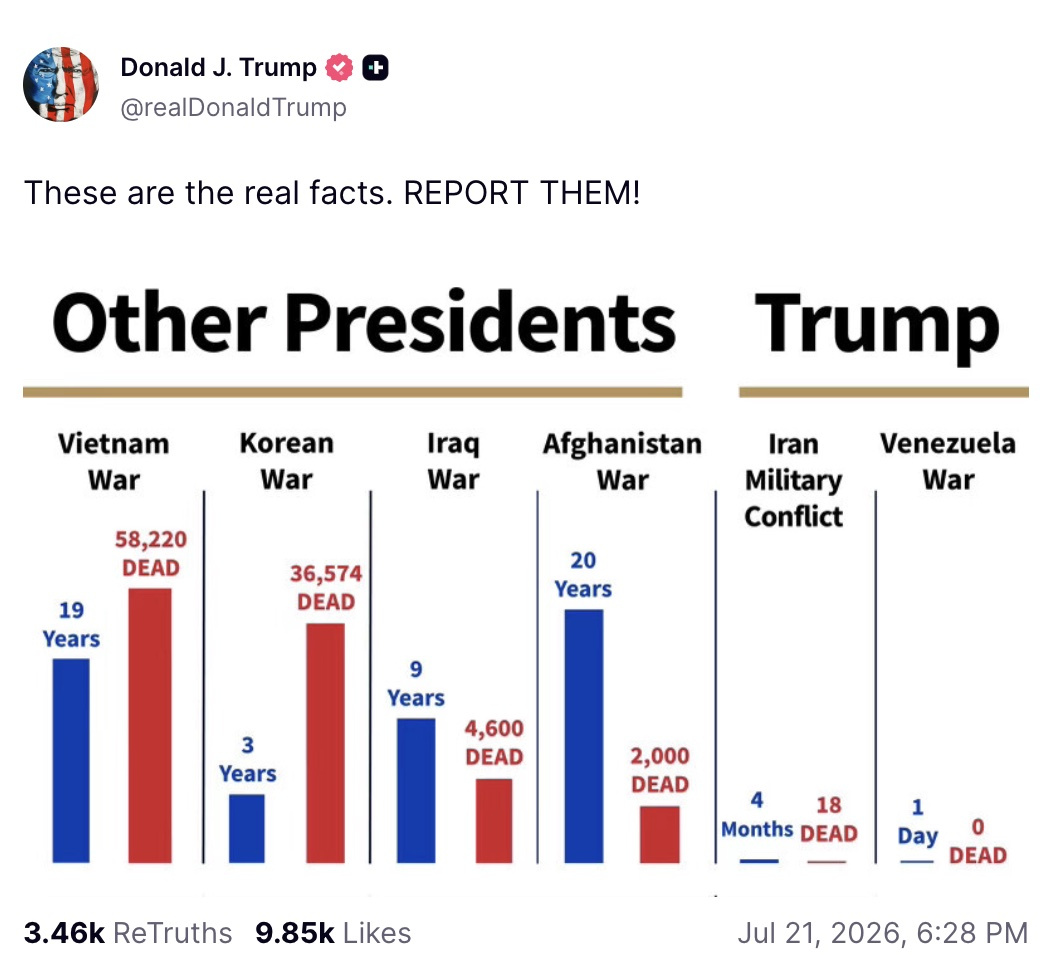
He is proud, as he said, that there are “only” eighteen dead in the Iran War. Only. I am sure that gives great solace to the families and friends of those killed in action. After all, in a campaign speech yesterday, he said the war against Iran is only a “skirmish.” Skirmish, conflict, or special operation, call it what you will, but for those on the front lines it is a war.
The country’s leadership still thinks only in terms of munitions expended and targets destroyed. The men and women of the U.S. military are doing a commendable and skillful job. But to what end? No nuclear weapons for Iran? Trump and Hegseth said that those capabilities were “obliterated” last summer. To open the Strait of Hormuz? It was open to free navigation for all nations before the war. In March Hegseth claimed that the U.S. had achieved an “overwhelming victory” that the Iranian military had been “destroyed” and “made combat ineffective.” In April he claimed that the operation achieved “every single objective.” They claim that the Iranian Navy sits at the bottom of the Persian Gulf. Yet, here we are. For eleven days now, and counting, the Iranians have engaged U.S. and regional forces, destroyed equipment and bases and killed and wounded our warriors. After nearly five months of fighting we are no closer to a resolution than we were at the start. In fact, our military as a whole, is less ready to take on another adversary than we were six months ago. Munition stocks are seriously depleted. Forces and equipment need rest and maintenance. What was supposed to take four weeks (at most!) has surpassed four months and we are worse off than before.
In hearings this week, Senator Gary Peters (D-Mich) summed it up nicely in a direct exchange with Hegseth. “Because I use the word ‘failure’ to their leaders. You sir are the failure, not the men and women who are on that front line, not the men and women who hold up their honor with distinction, but if there’s a lack of a winning strategy, they’re in harm’s way. Their leaders have failed them, and that’s what’s happening. You don’t have a strategy. You don’t have a long-term plan to actually win this war.” Hegseth responded by accusing the Senator of having Trump Derangement Syndrome.
They definitely do not have a real, viable plan. All they know how to do is post threats on social media.
If they are truly concerned about nuclear weapons in the Middle East, then why did the administration announce yesterday that they signed a deal with Saudi Arabia to help them build nuclear power plants? Especially when the deal explicitly contains language that exempts the Saudis from international inspections by the International Atomic Energy Agency (IAEA) or any other international inspection teams. This clearly gives the Saudis a path to enriching their own uranium. The Crown Prince of Saudi Arabia (sometimes known as “Prince Bone Saw” for ordering the murder and dismemberment of Jamal Khashoggi a journalist critical of the regime) has openly expressed his desire for a nuclear weapon if Iran gets one. The agreement goes against all previous U.S. policies concerning nuclear development that requires strict controls and compliance with conventions often called the “Gold Standard” of nuclear non-proliferation. I am sure that the billions of dollars invested by Saudi Arabia in Trump family businesses had nothing to do with the special treatment. Late today, Trump put a condition on the deal which was not in the original signed yesterday and may be a deal breaker for the Saudis. To come to fruition, Trump says that Saudi Arabia must normalize relations with Israel through the Abraham Accords. We will see if a few more billion dollars headed west makes that condition go away.
Every day there is a new outrage. Some policies are just plain bad but can be overcome. Monetary and economic policies can be adjusted or changed. The number one job of a government is to keep its citizens safe. Screw up national security policy and degrade our military and it is extremely difficult to recover before other nations take advantage of our weaknesses, real or perceived.
Please vote in November.
Appeasement, Donnie Style
Posted: June 19, 2026 Filed under: Uncategorized | Tags: Ballistic Missiles, Iran, iran-war, Israel, Memorandum of Understanding (MOU), Persian Gulf, Strait of Hormuz, Trump, U.S. Armed Forces Leave a comment
Federal workers are now on twelve hour shifts to clean up the algae bloom in Trump’s “pristine” reflection pool in front of the Lincoln Memorial. There probably could be no better metaphor for his administration. 14 million dollars on a no-bid contract to do, according to Trump, what no other president in history has done. To help kill the algae, the workers reportedly are also putting a 12 percent solution of hydrogen peroxide into the water where the bottom is painted “American flag blue”. Hydrogen peroxide in solutions over 10 percent acts as a paint remover. (photo-Facebook)
And it’s 1,2,3 what’re we fightin’ for? Don’t ask me, I don’t give a damn, next stop is ol’ Iran. And it’s 5,6,7 open up the pearly gates! Well, there ain’t no time to wonder why, Whoopee we’re all gonna die!
With apologies to Country Joe and the Fish for altering their 1969 “I-Feel-Like-I’m-Fixin-To-Die-Rag” sometimes known as the “Vietnam Song” written by Country Joe McDonald.
What a week it has been. It is hard to keep track of it all, but foremost on my mind is the debacle that took place this week as we acceded to all of Iran’s demands to end the war of choice started by Trump. As I wrote earlier this week, the U.S. is the clear loser, no matter what kind of happy face Trump and his flunkies try to paint on it. To me, it is not even obvious that the terms of the agreement will last very long. The Memorandum of Understanding (MOU) that Trump ceremonially signed with his trademark sharpie in the palace at Versailles France (oh, the historical irony) technically is not a treaty. It is supposed to be the framework for a more permanent peace agreement to be hammered out over the next sixty days. However, Trump and his administration are talking about it as if everything is already complete. If this is the end of it, then Iran got everything it wanted and the U.S. got nothing other than vague promises.
Indeed, there may be nothing more. In what can only be described as a fluid situation (government speak for nobody knows exactly what is going on), the follow on talks were postponed by Iran. They claim violations of the MOU are happening, especially on the part of Israel which was not a formal participant in the agreement. According to the MOU, the sixty day window started when the MOU was signed. All of this is to say, it reinforces my feeling that there may not be much in the way of formal negotiations to solidify the terms of the MOU.
There are fourteen points in the MOU which can be found here. In every detail, it is a humiliating end to a war that achieved nothing. While I am glad to see the fighting stop and an argument can be made that a bad deal is better than no deal, it is a clear sign of Trump’s ineptitude and preference to only look out for himself. The MOU achieves none of the alleged goals that were presented as the reason to go to war. The great victory the Trump administration is celebrating only requires Iran to open the Strait of Hormuz, which was open to free navigation before the war began. As spelled out in the MOU, Iran will allow “the safe passage of commercial vessels with no charge, for 60 days only, from the Persian Gulf to the Sea of Oman and vice versa.” (Emphasis added.) After 60 days they can consult with Oman to define the future administration of the strait which will surely include some form of fees to allow safe passage. Iran only reiterated its long standing position that they promise not to develop a nuclear weapon, a position they have espoused for decades. That is it. There are no provisions for inspections or otherwise monitoring Iran’s nuclear stockpile. Meanwhile, the U.S. lifts all of its sanctions and will work to lift international sanctions immediately which means Iran can get its oil to market at market prices where before, when they had to smuggle it out, they sold the oil at a discount. At current prices, that means Iran will earn about 105 billion dollars a year. Additionally, the U.S. will unfreeze Iranian assets and work to institute a 300 billion dollar “invest fund” for Iran to rebuild. None of those things will be monitored under this agreement. The MOU says nothing about Iran’s missile and drone programs or stopping its support for terrorists and proxies such as Hamas and Hezbollah. Guess where those billions will go.
In essence, the MOU is a multi-billion dollar payment to get Iran to re-open the strait for 60 days. Coupled with vague promises to negotiate a more permanent deal to control Iranian nuclear stockpiles. We are worse off than we were before the war. Not to mention that we threw Israel under the bus by including Lebanon in the agreement without consulting Israel.
Thirteen U.S. service members, 165 young Iranian school girls and their teachers, thousands of civilians throughout the Middle East, all dead. Roughly 400 U.S. service members wounded. Iranian citizens yearning to throw out their oppressors were abandoned. (Trump told them in January that “Help is on its way!”) Billions and billions of dollars spent. Everything wasted for no discernible purpose.
From a purely historical viewpoint, the U.S. again had to relearn a lesson that has been tested many times since World War II. Wars cannot be won by air power alone, no matter how grand, courageous or incredible our air forces and personnel may be. Ground troops have to be used at some point or the enemy can just wait out the onslaught. The Battle of Britain in 1940 showed that the first time around and we have relearned the lesson over and over since then. If your war aims are “unconditional surrender” — which Trump demanded at the start of the war — then ground troops are needed. If a nation does not want to do that — and thank goodness we did not put troops into Iran — then you may have tactical or operational success but not strategic success. It also says something about the will of those involved in the fighting. A nation may have tremendous military capabilities, but if there is not the will to fight at any cost, success is going to be relative.
Trump did tell the truth in one way. During a press conference at the G-7 conference in Evian, France this week he said, “I didn’t want to see economic catastrophe. If you kept this going, that could have happened. But all I know is, every time we talked about the possibility of peace, the stock market shot up like a rocket ship.” Trump went on to say that he stopped the fighting, “rather than possibly going into a depression, rather than having your favorite president be Herbert Hoover, he was always the one I didn’t want to be.” In other words, he admitted that his economy was not “golden” and that things could get even worse if the war continued. Specifically, the economic impact of the war was intolerable and that the world was facing a severe shortage of oil. At the G-7 conference on June 17, he said if he hadn’t agreed to the MOU, the U.S. “would run out of [oil] reserves in about four weeks.”
Hold on a second. About those ballistic missiles. Did Trump let Iran keep their missile programs? The ones that Secretary of Defense Hegseth said that the goal of the war was to “destroy Iranian offensive missiles, destroy Iranian missile production.” Yes. Apparently the Iranians can keep their ballistic missiles and programs because, otherwise, it wouldn’t be fair. But I will let Trump explain it. “I mean, they have to have some because other people have some. You’ve got to have some,” Trump went on: “‘Sir, you shouldn’t let them have any missiles.’ I said, ‘Well, what am I going to do? I’m going to let Saudi Arabia have missiles, but they can’t have them?’ ‘Yes, sir.’ It can’t — doesn’t work that way,” Trump said.
So there you go.
The war did not weaken the Iranian regime or strengthen the U.S. Gulf states will now have to deal with a revitalized Iran that keeps its war making capability and is now richer, stronger and tougher with the knowledge that it can survive an American attack.
On a brighter note, the Obama Center officially opened yesterday. All living presidents and their wives — except for the current one — attended the joyous celebration surrounding the opening. It reminded me of what America can be when we stick to our values and traditions.
And Happy Juneteenth!
Desperation Trumps Reality
Posted: June 15, 2026 Filed under: Uncategorized | Tags: Carl von Clausewitz, Iran, Iranian Revolutionary Guard Corp (IRGC), Israel, JCPOA, Middle East, MOU, Oil, Persian Gulf, Strait of Hormuz Leave a comment
Vessels at anchor in the Strait of Hormuz. (Reuters)
Yesterday to celebrate his birthday, Trump declared that his war with Iran is over and that peace prevails. While details of an agreement are unclear — all of the parties involved have stated different conditions and no transcript yet exists — it appears that we have a “concept of a plan” in place that the Trump administration is calling a Memorandum of Understanding (MOU). It is not finalized as the MOU will not be signed until Friday. Everything stays in place at least until then. As the U.S. military command in charge — Central Command or CENTCOM — stated today, the U.S. naval blockade remains in place until the MOU is officially signed. This, despite Trump posting that “I hereby fully authorize the toll free opening of the Strait of Hormuz.” Of course, the Iranians might have a say in its reopening.
For insiders, look at insurance rates for ships in the Persian Gulf transiting the strait as an indicator of how things are proceeding. Businesses and insurance underwriters are not going to send their ships through without the knowledge that it is safe. Extravagant insurance rates means the strait is not safe. The more the rates approach pre-war costs — it will be a long time before they are the same — the more traffic will transit the strait.
As with most things involving Trump, he took a bad situation, put some Home Depot gold gilding on it, and sold it as a huge success. We have a long way to go before the situation is resolved. Supposedly, the MOU signed next Friday will lead to a renewed ceasefire that will open a sixty day window of negotiations. It is always a promising start when the shooting stops and people are not dying or getting maimed, but peace is hardly ensured. I suspect that most of the process involves Trump getting fed up with the war and just walking away while trying to put a happy face of victory on the debacle.
Clearly Trump failed to achieve any of the goals he set at the start of the war. Indeed, we are worse off now than we were at the start of the war. There is new leadership in charge in Iran that is more hardline than the one we killed off. Now the Iranian Revolutionary Guard Corp (IRGC) appears to be calling the shots and they are more confident in their ability to survive the U.S. military’s best efforts. Trump promised the people of Iran that he would help them throw off their oppressive government. In fact, they are under a more repressive regime and have suffered thousands of civilian casualties in the process. The elimination of Iranian missile and drone production is not mentioned in the MOU. Trump finally settled on dismantling the Iranian nuclear program as the basis of the war but the program remains. The Strait of Hormuz was open to free navigation and now it is not. Notice that Trump declared the “toll free” opening of the strait. Look for Iran to impose a tax, or a processing fee, or an administration fee or an environmental fee or some other fig leaf otherwise known as a toll. Even if they do not charge anything, Iran now knows that they can close the strait or restrict traffic or prohibit ships from designated countries from using it or control it in any way that they care to do so, with significant impact on the world economy. The U.S. did not reopen the strait and the Iranians are betting that the U.S. will not come back to do it in the future. At least not in the next two and a half years.
The mere fact that the administration is talking in vague generalities is a clue to how little has been achieved. Rather, it seems Trump was desperate to get out from under the quagmire he created in the Persian Gulf. I have seen nothing addressing Iran’s sponsorship of terrorism. It appears that sanctions against Iran will be lifted as part of the deal and that billions of dollars in frozen Iranian assets will be released. That unfortunate development is one that Trump is trying desperately to gloss over. He accused President Obama of giving the Iranians “pallets” of money under the JCPOA. It is expected that Trump’s deal will give the Iranians billions more. It is widely reported that Trump will free up twenty billion dollars in Iranian funds, dwarfing the roughly 400 million in frozen assets released under Obama in 2015 (with accrued interest since 1979 the total was about 1.5 billion dollars). Probably, three billion dollars has already been released through the United Arab Emirates (UAE) as Trump is desperate to keep his finger prints off of the cash. There is also talk of the U.S. paying reparations to Iran to help rebuild the infrastructure destroyed during the war. Notably, nowhere to date has there been any talk of inspectors monitoring or restricting the Iranian nuclear program. Without inspections, any paper agreement is meaningless.
Looking at the big picture, Iran achieved its strategic goals and the U.S. achieved none. Yes, Iran is battered and our military is significantly more powerful than Iran is, but as I have written many times in this space, that is not all there is to warfare. Strategy matters. Clear objectives matter. Matching ends, ways and means matters. Despite Secretary of Defense Pete Hegseth’s belief that blowing stuff up is fun and is all that matters, there is more to warfare than bombs. There is a reason that military strategists, including in senior U.S. war colleges, still study On War by Carl von Clausewitz. It is not just a cliche to repeat his fundamental precept that “war is the continuation of policy [politics] by other means.” Nations do not, or at least should not, go to war for the fun of it. The military is one tool to support diplomacy to achieve specific objectives. I dare say that Trump and Hegseth and the rest of Trump’s civilian advisors are too vain to believe that they have anything to learn from those that are professionals in the art of war. This is the result.
Iran’s power, finances and stature on the world stage are significantly enhanced. The U.S. is significantly diminished.
We will have to wait and see what actually takes place on Friday and what is accomplished during the negotiations. The wild card is Israel. Iran insists that Hezbollah in Lebanon is part of the agreement and that Iran will not abide by any agreement if Lebanon is not part of the settlement. Israel insists that their actions in Lebanon are distinct from those in Iran. (Israeli Prime Minister Benjamin Netanyahu is adamantly opposed to any agreement with Iran before their nuclear program is eliminated. Speculation is that he launched an attack into Lebanon just before the MOU was announced for one of two purposes. The benign explanation is that he wanted to emphasize that Israeli actions in Lebanon are not part of the agreement. The less kind explanation is that the attacks were an attempt to get Iran to withdraw from the agreement with the U.S. Netanyahu is in a political bind. He needs to exert his independence and maintain his sovereign responsibilities but Trump is publicly acting like he controls Netanyahu. Time will tell.)
Iran is a bad actor. They are the leading sponsors of terrorism around the world. The leaders of Iran are fanatics and there is every incentive to hold them in check and accountable. Reckless military actions were not the way to reel them in. I think that the waste of lives and treasure will haunt us well into the future. The Trump administration will try and paint a picture of total victory. It is not. We will soon see if this group of third rate actors in the administration have any ability to learn from their mistakes as there is already talk of going into Cuba. Maybe the spineless members of Congress that let Trump do whatever he wants will finally step up. I am not holding my breath waiting for them to get a backbone.
Iran’s Strategic Victory
Posted: May 29, 2026 Filed under: Uncategorized | Tags: Abraham Accords, Drone Warfare, Iran, Israel, JCPOA, Lebanon, Memorandum of Understanding, Middle East, Policy Strategy Mismatch, Russia, Strait of Hormuz Leave a comment
A billboard in downtown Tehran depicting Donald J. Trump with his lips stitched together in a symbolic illustration of the closed Strait of Hormuz. (Reuters)
For several days now, there have been rumors of a “deal” between Iran and the U.S. In diplomatic terms, there is no such thing as a deal. There are treaties, agreements, alliances, and a host of other official documents that exist under international law. In truth, the Trump administration calls the agreement a Memorandum of Understanding or MOU. A MOU — and this one is supposedly one page — is not how wars end. A MOU is more like a concept of a plan and in fact, this one calls for a continued ceasefire for sixty days while the actual terms are hammered out. One thing is for sure, Trump has no idea what he is doing and he is giving the word “deal” a bad connotation. Last Saturday Trump said they were close to an agreement. On Sunday he said that they were not close. On Monday we attacked targets in Iran, allegedly in self-defense, but contrary to the existing ceasefire. Then we learned that the negotiators have come to terms but as of this writing, neither the leadership in Iran nor Trump have agreed to it. Wednesday the two sides exchanged attacks.
It is hard to assess whether the U.S. achieved its strategic goals because they were never articulated, other than vague announcements that Iran must give up their “nuclear dust” (enriched uranium). Or was it his declaration that he would accept nothing less than Iran’s “unconditional surrender?” Or was it that he was going to select “acceptable” new leaders in Iran — regime change? Or was it to destroy all of their ballistic missiles? (Intelligence assessments made public indicate Iran has about 70% of their arsenal intact.) Or was it “a whole civilization will die tonight, never to be brought back again”? Or anything else that happens to pop into his head.
In my view, the Iranians scored a resounding strategic victory that puts the U.S. on its heels around the globe. Historically, this could be the turning point where the U.S. goes from being a global leader to becoming a regional power. It will be the end of American dominance enjoyed since the end of World War II. There are multiple reasons as to why we will look back on this war of choice as a disaster bigger than Viet Nam or Afghanistan.
What is in the agreement? As I write, that is unclear. Both the U.S. and Iran have publicly discussed different elements of the MOU and the parts do not often match. It appears that it will extend the current (almost) ceasefire for another sixty days. During those sixty days, talks would continue for a more permanent agreement. At some point, and right now it looks like after the sixty days, nuclear talks would begin as to the disposition of the Iranian program. There are very little specifics. The Strait of Hormuz, which was open before Trump initiated the conflict, would reopen. The U.S. blockade of the Gulf and Iranian ports would end. Additionally some sanctions against Iran would be lifted and some amount of frozen assets (pallets of money?) released. In other words, we will be worse off, Iran will be better off, after hostilities cease. President Obama’s Joint Comprehensive Plan of Action (JCPOA) hammered out with the P-5+1 (the five permanent members of the U.N Security Council plus Germany) and Iran to curtail Iran’s nuclear program was a much more fruitful and impactful agreement. Critically, that plan included intrusive inspectors to monitor compliance. Trump tore it up. The MOU makes no mention of inspectors which makes any discussion of the nuclear program meaningless unless inspectors are given unrestricted access.
As the talks progressed this week, out of nowhere, Trump invoked the Abraham Accords and demanded that all of the Muslim countries sign on as part of the MOU. The Abraham Accords are a series of agreements, brokered by the U.S. between Israel and Muslim and Arab majority states. Egypt and Jordan have had relations with Israel since 1979 and 1994 respectively. UAE, Bahrain, Morocco and Sudan have joined the Accords since 2020. Complicating the picture is Palestine. Saudi Arabia and other Gulf states plus Pakistan and others will not establish diplomatic relations with Israel until the Israelis commit to a two state solution for the Palestinians. The Israelis, or more specifically Benjamin Netanyahu, refuses. Analysts speculate that Trump threw in that proposal to try and salvage what is going to clearly be a major failure on his part if the MOU goes forward. Should he stick to that requirement, it will prevent agreement on the MOU.
Remember that Israel is conducting military operations in Lebanon against Hezbollah, a proxy of Iran’s. Iran declared that fighting in Lebanon must be included in any settlement or ceasefire. Israel declared that Lebanon and Iran are two distinct issues and that any agreement with Iran does not include Lebanon. This is but one of many complicating factors preventing a permanent agreement and thus the MOU. Additionally, Netanyahu is against any agreement that does not eliminate Iran’s nuclear programs upfront, before the war ends.
One of the biggest lessons learned is the changing nature of warfare. If nothing else, Ukraine and now Iran have demonstrated that a militarily inferior nation can hold out against a much larger and better equipped nation. One big reason is drones. Clearly a Tomahawk surface to surface missile is a more powerful weapon than a relatively cheap drone. But warfare in the modern era is not just about who has the biggest guns. It is economic warfare as well as combat. We have a finite number of expensive precision offensive munitions and our defenses are finite and expensive. Iran can quickly and cheaply churn out a nearly unlimited supply of drones. Are cheap drones sufficient for today’s warfare? No. But if the future of warfare is drones, then Hegseth’s and Trump’s infatuation with a manly non-woke military is a distraction from what really counts. Trump and Hegseth want to take us back to the 1990s with big platforms like the Trump battleship or the F-47 stealth fighter (Trump thinks it is named after him as the 47th president). Those programs cost tens of billions of dollars. One Trump battleship is estimated to cost at least 20 billion dollars (while we are going back to the future, why not propel the ship with big, beautiful coal which Trump seems to want to use to power everything). For example, one Tomahawk missile costs about 2 million dollars launched from a multi-billion dollar platform manned by hundreds of sailors which does not include other costs such as maintenance, fuel, logistics and so on. One Iranian Shaheed drone costs about twenty thousand dollars. Are they terribly sophisticated? No. But when fired by the hundreds coming from multiple directions, some are going to get through, no matter how sophisticated the air defense system is — and our sophisticated air defense systems also use very expensive radars and missiles.
The American military uses drones but they are big expensive ones with a long logistical tail. For example, a set of four MQ-9 Reaper drones (also known as the Predator B — a long range, long endurance, remotely piloted aircraft) plus the ground control station and satellite link systems, cost about $30 million dollars. We have lost several to the Houthis and Iranians as well in operational accidents. Each F-22 Raptor (the current all weather stealth fighter aircraft) costs about 150 million dollars. None of the aircraft have been built since 2011 with only 187 total put into service. However, looking at the total program cost per aircraft (which includes research, development, and start up costs) it comes out to about 340 million dollars per plane. It costs about 70,000 dollars per flight hour to use one. You get the idea, our modern arsenal is expensive. The Pentagon claims that the war against Iran cost taxpayers about 30 billion dollars to date. Most economists estimate that the actual figure is around one trillion dollars when adding up the cost of the operations in theater plus damage to bases and equipment plus the long term replenishment of depleted stockpiles and the personnel involved. So far we have lost thirteen service members killed in action and about five hundred wounded. None of that includes the impact on our domestic economy.
We must also remember that one of the keys to our economy and our role in it is freedom of the seas. Iran now knows that it can control the Strait of Hormuz regardless of any ceasefire or other agreement. That means they also control about 20% of the flow of the world’s oil, significant amounts of natural gas, fertilizer and other “must have” commodities. They will demand to be treated with respect or else they can threaten to disrupt the world’s economy and close it again. Or close it to those nations that are not friendly to them or otherwise refuse to meet Iranian demands. The rest of the world will have to deal with Iran or be prepared for threats to their economy. Iran is now a major player in the region and the world. Despite the Iranian navy “lying on the bottom” as Trump puts it, the U.S. could not keep the Strait open. We also were unable to provide the deterrence or protection we promised to our Gulf friends and allies in the region. Trump even threatened one of our strongest regional supporters. When asked this week about Oman working with Iran to control the Strait he said, “the Strait’s got to be open to everybody… nobody’s going to control it. We’re going to watch… over it… Oman will behave like everybody else or we’ll have to blow ‘em up.” Very reassuring.
Trump bullies and shouts, but in the end, what does he really talk about? Venezuela, Cuba, Greenland, Canada, Mexico, and other Western Hemisphere nations. He mocks NATO, our strongest allies ever, and refuses to commit to their defense. Where does that leave us? We are fast losing our status as a world power and are becoming a regional power. Russia, and especially China, are ready to fill the void.
All for what?
Our Alleged “Stable Genius”
Posted: April 29, 2026 Filed under: Uncategorized | Tags: Department of Defense, Donald Trump, IAEA, Iran, Iran Deal, Iran Nuclear Deal, Israel, JCPOA, Middle East, Strait of Hormuz, Truth Social Leave a comment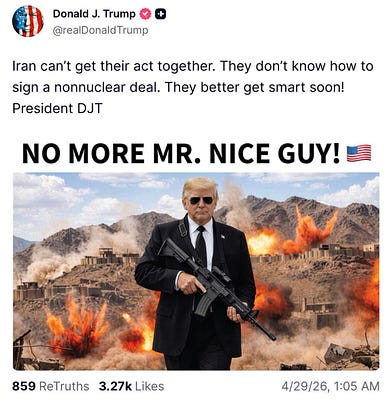
A Truth Social meme posted, when most of us were asleep, by the President. Of the United States. When I first saw it I thought it was a joke put up by a fake account. Sadly, it is real.
With all of the talk about ballrooms and sea shells on North Carolina beaches and the continued stonewalling about the Epstein files, one may forget that we are still at war with Iran. The Strait of Hormuz remains closed, gas is now averaging $4.23 a gallon nationally, farmers are having trouble finding fertilizer for the planting season and our Commander-in-Chief knows only how to use AI to try and make himself look tough. Emphasis on “try.” Trump thinks that he can bully Iran into giving up its “nuclear dust” (as he calls it, and I’m not really sure what he means but probably he means enriched uranium). This is the very same guy that claimed it was “obliterated” last summer. I could fill several pages in this space recounting all of the lies that he and his administration have told about this war of choice, but since most of them are preposterous and easily debunked, I won’t waste your time. Simply ask yourself if you, and indeed the world, are better off, safer and more financially secure as a result of this war than you were two months ago.
We still do not know what the reason for the attacks on Iran are all about. Our service men and women have performed professionally and with skill. They are tremendous. But what are they risking their lives to do? Tactical brilliance does not translate to strategic success without a well thought out rationale for war with clear goals set at the beginning. Trump and his man servant Hegseth continue to change their story with each passing day and cannot articulate any strategic goals, only tactical successes. Military planning is based on, and in this order, delineating the ends (strategic goal — when do you know you won?), ways (the operational use of force — attack from the air, the sea, direct assault, hit command and control?) and the means (tactical application of force — what armaments and forces are available?). All three must be in alignment.
Currently, we are in a stalemate with Iran. Both the Iranians and the Trump Administration think that they can wait out the other side and that they can force the other guy to give up. Among the many factors that this administration overlooked or underestimated is the steadfast will of the Iranian culture. Couple that with a government that does not answer to the population but is only interested in its own survival, and it gives the Iranians an advantage. They are suffering, without a doubt, but most regional experts assess that they can hold out much longer than expected. The rest of the world is already beginning to suffer and will be experiencing real economic and quality of life hardships in the very near future. It is unclear whether or not our friends and allies (a different topic as Trump works overtime to alienate every single one of them — except his best buddy Putin) can bring pressure to bear for Trump to settle with the Iranians.
As it stands now, and Trump could change it all in the next five minutes with a Truth Social post, the Iranians have offered to reopen the Strait and then come to the negotiating table to discuss other issues, such as what to do about their enriched uranium. In exchange, the U.S. must lift its blockade of Iran. Trump refuses to discuss it and is increasing the strength of the blockade and ordering the seizure of Iranian ships worldwide.
In recent days it became clear that the U.S. and our regional supporters suffered more damage than previously understood. It is estimated that the U.S. suffered about five billion dollars in damages to equipment such as missile defense radars in Qatar, Jordan and UAE, the Navy’s Fifth Fleet headquarters in Bahrain, air bases in Jordan, Kuwait and Saudi Arabia and numerous high end aircraft and drones, to name a few. All of the Gulf state countries plus Jordan suffered damage to their infrastructure and some oil and natural gas facilities. Of course most importantly, human beings were killed and injured including thirteen U.S. service members killed and around three hundred and fifty wounded.
Trump is in a bind. He has lost interest in the war but cannot look weak. If he withdraws U.S. forces without some concessions from the Iranians the world will consider it a defeat. If he stays indefinitely he looks weak because Iran gets stronger everyday and will have survived our best shot and lived to fight another day. Continuing direct combat operations weakens our ability to defend our interests in other hotspots around the world. The U.S. has already used up thousands of cruise missiles and air defense missiles that could take three to five years to replenish. According to the Department of Defense, the war cost us 25 billion dollars to date. Most analysts put the total costs at a much higher level, as much as 65 billion dollars. Today Hegseth testified before Congress that the DOD requested budget for the next fiscal year is 1.5 trillion dollars, a forty-four percent increase over the current budget.
To settle his war of choice, Trump must get serious about the negotiations. Sending two real estate tycoons to negotiate a meaningful settlement is ridiculous, not to mention that the last two times the Iranians met with these same individuals — thinking that they were making meaningful progress — their country was attacked. There can be no “take it or leave it” agreement forced on the Iranians. Bullying will not work — it only makes them more determined. It will take a team of experts and seasoned negotiators to spend a lot of time with great patience to reach a negotiated settlement. Trump should set the process in motion, shut up, and see what happens over time. Pakistan showed that it can be a helpful and effective mediator. Let them try.
In the end, Trump is likely to end up with an agreement that is barely as good as the one that the U.S. negotiated during the Obama Administration that Trump tore up. The 2015 Joint Comprehensive Plan of Action (JCPOA) between Iran and the “P-5+1” (the five permanent members of the U.N. Security Council US, UK, France, China, Russia, plus Germany along with the EU) limited Iran’s capability to enrich uranium. The agreement limited the number of Iranian centrifuges, the level of enrichment and the size of their stockpiles. As part of the agreement, intrusive monitoring was conducted by the International Atomic Energy Agency (IAEA). In exchange, Iran got some sanctions relief, some frozen assets were released and a timetable for other future provisions. Sanctions remained in place for Iran’s missile program, support for terrorist groups and efforts to improve Iran’s human rights record. It was not perfect but it was working, it was building trust for future agreements, and it kept Iran in relative check. Israel opposed the deal. It took twenty months of detailed negotiations using technical experts as well as diplomatic experts. The negotiations were slow going with ups and downs as each side sounded out the other and built trust. No such expertise accompanied Trump’s recent negotiating teams. I suppose that as a very stable genius he did not need any other experts working on the issues.
Trump is likely to declare victory once the Strait of Hormuz is reopened. The very Strait that was open to free flowing ship traffic before the war. He will continue to make noises about the Iranian nuclear program but will not seriously negotiate a settlement. The wild card in ending the war is Benjamin Netanyahu of Israel. He is determined to turn southern Lebanon into another Gaza strip by destroying it in his fight with Hezbollah. He is also not satisfied with the status quo in Iran. The next step may not be Trump’s to take. Remember that initially Secretary of State Marco Rubio stated that the U.S. attacked Iran because Israel was about to do so and since Iran would retaliate, the U.S. decided to strike first. One wonders who has their hand on the wheel driving us to who knows where.
Mad King Donnie Disrupts The World
Posted: April 9, 2026 Filed under: Uncategorized | Tags: Donald Trump, Genocide, Iran, IRGC, Israel, Nuclear Weapons, Persia, Persian Gulf, Russia, Strait of Hormuz Leave a comment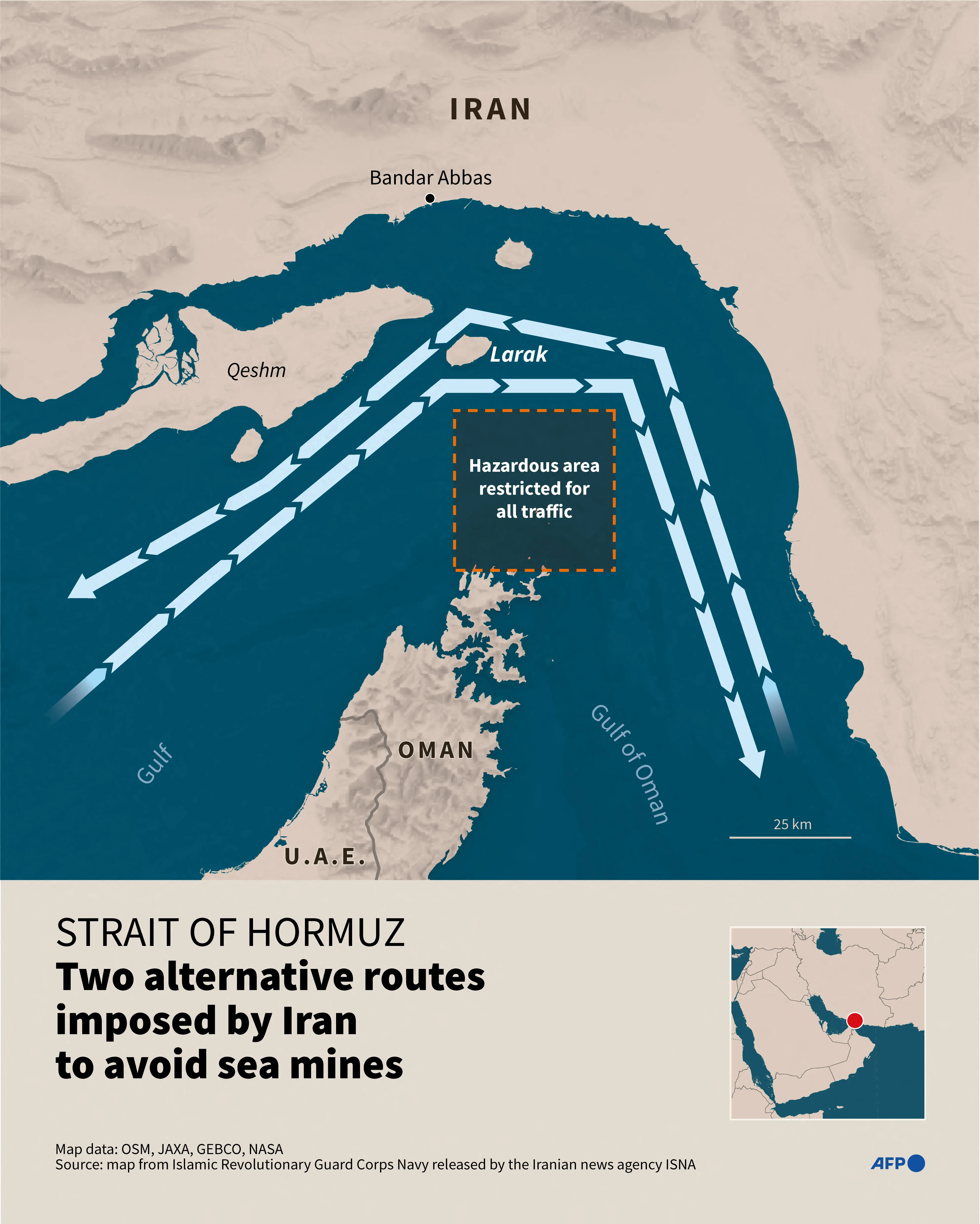
On Tuesday, Trump claimed that in accordance with an announced cease-fire with Iran that the Strait of Hormuz is open. On Thursday, officials from the United Arab Emirates (UAE) stated that “the Strait of Hormuz is not open. Access is being restricted, conditioned and controlled” by Iran. The map shows how Iran is rerouting shipping so that it can pass within the firing range of the Iranian Revolutionary Guards so that they can shake down the shippers for cash. From CNBC (AFP/Getty Images)
On one level, all of us should be thankful that Trump pulled his TACO routine (Trump Always Chickens Out) after posting on social media Tuesday morning, directed at Iran and its population of 93 million men, women and children that “A whole civilization will die tonight, never to be brought back again.” That is what scholars, pundits and most of the public call genocide. From the President of the United States. Speaking to the world in our name. The reaction from his fellow Republicans? Nothing. No accountability. No responsibility. No consequences. This is not okay. This is beyond shameful and is sufficient cause for getting rid of the whole lot of them. Our Constitution is soiled and our system of government is broken. Clearly the president is deranged. It is no longer a slogan or an exaggeration or any other mitigating definition. He is just plain crazy and he controls nuclear weapons. Two things are clear from his statement. First and foremost he has no moral compass, code of ethics or empathy for any human besides himself. Second, he clearly thinks he can do whatever he wants without restraint from anybody or any organization. If he wants it, he will order it, and expect it to be carried out. This should scare all of us right to our core. Thank goodness he chickened out. But let’s look deeper.
One hour before his stated deadline for Iran to end the war and open the Strait of Hormuz, Pakistani Prime Minister Sharif offered up a fig leaf to provide an exit ramp from doomsday. Both Trump and Iran accepted a two week ceasefire to allow diplomatic efforts to continue towards a more lasting settlement. In doing so, Trump said that the Iranian ten point plan for a negotiated settlement was a “workable basis on which to negotiate.” Iran took that literally, always dangerous when dealing with Trump. It appears that Trump probably did not know what was in the Iranian proposal. Here are the points in the plan:
- Cessation of the war on Iraq, Lebanon, and Yemen.
- Cessation of the war in Iran with no time limit.
- Ending all conflicts in the region.
- Reopening the Strait of Hormuz.
- Establishing a protocol and conditions to ensure freedom and security of navigation in the Strait.
- Full payment of war reparations to Iran.
- Lifting sanctions on Iran.
- Release of the Iranian frozen assets held by the United States.
- Iran commits to not seeking possession of any nuclear weapons.
- Immediate ceasefire on all fronts upon the ceasefire announcement.
Looks a lot like Iran got nearly everything that they wanted. After scathing criticism stating that fact, Trump retreated. Now the administration is claiming that this is not the plan, instead there is a “secret” plan that they cannot reveal. If you believe that, you probably have a degree from Trump University.
For forty-seven years Iran has been the leading exporter of terrorism. There are no tears shed for the regime, its military or any of the other suppressors of the Iranian people. Iranians — Persians — have a long and storied history and culture. We will all rejoice when they rejoin the nations of the world as a stable, productive and welcomed member of society. This assault did not achieve that but it did make life worse for the average citizen of the country.
Israel, of course, is not honoring the ceasefire, whatever form it may be in. They continue to bomb Lebanon claiming that that war is different than the one on Iran. Iran refuses to fully open the the Strait until the Israelis stop their bombing. In short, it is a very confusing situation as I write. We do know, that for now, the United States has ceased attacking targets in Iran. That is about the only thing that is for sure. Oh, and Trump and his minions are claiming a “historic and overwhelming victory on the battlefield. A capital V military victory” as the former Fox News weekend host and current Secretary of Defense describes it.
The U.S. military did what they were asked to do. They significantly degraded the Iranian military in an overwhelming tactical win. But, strategically? Iran won big time. There is a famous conversation between adversaries in Viet Nam some years after the war. Harry Summers, an American colonel allegedly told a North Vietnamese counterpart, “You know, you never defeated us on the battlefield,” to which the Vietnamese colonel replied, “That may be so, but it is also irrelevant.” History is replete with examples of similar tactical losses leading to strategic victory. One can argue our most recent example was the U.S. involvement in Afghanistan.
Here is some of what Trump expected from Iran for our war of choice to cease and the assault on Iran to end. First, he called on the Iranian people to rise up and take control of their government. Then he simplified that to “regime change.” Then he called for “the complete and unconditional surrender” of the nation. Then it was to destroy Iranian stockpiles of enriched uranium. Then it was to prevent Iran from building a nuclear weapon. Then it was to keep their proxies (Hezbollah and the Houthis) from participating in the war. Then I lost track, but they ended with opening the Strait of Hormuz — which I will gently remind everyone was open to free navigation prior to the war. None of these objectives were achieved. In fact, in some ways, Iran is in better shape now. They have an even more entrenched and radical regime in control of the country. Sanctions have been lifted so Iran is making lots of money with oil prices so high. Iran is charging tolls for the use of the Strait of Hormuz — more money to the regime to rearm and rebuild, especially as Russia has openly supported Iran and reports indicate that China has been helping them as well.
(Distracting Note: Were I conspiracy theorist, I might opine that the entire reason for Operation Epic Fury was to help Vladimir Putin and Russia. Sanctions against Russia are lifted, allowing for them to purchase more weapons for use against Ukraine. Weapons and ammunition destined for Ukraine was diverted to the U.S. attack on Iran. Russia supplied targeting information on U.S. forces to Iran. Trump has all but broken NATO. He viciously denigrates our closest allies and even said this week that “I was never swayed by NATO. I always knew they were a paper tiger, and Putin knows that too, by the way.”)
The war claimed thirteen American lives, with close to four hundred wounded. The cost — to date — is roughly 40 billion dollars. We have depleted stocks of weapons and ammunition that will take years to replace, especially high cost missiles and aircraft. (We know the U.S. has lost four F-15E [fighters], 1 A-10 [ground attack], 1 E-3 [AWACS], 2 KC-135 [tankers], 2 C-130 [special operations configured transports], 17 MQ-9 [sophisticated drones], 1 MH-6 [specialized little helicopter] and there are rumors of additional helicopters lost.) Thousands of civilians killed in Iran, Lebanon, Israel and around the Persian Gulf. Oil prices soaring impacting the world’s economy. And more. For what?
Are we better off than we were six weeks ago? Strategically, Iran is. We look weak, chaotic, unhinged and untrustworthy as the world wonders where Trump will next declare “the end of civilization” is at hand. Trump is attempting to end this war in the same manner he ends everything. Create a crisis, claim to be fixing it, and then walk away when it gets too hard and pronounce that its not his problem, someone else will have to clean it up.
This is not the end of our nightmare. It is only the beginning.
A War Without Leaders, Only Zealots
Posted: April 5, 2026 Filed under: Uncategorized | Tags: Board of Peace, Christians, Crusades, Donald Trump, Easter, Iran, Israel, Leadership, Strait of Hormuz, Trump, Truth Social, United States Constitution, War Crimes Leave a comment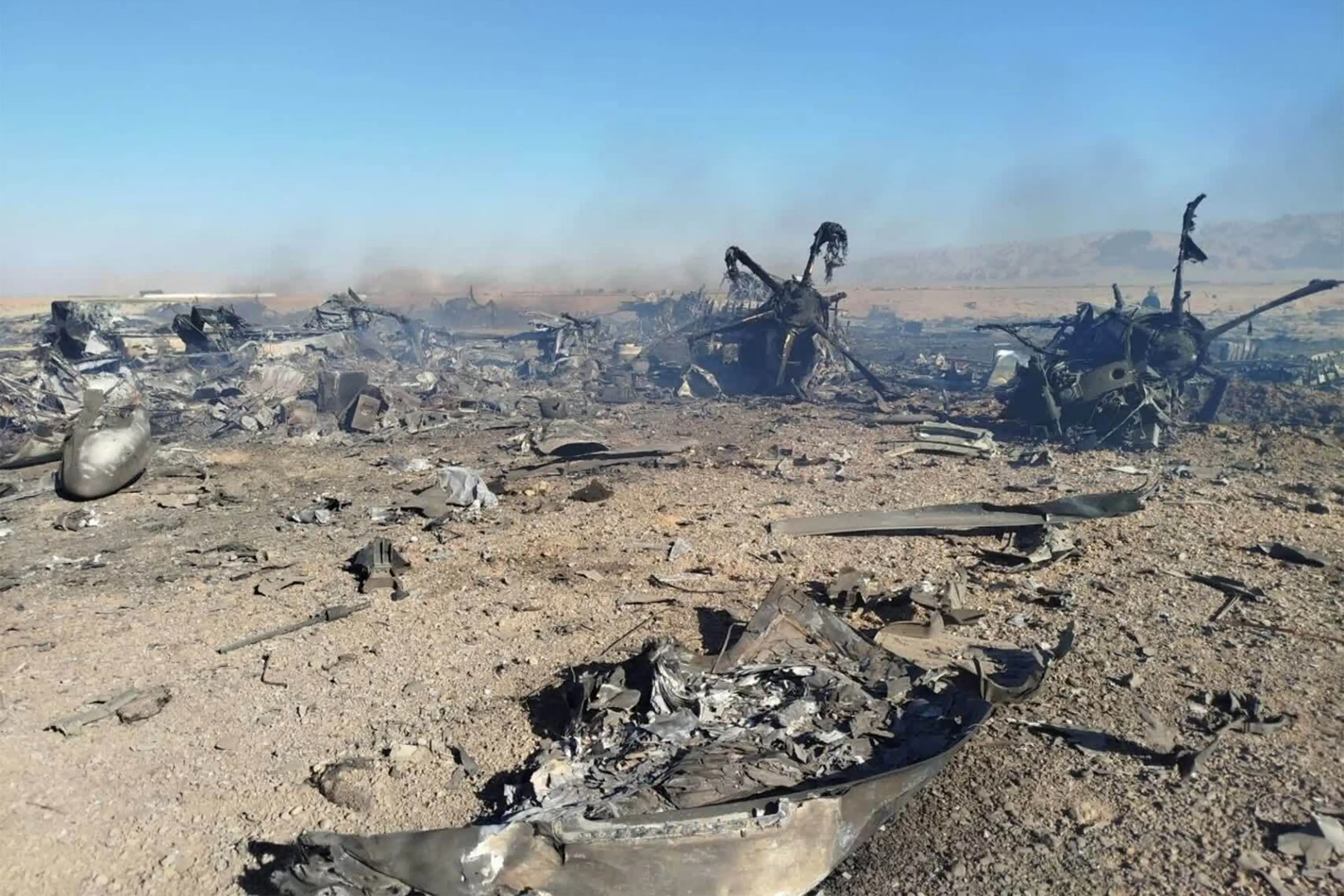
One of the pictures released by the government of Iran showing the remains of U.S. aircraft destroyed on the ground during rescue operations to recover a second crewmember from a USAF F-15E shot down by Iranian forces on Friday. A massive operation successfully recovered the missing crew member but the recovery force had to destroy two specialized C-130 aircraft and at least two Black Hawk helicopters on the ground. Thankfully, all participants reportedly were recovered without casualties.
This morning we received the following Easter greeting from the President of the United States who believes, as do others in our country, that he was chosen by God to lead our country and who some Evangelical pastors compare to Jesus Christ. (I apologize for the language, but I see no reason to clean up Trump’s preferred presidential language.)
“Tuesday will be Power Plant Day, and Bridge Day, all wrapped up in one, in Iran. There will be nothing like it!!! Open the Fuckin’ Strait, you crazy bastards, or you’ll be living in Hell – JUST WATCH! Praise be to Allah. President DONALD J TRUMP.”
This is not a joke or a hoax. These are the deranged postings of a sick man on his way to play golf at one of his courses in Northern Virginia. You know, the traditional way many Christians celebrate the holiest day of the liturgical year. It came on the heels of the previous day’s post.
“Remember when I gave Iran ten days to MAKE A DEAL or OPEN UP THE HORMUZ STRAIT. Time is running out — 48 hours before all Hell will reign (sic) down on them. Glory be to GOD! President DONALD J TRUMP”
If you ever thought that Iran might cave, those social media posts nearly guarantee that Iran will never give in and will work as hard as possible to make life hell for us, Israel and the Gulf states. Trump thinks he can bully anyone. To me, he sounds desperate. He is in over his head and does not know how to get out. Please note that the Iranians have yet to deploy one of their most deadly weapons — terrorist sleeper cells.
Oh, by the way, what he is threatening to do is, by the standards of international law, a war crime. But then he has been threatening Iran with promises to commit war crimes for quite some time now. His Secretary of Defense has also been promising that our troops will commit war crimes when he pledged at one of his “tough guy” press speeches on 15 March that there will be “no quarter, no mercy for our enemies.” Since our Civil War, our military has been taught that “no quarter” which means there will be no prisoners, everyone is to be massacred, is a war crime. It is also enshrined in the Hague and Geneva conventions. The U.S. Pentagon’s own war manual clearly states that it is a war crime. But then this is the same guy that vowed on 2 March that there would be “no stupid rules of engagement” and “no politically correct wars.” I do not know who is copying who with their blasphemous invocations of God and Jesus Christ, but at a recent prayer service in the Pentagon, Hegseth invoked both in his lust for killing. He is on record as saying that our troops need to continue dispensing death and violence in God’s name. It is a religious duty, according to his sick reasoning, in order to “save” western civilization, a belief he shares with many in Trump’s orbit. (Project 2025 anyone?) He actually pronounced a prayer that said in part, “let every round find its mark against the enemies of righteousness and our nation” and produce “overwhelming violence of action against those who deserve no mercy.” In their own words, both Trump and Hegseth think that they are on some kind of Crusade against Islam. Shoot, Hegseth even has tattoos all over his body referencing the Crusades. To name a few, his arm has a tattoo reading “Deus Vult” which is Latin for “God will it” and is linked to the First Crusade as a battle cry. On his chest he has a large Jerusalem Cross, also a link to the Crusades and a popular symbol for today’s white Christian nationalists. Another tattoo on his arm is a cross with a sword referencing the New Testament verse Mathew 10:34 which reads “Do not think that I have come to bring peace to the earth; I have not come to bring peace, but a sword!” I have no problem with anyone’s private beliefs. I have a huge problem when our Secretary of Defense is trying to turn our military into an arm of his and Trump’s efforts to create a white Christian nationalist country of which they are in charge. An exaggeration? I think not when you look at the record. Hegseth has fired over twenty senior Admirals and Generals in order to put in place officers more “loyal” to Trump and Hegseth. Not to the Constitution. To them. Most recently it was the Chief of Staff of the Army. In the middle of a war. Rumor has it that he was fired because he argued against putting U.S. troops into Iran. Hegseth has tampered with the promotion process destroying an apolitical system based on merit and instead is promoting people ideologically and politically aligned with his beliefs. Most recently he pulled four officers off of the Army’s promotion list to Brigadier General (a one star rank) — something previously unheard of by a Secretary of Defense. Two of the officers were black and two were women.
Just as an aside, if one ever wanted to make sure that no one in the Middle East will give you the time of day, start talking about Crusades against Islam. It is the one thing that will unite Arabs and Persians.
I was out of the country for most of March which gave me a chance to reflect on events in our country and to look at things through the eyes of our (former) allies and friends. It scares me deeply. I have been of the opinion that we could recover from the rampaging MAGA crowd that are out to destroy everything that traditionally makes us Americans. Now I am not so sure. When I think about the fact that this guy is the person that the plurality of Americans wanted as their president despite all that he has done, I know that there are no limits to his depravity and willingness to do anything to stay in power. Trump is a convicted felon and an adjudicated sexual predator that is on tape saying that he can abuse women because “when you’re a star, they let you do it. You can do anything…” This is the same guy that worked for months to overturn a free and fair election and when he failed, he unleashed a mob that attacked our seat of government and that was hell bent on killing the Vice President and the Speaker of the House. Why would anyone think that he would stop at anything, repeat, anything to get what he wants? Obviously I am not a physician, but anyone with half a brain can watch him speak and realize that he is ill — both physically and mentally. How desperate will he be to cement his legacy as the first autocrat to rule America and change our way of life? He is already busy slapping his name on anything around the District of Columbia that he can find and is planning to build monuments to himself all around the city. I am sure he knows more about the details of his proposed ballroom than he knows about the details of the war that he started. Meanwhile, his Cabinet, advisers and Republican (?) members of Congress let him do whatever pops into his sick mind.
Trump is only interested in his personal aggrandizement and wealth. Not in actually governing. Here are two examples of what he is doing with your tax dollars. The Department of State recently cut multiple programs to raise 1.2 billion dollars for Trump’s Board of Peace. All current members ante up one billion dollars each to join. Allegedly, the Board is formed to oversee the restoration of the Gaza Strip but let’s cut to the chase. The Chairman is Trump. For Life. Yes. The Chairman can override any vote of the rest of the Board. The Chairman controls the funds, exclusively. The Chairman decides who can or cannot be on the Board. Can you say slush fund?
Or how about this gambit? Trump is suing his Department of Justice for ten billion dollars. Ten billion of your tax dollars. He claims irreparable harm from the release of his tax returns by a contractor and from the lawful investigation into his theft of classified documents stored at Mar-a-Lago. Gee. Let’s think about who controls the Department. As Trump said, “But isn’t that a strange position to be in? I’ve gotta make a deal. I negotiate with myself.” He might as well. Our paper money is now going to be signed by him rather than the Treasurer of the United States. Another “historic” moment (it’s never happened in our history) and a sure sign of an entrenched autocrat.
Everything that is happening in the war with Iran was predictable. Indeed, even I predicted it in this space on 25 February before the war began. Trump and Hegseth either ignored the warnings from their experts or were bound and determined to attack regardless. Now the world is in a mess and no one trusts us at all. Not our friends, not our Allies, not our enemies. No one is likely to trust us for a generation, if then. One “Trump” can be explained away. Two “Trumps” and the rest of the world has to understand that another “Trump” could come along at any time. Our country asked for this and from the rest of the world’s view point, there is nothing to stop it from happening again. I will also point out, that we still have not heard Trump or anyone in his cabinet articulate the strategic objectives for our assault on Iran. Mostly they talk in tactical terms (all Hegseth knows how to do) and even then, they change everything based on which way the wind is blowing. There is a huge leadership void at the top of the government. Very dangerous.
Life is hard but it is harder when you’re stupid. Unfortunately, their stupidity is leading to the needless deaths of thousands of civilians. And now they are advocating for war crimes against civilians by attacking infrastructure that has no real military value. Our military men and women deserve better.
Amateur Hour Continues
Posted: March 7, 2026 Filed under: Uncategorized | Tags: Ayatollah Ali Khamenei, Iran, Israel, Middle East, Secretary of Defense, Secretary of the Treasury, Shiite, Strait of Hormuz, The Persian Gulf, Trump, Unconditional Surrender, Vladimir Putin, War Aims Leave a comment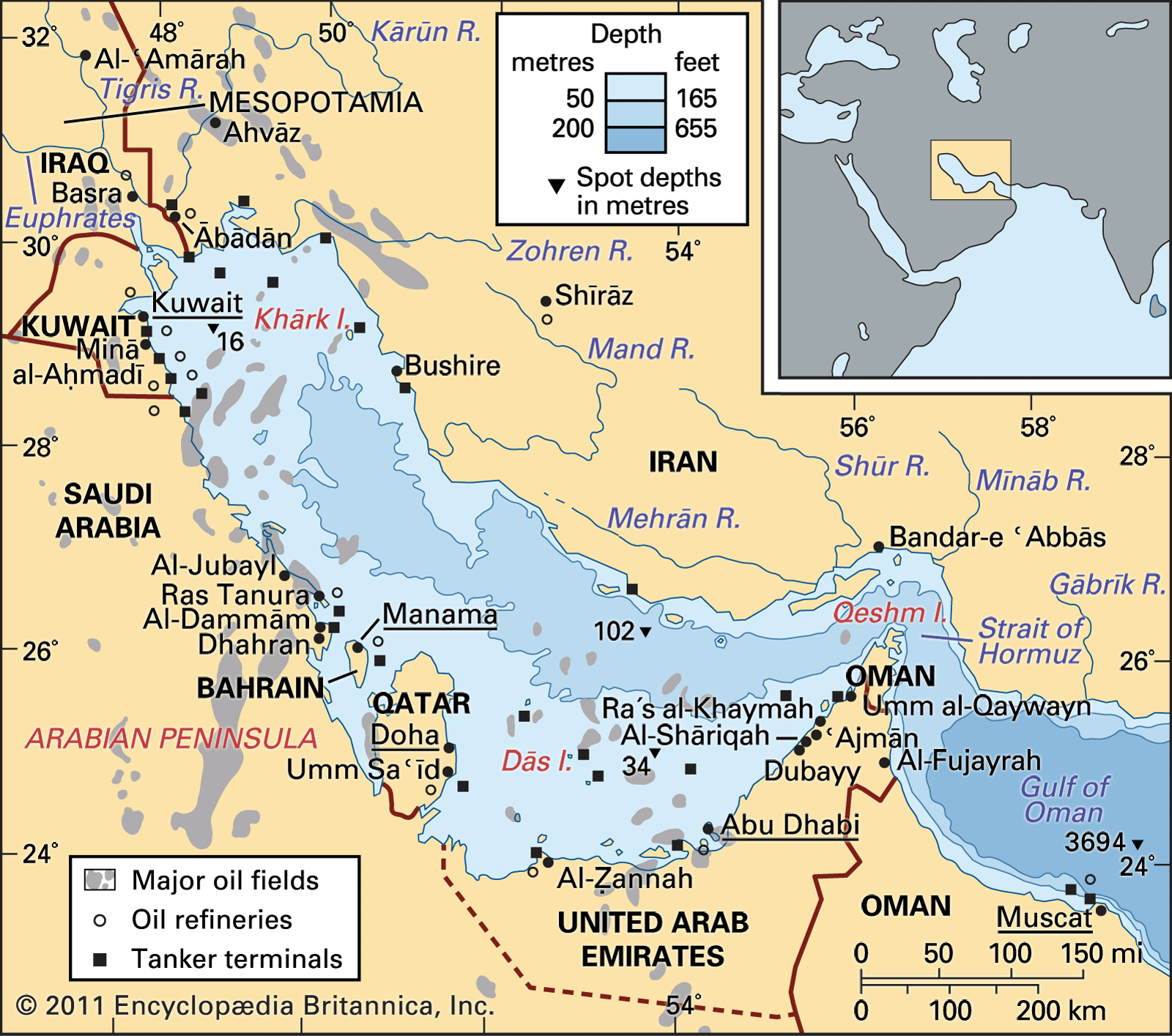
The Persian Gulf. (Encyclopedia Britannica)
No one knows when the war in the Middle East will end. Government leaders continue to give multiple and often contradictory reasons for the attack and the strategic conditions that will end it. One thing is certain, we have a Commander-in-Chief that is unleashed, impulsive, and clueless. In his usual way of setting policy, and expecting it to be taken seriously, Trump set the terms of ending the war via Truth Social. In part he posted, “There will be no deal with Iran except UNCONDITIONAL SURRENDER!” As if they needed more incentive, the Iranians will now fight to the bitter end. There will be no unconditional surrender unless Trump plans to literally kill nearly everyone in the country. As I have stated often in these spaces, wars only end when the loser chooses to end them. No matter how bad things are, they will continue to fight until the attacker goes home or there is a negotiated settlement. There have been no wars settled by unconditional surrender since World War II. As if setting policy via social media was not enough, Trump shows us just how unserious he is by also including in his post “MAKE IRAN GREAT AGAIN (MIGA!).” Because, of course.
Ever the clever one, Karoline Leavitt, Trump’s spokesperson, when asked about what unconditional surrender means said, “When he as Commander-in-Chief determines that Iran no longer poses a threat to the U.S. and the goals of Operation Epic Fury have been fully realized, then Iran will essentially be in a place of unconditional surrender whether they say it or not.” Please see the above paragraph. There will be no unconditional surrender, Trump will just say it and go home claiming victory. Consequences be damned because the Iranians will not accept that as a permanent outcome. When asked by Time magazine reporters whether we should worry about retaliatory terror attacks on our homeland Trump replied, “I guess.” He went on to say “We think about it all the time. We plan for it. But yeah, you know, we expect some things. Like I said, some people will die. When you go to war, some people will die.” Well, that’s good to know.
Trump also claims that he will pick the next leader of Iran. Hubris or ignorance, you decide. Whichever you choose, he is of course fooling himself and trying to hoodwink us, the citizens of the United States in to believing that he somehow is the Master of the Universe. Let us remember that not only did Trump take out the Supreme Leader of Iran, Ayatollah Ali Khamenei was also the spiritual leader for all Shi’ites. Saying that he will pick the next leader is akin to declaring that he will pick the next Pope. There are about 240 million Shia Muslims in the world (the largest sect with about 90% of all Muslims are the Sunni). The largest concentrations of Shi’ites are in Iran (about 68 million people), Iraq and Azerbaijan. There are also significant numbers of Shi’ites in Lebanon, Yemen and Afghanistan. To add to the equation, their leader was killed during Ramadan which takes place during the ninth month of the Islamic calendar, a holy month, and is believed to be the month where the Quran was revealed to the prophet Mohammed. None of them are going to let Trump pick the next leader.
The Washington Post reports that Russia is supplying targeting intelligence to Iran giving them the location of naval vessels, aircraft and other high value assets. The Secretary of the Treasury just announced that in order to keep the flow of oil going to Asia (the main buyers of oil coming through the Strait of Hormuz) the U.S. is issuing a temporary waiver for refiners, mainly in India, to buy Russian oil, which has been embargoed since Russia invaded Ukraine. So, let’s see, the longer the Strait remains closed, the more oil Putin can sell and thus save his nearly collapsed economy. And buy weapons to use against Ukraine. Are we sure Vlad doesn’t have something on his good friend Donnie? Nothing like acting in Putin’s interests to keep the war going while he makes money and helps to target Americans.
Meanwhile the disgraceful buffoon that calls himself the Secretary of Defense continues to strut and dance around while he brags about killing people. On a preview of an upcoming 60 Minutes interview he is asked about Russian involvement and said “we aren’t concerned about that.” He went on to say “the only ones that need to be worried right now are Iranians that think they’re gonna live.” Asked a similar question yesterday by a Fox News reporter Trump responded “What a stupid question that is to be asking at this time.” Such articulate and deep strategic thinkers. Recall that at a press conference this week the Secretary was asked about the American soldiers that were killed. He took the opportunity to berate the media for only reporting on the bad news in order to make Trump look bad. Because, of course, everything has to be about Trump.
One only has to know what the Secretary and the Trump administration think about the war right now is to look at what they are posting on social media. Most of their posts are memes splicing together scenes from video games, war movies and actual combat footage. Here is one example as reported in the Washington Post. “On Thursday, the White House also posted a video overlaying airstrike footage with the lyrics “Kaboom, kablow” from the viral rap song “Bazooka,” and another mixing clips of missile detonations with SpongeBob SquarePants. On Friday, the White House published another video referencing “Grand Theft Auto: San Andreas,” flashing the message “WASTED” — what the game’s players see when they die — atop missile footage showing trucks and people engulfed in flames.”
These are the people speaking for our nation. A school in Iran was bombed and killed dozens of elementary school girls and six Americans were killed in combat and our leaders think it is all a funny game.
Our military professionals are doing their job and doing it well. We pray that they are safe. Our government leaders are not only ignorant about the Middle East and amateurish in the formulation of strategy, but they also care little to nothing about our military men and women or the citizens of these United States.
The Autocrat’s Excuse
Posted: March 5, 2026 Filed under: Uncategorized | Tags: AUMF, Autocracy, Benjamin Netanyahu, Iran, Israel, Middle East, Mohammad Bin Salman, Operation Epic Fury, United States Constitution, War Aims, War Powers Act, World Liberty Financial 1 Comment
“Some of you may die, but it’s a sacrifice I am willing to make!” Lord Farquaad in the animated movie Shrek (2001).
“The lives of courageous American heroes may be lost, and we may have casualties. That often happens in war.” Trump on 28 February announcing the attack on Iran. He later that day held a million dollar a plate dinner at Mar-a-Lago.
As I write, we are in day six of Operation Epstein Files Epic Fury, the U.S. and Israeli attack on Iran. At this point, we still do not know why the war had to start right now and we still do not know the desired end state. As I explained in my post prior to the attack, without a stated end state, no one knows when we have “won”. So far, the Trump administration has posited multiple and often conflicting reasons for the attack and cannot seem to get their story straight. Key leaders such as the Secretary of Defense still talk in tactical terms rather than strategic. They cannot articulate what winning looks like and what the overall goal is for governing in Iran.
Before I go further let me say that Ayatollah Ali Khamenei, the Supreme Leader of Iran, and those that supported his regime while suppressing the aspirations of everyday Iranians was an evil man. I do not defend him or his regime in anyway. They have been bad actors for decades. I also commend our women and men in uniform whose professionalism and expertise has again demonstrated that the U.S. military is the best of the best. Our service members have preformed admirably and courageously.
Neither of those facts, however, justify this attack on Iran.
Why not Russia, China and/or North Korea? Let’s look at the rationale behind the war — and I will return to that momentarily but the Trump administration is calling it a “war.” Comparing the reasons given for attacking Iran and comparing them to our relations with the Bush era defined “Axis of Evil” does not explain why Iran or why now. Stalled negotiations. Check. Might be pursuing a nuclear weapon. Check. Promotes terrorism. Check. Has ballistic missiles that threaten the U.S. and our allies. Check. Everything that Trump and his cabinet say are our reasons for launching the war is the same, or poses an even greater threat from Russia, China, and North Korea. No one is arguing that we attack them. Indeed, Russia’s assault on Ukraine is ongoing after four years and this administration barely acknowledges the atrocities committed by Russians. Russia invaded a democratic Ukraine and all that Trump does is berate the Ukrainian leadership and pester them into giving in to Russian demands. Nothing is asked of Russia.
Maybe we struck Iran because we could and Trump likes to act the part of the tough guy Commander-in-Chief. Or maybe it is because Trump is beholden to Benjamin Netanyahu of Israel and to Mohammed bin Salman al Saud of Saudi Arabia. Netanyahu has been warning for thirty years that Iran was on the brink of obtaining a nuclear weapon “any day”. Maybe Trump believed him, because he certainly did not believe his own intelligence agencies that were telling Trump that there was no imminent threat of Iran developing a nuclear weapon and that they had no means of weaponizing one. It is known that Mohammed (aka MBS) was calling Trump repeatedly over the last month telling him that Iran needed to be taken care of. Let’s speculate a bit. Netanyahu knows how to play Trump like a fiddle and Trump dances. But that may not be enough. It may be just a coincidence but when Trump left office after his first term, Jared Kushner his son-in-law got a two billion dollar investment from the Saudis. The United Arab Emirates (UAE) in the past year bought a 500 million dollar stake in the Trump family crypto venture called World Liberty Financial. Qatar gave Trump — personally, not as president — a luxury Boeing 747 with an estimated worth of 400 million dollars. Oman is working with the Trump family to develop properties in their country. Saudi Arabia is also working with the Trump family on developing real estate such as Trump Tower Jedda and Trump Plaza Riyadh and a 63 billion dollar project in Diriyah. All of these Arab countries have competing interests opposed to Persian Iran. Could that be why we took out Iran? Just asking.
I am not even sure that Trump knows why he ordered the operation. In a press gaggle at the White House he stated that he had a feeling that Iran would attack first so he got the jump on them. He decided instinctively that he should go to war rather than listen to advisers (he doesn’t) or believe the intelligence presented to him (he ignores it). In a way this fits with Secretary of State Marco Rubio’s explanation of why now. It was convoluted as many of his statements are in trying to explain yet another poor decision. He claimed that the the Israelis were going to attack Iran anyway, and since the Iranians were going to respond across the region, then the U.S. had to strike first to stop Iran’s response to an Israeli attack. In other words, Israel can decide when the U.S. goes to war. Speaker of the House “Lil Mikey” Johnson gave the same explanation as did Rubio. Rubio later walked it back but it makes about as much sense as any other explanation the administration has offered.
One would hope that they have some strategic objective in mind as the war is beginning to spread out of the Middle East. A U.S. submarine sank an Iranian warship off the coast of Sri Lanka. Iran sent drones against a British base on Cyprus. The economic consequences are already being felt around the world. Where are we headed?
I am out of the prediction business, but here is what would not surprise me. One day, when it is clear that it is not going to be easy to clean up the mess he made in the Middle East, Trump will wake up and decide it’s over. Stop the fighting, go home and figure out the next country he wants to attack. (Cuba anyone? Earlier this week he raised the prospect of “a friendly take over” of Cuba.) Of course that will leave a huge vacuum in a volatile area of the world. It could leave behind the same conditions that led to the growth of ISIS and al-Qaeda in other areas of the region. It will also not rid us of Iranian meddling. They have a long history, a long memory and a willingness to retaliate on their own time and at a place of their choosing. Terrorism will not go away with a leaderless, devastated Iran. The threat may even increase if we just pack up and leave. So far, it doesn’t appear that he thinks much past day one of anything. Our assault on Venezuela was supposedly to eliminate the Maduro regime. The Maduro regime is still in power, still terrorizing their population and still making themselves rich. Nothing changed except that now Trump has access to Venezuelan oil. I surmise that he cares as much about the Iranian people as he does the Venezuelans or the populations of the other six countries he’s bombed in his second term.
Yesterday in the Senate, and soon in the House, Congress will again abdicate its power and responsibility under the Constitution and give in to the president by failing to pass a resolution under the War Powers Act. The two biggest responsibilities of the Congress are the power to declare war and to control the funding of the government. This Congress has shirked both obligations thus allowing a president that already acts like he can do whatever he wants, to, in fact, do whatever he wants, even starting a needless war. Many people point to the wars in Afghanistan and Iraq as precedents to Trump’s actions. That overlooks the fact that President George W. Bush built a case for war in both areas, went to Congress, explained the need, and acted in concert with the will of the American people at the time. Congress passed Authorization for Use of Military Force (AUMF) acts for Afghanistan and Iraq. One can question whether that was wise and question whether it gave the president too much latitude. The point is, however, that he did consult with and get approval from, the Congress. Trump just ignores them. There is not any “wiggle room” either that this is just a “combat operation” or a “police action” or some other euphemism for “war.” Trump, his cabinet and others have specifically used the word war. I think they like the sound of it. However, contrary to his assertions, there was no imminent threat. He had time to build the case with the American people and to work with our representatives in Congress to justify his actions. He does not think that he has to do that or anything else that he perceives as limiting his power.
When things are going poorly, the aspiring autocrat looks outside of their national borders to create a new enemy and to turn the people’s attention away from what is happening at home.
Long live the king!
 Tom
Tom

Recent Comments