
Amateur Hour Continues
Posted: March 7, 2026 Filed under: Uncategorized | Tags: Ayatollah Ali Khamenei, Iran, Israel, Middle East, Secretary of Defense, Secretary of the Treasury, Shiite, Strait of Hormuz, The Persian Gulf, Trump, Unconditional Surrender, Vladimir Putin, War Aims Leave a comment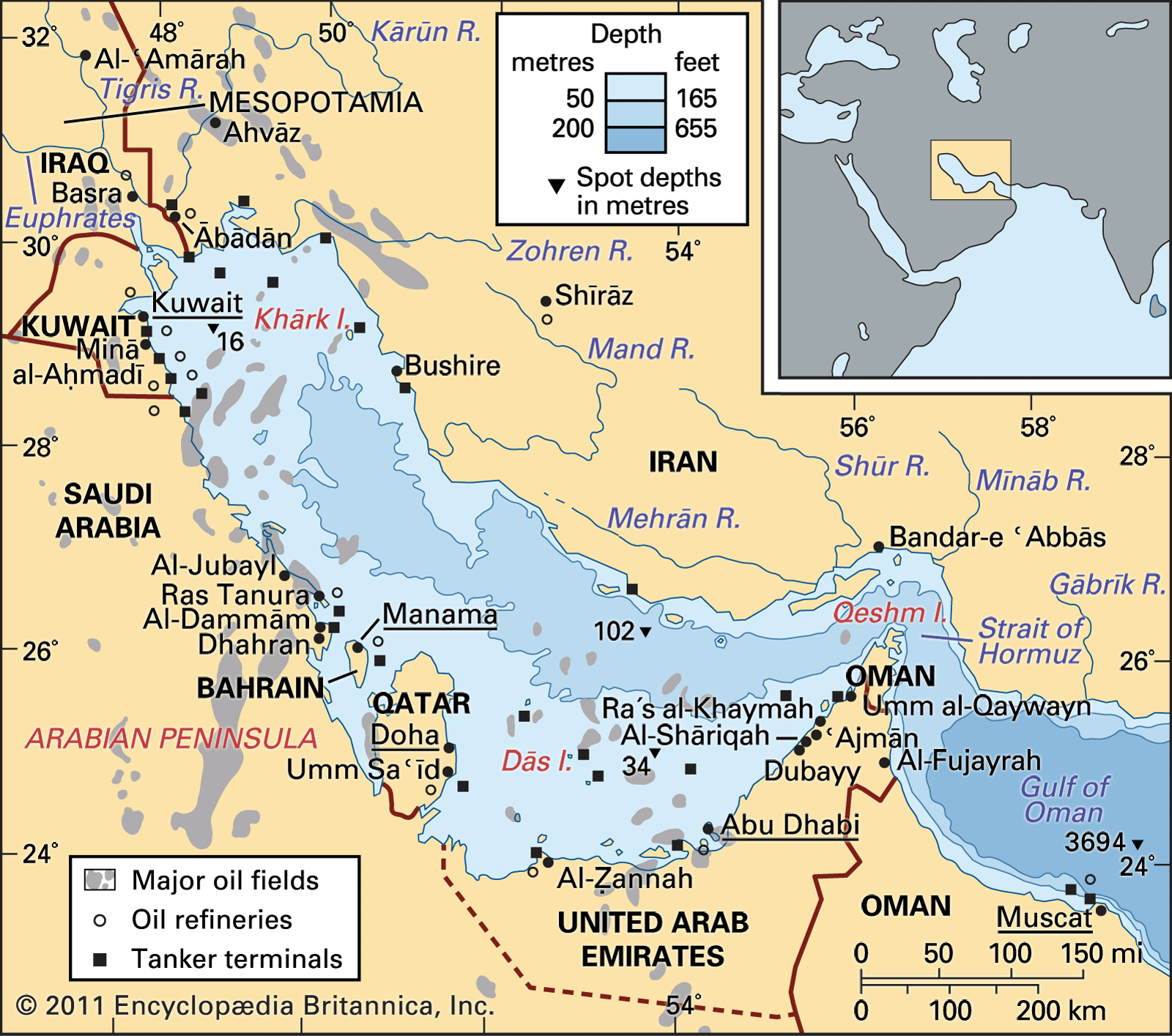
The Persian Gulf. (Encyclopedia Britannica)
No one knows when the war in the Middle East will end. Government leaders continue to give multiple and often contradictory reasons for the attack and the strategic conditions that will end it. One thing is certain, we have a Commander-in-Chief that is unleashed, impulsive, and clueless. In his usual way of setting policy, and expecting it to be taken seriously, Trump set the terms of ending the war via Truth Social. In part he posted, “There will be no deal with Iran except UNCONDITIONAL SURRENDER!” As if they needed more incentive, the Iranians will now fight to the bitter end. There will be no unconditional surrender unless Trump plans to literally kill nearly everyone in the country. As I have stated often in these spaces, wars only end when the loser chooses to end them. No matter how bad things are, they will continue to fight until the attacker goes home or there is a negotiated settlement. There have been no wars settled by unconditional surrender since World War II. As if setting policy via social media was not enough, Trump shows us just how unserious he is by also including in his post “MAKE IRAN GREAT AGAIN (MIGA!).” Because, of course.
Ever the clever one, Karoline Leavitt, Trump’s spokesperson, when asked about what unconditional surrender means said, “When he as Commander-in-Chief determines that Iran no longer poses a threat to the U.S. and the goals of Operation Epic Fury have been fully realized, then Iran will essentially be in a place of unconditional surrender whether they say it or not.” Please see the above paragraph. There will be no unconditional surrender, Trump will just say it and go home claiming victory. Consequences be damned because the Iranians will not accept that as a permanent outcome. When asked by Time magazine reporters whether we should worry about retaliatory terror attacks on our homeland Trump replied, “I guess.” He went on to say “We think about it all the time. We plan for it. But yeah, you know, we expect some things. Like I said, some people will die. When you go to war, some people will die.” Well, that’s good to know.
Trump also claims that he will pick the next leader of Iran. Hubris or ignorance, you decide. Whichever you choose, he is of course fooling himself and trying to hoodwink us, the citizens of the United States in to believing that he somehow is the Master of the Universe. Let us remember that not only did Trump take out the Supreme Leader of Iran, Ayatollah Ali Khamenei was also the spiritual leader for all Shi’ites. Saying that he will pick the next leader is akin to declaring that he will pick the next Pope. There are about 240 million Shia Muslims in the world (the largest sect with about 90% of all Muslims are the Sunni). The largest concentrations of Shi’ites are in Iran (about 68 million people), Iraq and Azerbaijan. There are also significant numbers of Shi’ites in Lebanon, Yemen and Afghanistan. To add to the equation, their leader was killed during Ramadan which takes place during the ninth month of the Islamic calendar, a holy month, and is believed to be the month where the Quran was revealed to the prophet Mohammed. None of them are going to let Trump pick the next leader.
The Washington Post reports that Russia is supplying targeting intelligence to Iran giving them the location of naval vessels, aircraft and other high value assets. The Secretary of the Treasury just announced that in order to keep the flow of oil going to Asia (the main buyers of oil coming through the Strait of Hormuz) the U.S. is issuing a temporary waiver for refiners, mainly in India, to buy Russian oil, which has been embargoed since Russia invaded Ukraine. So, let’s see, the longer the Strait remains closed, the more oil Putin can sell and thus save his nearly collapsed economy. And buy weapons to use against Ukraine. Are we sure Vlad doesn’t have something on his good friend Donnie? Nothing like acting in Putin’s interests to keep the war going while he makes money and helps to target Americans.
Meanwhile the disgraceful buffoon that calls himself the Secretary of Defense continues to strut and dance around while he brags about killing people. On a preview of an upcoming 60 Minutes interview he is asked about Russian involvement and said “we aren’t concerned about that.” He went on to say “the only ones that need to be worried right now are Iranians that think they’re gonna live.” Asked a similar question yesterday by a Fox News reporter Trump responded “What a stupid question that is to be asking at this time.” Such articulate and deep strategic thinkers. Recall that at a press conference this week the Secretary was asked about the American soldiers that were killed. He took the opportunity to berate the media for only reporting on the bad news in order to make Trump look bad. Because, of course, everything has to be about Trump.
One only has to know what the Secretary and the Trump administration think about the war right now is to look at what they are posting on social media. Most of their posts are memes splicing together scenes from video games, war movies and actual combat footage. Here is one example as reported in the Washington Post. “On Thursday, the White House also posted a video overlaying airstrike footage with the lyrics “Kaboom, kablow” from the viral rap song “Bazooka,” and another mixing clips of missile detonations with SpongeBob SquarePants. On Friday, the White House published another video referencing “Grand Theft Auto: San Andreas,” flashing the message “WASTED” — what the game’s players see when they die — atop missile footage showing trucks and people engulfed in flames.”
These are the people speaking for our nation. A school in Iran was bombed and killed dozens of elementary school girls and six Americans were killed in combat and our leaders think it is all a funny game.
Our military professionals are doing their job and doing it well. We pray that they are safe. Our government leaders are not only ignorant about the Middle East and amateurish in the formulation of strategy, but they also care little to nothing about our military men and women or the citizens of these United States.
The Autocrat’s Excuse
Posted: March 5, 2026 Filed under: Uncategorized | Tags: AUMF, Autocracy, Benjamin Netanyahu, Iran, Israel, Middle East, Mohammad Bin Salman, Operation Epic Fury, United States Constitution, War Aims, War Powers Act, World Liberty Financial 1 Comment
“Some of you may die, but it’s a sacrifice I am willing to make!” Lord Farquaad in the animated movie Shrek (2001).
“The lives of courageous American heroes may be lost, and we may have casualties. That often happens in war.” Trump on 28 February announcing the attack on Iran. He later that day held a million dollar a plate dinner at Mar-a-Lago.
As I write, we are in day six of Operation Epstein Files Epic Fury, the U.S. and Israeli attack on Iran. At this point, we still do not know why the war had to start right now and we still do not know the desired end state. As I explained in my post prior to the attack, without a stated end state, no one knows when we have “won”. So far, the Trump administration has posited multiple and often conflicting reasons for the attack and cannot seem to get their story straight. Key leaders such as the Secretary of Defense still talk in tactical terms rather than strategic. They cannot articulate what winning looks like and what the overall goal is for governing in Iran.
Before I go further let me say that Ayatollah Ali Khamenei, the Supreme Leader of Iran, and those that supported his regime while suppressing the aspirations of everyday Iranians was an evil man. I do not defend him or his regime in anyway. They have been bad actors for decades. I also commend our women and men in uniform whose professionalism and expertise has again demonstrated that the U.S. military is the best of the best. Our service members have preformed admirably and courageously.
Neither of those facts, however, justify this attack on Iran.
Why not Russia, China and/or North Korea? Let’s look at the rationale behind the war — and I will return to that momentarily but the Trump administration is calling it a “war.” Comparing the reasons given for attacking Iran and comparing them to our relations with the Bush era defined “Axis of Evil” does not explain why Iran or why now. Stalled negotiations. Check. Might be pursuing a nuclear weapon. Check. Promotes terrorism. Check. Has ballistic missiles that threaten the U.S. and our allies. Check. Everything that Trump and his cabinet say are our reasons for launching the war is the same, or poses an even greater threat from Russia, China, and North Korea. No one is arguing that we attack them. Indeed, Russia’s assault on Ukraine is ongoing after four years and this administration barely acknowledges the atrocities committed by Russians. Russia invaded a democratic Ukraine and all that Trump does is berate the Ukrainian leadership and pester them into giving in to Russian demands. Nothing is asked of Russia.
Maybe we struck Iran because we could and Trump likes to act the part of the tough guy Commander-in-Chief. Or maybe it is because Trump is beholden to Benjamin Netanyahu of Israel and to Mohammed bin Salman al Saud of Saudi Arabia. Netanyahu has been warning for thirty years that Iran was on the brink of obtaining a nuclear weapon “any day”. Maybe Trump believed him, because he certainly did not believe his own intelligence agencies that were telling Trump that there was no imminent threat of Iran developing a nuclear weapon and that they had no means of weaponizing one. It is known that Mohammed (aka MBS) was calling Trump repeatedly over the last month telling him that Iran needed to be taken care of. Let’s speculate a bit. Netanyahu knows how to play Trump like a fiddle and Trump dances. But that may not be enough. It may be just a coincidence but when Trump left office after his first term, Jared Kushner his son-in-law got a two billion dollar investment from the Saudis. The United Arab Emirates (UAE) in the past year bought a 500 million dollar stake in the Trump family crypto venture called World Liberty Financial. Qatar gave Trump — personally, not as president — a luxury Boeing 747 with an estimated worth of 400 million dollars. Oman is working with the Trump family to develop properties in their country. Saudi Arabia is also working with the Trump family on developing real estate such as Trump Tower Jedda and Trump Plaza Riyadh and a 63 billion dollar project in Diriyah. All of these Arab countries have competing interests opposed to Persian Iran. Could that be why we took out Iran? Just asking.
I am not even sure that Trump knows why he ordered the operation. In a press gaggle at the White House he stated that he had a feeling that Iran would attack first so he got the jump on them. He decided instinctively that he should go to war rather than listen to advisers (he doesn’t) or believe the intelligence presented to him (he ignores it). In a way this fits with Secretary of State Marco Rubio’s explanation of why now. It was convoluted as many of his statements are in trying to explain yet another poor decision. He claimed that the the Israelis were going to attack Iran anyway, and since the Iranians were going to respond across the region, then the U.S. had to strike first to stop Iran’s response to an Israeli attack. In other words, Israel can decide when the U.S. goes to war. Speaker of the House “Lil Mikey” Johnson gave the same explanation as did Rubio. Rubio later walked it back but it makes about as much sense as any other explanation the administration has offered.
One would hope that they have some strategic objective in mind as the war is beginning to spread out of the Middle East. A U.S. submarine sank an Iranian warship off the coast of Sri Lanka. Iran sent drones against a British base on Cyprus. The economic consequences are already being felt around the world. Where are we headed?
I am out of the prediction business, but here is what would not surprise me. One day, when it is clear that it is not going to be easy to clean up the mess he made in the Middle East, Trump will wake up and decide it’s over. Stop the fighting, go home and figure out the next country he wants to attack. (Cuba anyone? Earlier this week he raised the prospect of “a friendly take over” of Cuba.) Of course that will leave a huge vacuum in a volatile area of the world. It could leave behind the same conditions that led to the growth of ISIS and al-Qaeda in other areas of the region. It will also not rid us of Iranian meddling. They have a long history, a long memory and a willingness to retaliate on their own time and at a place of their choosing. Terrorism will not go away with a leaderless, devastated Iran. The threat may even increase if we just pack up and leave. So far, it doesn’t appear that he thinks much past day one of anything. Our assault on Venezuela was supposedly to eliminate the Maduro regime. The Maduro regime is still in power, still terrorizing their population and still making themselves rich. Nothing changed except that now Trump has access to Venezuelan oil. I surmise that he cares as much about the Iranian people as he does the Venezuelans or the populations of the other six countries he’s bombed in his second term.
Yesterday in the Senate, and soon in the House, Congress will again abdicate its power and responsibility under the Constitution and give in to the president by failing to pass a resolution under the War Powers Act. The two biggest responsibilities of the Congress are the power to declare war and to control the funding of the government. This Congress has shirked both obligations thus allowing a president that already acts like he can do whatever he wants, to, in fact, do whatever he wants, even starting a needless war. Many people point to the wars in Afghanistan and Iraq as precedents to Trump’s actions. That overlooks the fact that President George W. Bush built a case for war in both areas, went to Congress, explained the need, and acted in concert with the will of the American people at the time. Congress passed Authorization for Use of Military Force (AUMF) acts for Afghanistan and Iraq. One can question whether that was wise and question whether it gave the president too much latitude. The point is, however, that he did consult with and get approval from, the Congress. Trump just ignores them. There is not any “wiggle room” either that this is just a “combat operation” or a “police action” or some other euphemism for “war.” Trump, his cabinet and others have specifically used the word war. I think they like the sound of it. However, contrary to his assertions, there was no imminent threat. He had time to build the case with the American people and to work with our representatives in Congress to justify his actions. He does not think that he has to do that or anything else that he perceives as limiting his power.
When things are going poorly, the aspiring autocrat looks outside of their national borders to create a new enemy and to turn the people’s attention away from what is happening at home.
Long live the king!
Israel – Hamas War
Posted: March 28, 2024 Filed under: Uncategorized | Tags: Gaza, Hamas, Israel, Middle East, news, Palestine, Palestinians, Saudi Arabia, Two State Solution, War, War Aims 2 CommentsThe war between Israel and Hamas rages on as it passes the six month mark. Starting with the horrific and brutal attack into Israel on 7 October 2023, it has been a ferocious conflict. Now is the time to assess the policies involved and to reevaluate what Israeli war aims may be.
In so doing, two underlying assertions are necessary. First, Israel had and continues to have, every right to defend itself and to respond to the terrible attack that killed over 1200 innocent Israelis in October in order to preclude future attacks. Second, criticism of Israel’s government or Prime Minister Benjamin Netanyahu’s policies are not in themselves anti-Semitic, just as criticizing President Biden’s policies does not make anyone anti-American.
As the war continues with much of Gaza destroyed and approximately 1.7 million Palestinians displaced, no clear war aims have been articulated by Prime Minister Netanyahu. As announced to date, their goals are the destruction of Hamas, the infrastructure supporting their rule and terrorist activities, and the release of the hostages. These are not political solutions. Killing every member of Hamas is not possible. Indeed one could argue that current Israeli actions in Gaza are only ensuring another generation of pro-Hamas fighters, or at least anti-Israeli fighters. The only way to ensure that every member of Hamas is eliminated is to kill every male over the age of twelve.
Hamas war aims are simple and are the mirror image of Israel’s. Kill every Israeli and destroy the Israeli state. They have no means to achieve their war aims. Israel does.
Israeli Defense Force (IDF) spokesmen claim that they have “dismantled” twenty of the estimated twenty four Hamas battalions in Gaza. Assuming this is true, dismantled is not the same as eliminated. The command and control function of the organization is clearly degraded, if not destroyed, but guerrilla operations can continue indefinitely with groups of four or five fighters using hit and run tactics. From a fighting perspective, as I have explained in other, earlier posts, the loser decides when the war is over. If the enemy does not stop fighting, then the war continues, even if by conventional standards one side “won.” The IDF does not give detailed information on troop movements but has said that only two divisions of the IDF remain in Gaza, down from the original five that attacked into Gaza at the war’s start. All of the reserve units are said to have stood down and gone home — partly because those forces are no longer needed and partly because the economy of Israel was suffering with so many workers away from their jobs. A casual look at the situation in Gaza today indicates that the Israelis have won, but yet the war continues.
Indeed, Prime Minister Netanyahu plans on expanding the war by attacking Rafah, a city in the south of Gaza that is the primary location of the displaced Gazans from the north, especially from Gaza City, which will be discussed further below.
Although IDF troops on the ground are significantly fewer, air operations continue at a heavy rate. Bombs and drone strikes are a part of life in Gaza every day. Exact numbers of casualties are difficult to confirm as the IDF does not supply certified numbers of either their own or Palestinian losses and the Gaza Health Ministry — the source providing the number of Palestinian casualties — cannot be fully relied upon. That said, the international consensus is that over 32,000 Palestinians have died so far in the war with roughly 100,000 wounded, mostly civilians. There does not seem to be much consideration for collateral damage (civilians killed or wounded) in the indiscriminate bombing of areas such as Gaza City. The IDF is a modern, well-equipped, well-trained force. In the early stages of the war perhaps it was necessary to destroy civilian infrastructure to attack the Hamas infrastructure, especially Hamas tunnels that are said by the IDF to run for 350 to 450 miles under Gaza, using schools, mosques and other civilian structures as nodes. The current situation appears to preclude the need for mass bombings as a means to their ends and more pinpoint targeting could reduce the number of civilian casualties. So far, that does not seem to be happening, raising concerns in the U.S. and elsewhere that the Israelis are not just hunting down Hamas, but that they are punishing Palestinians in Gaza for “allowing” Hamas to carry out its terrorist attacks. Such indiscriminate attacks also calls into question the status of Israeli hostages in Gaza. Mass bombing puts the hostages in danger. One stated war aim is to recover all of the remaining 134 hostages (some of whom are known to already be dead), and yet only two have been rescued by the IDF. Three hostages escaped and tried to surrender to the IDF but were shot and killed while approaching IDF positions. (An additional 105 hostages were released in a prisoner exchange last November, four were unilaterally released by Hamas.) Are the hostages also collateral damage?
Prime Minister Netanyahu publicly stated that the IDF was preparing to attack Rafah, on the Egyptian border, to eliminate remaining Hamas forces. Rafah has 1.4 million Palestinians living there, many are refugees from the north living in dire circumstances in tents. The U.S. position is that Israel cannot attack Rafah without creating an even greater humanitarian crisis and any military operations must wait until a plan is put forward as to what to do about the people living there. Recently, Mr. Netanyahu agreed to send members of his government to Washington D.C. to explain the plan to the U.S. (That trip was canceled over a disagreement about U.S. votes in the U.N. Security Council calling for a cease fire, but it was just announced that now the trip is back on.) The seeming disregard for the plight of the Palestinians is the source of a growing rift between the U.S. and Israel and the cause for the growing number of protests around the U.S. in support of the Palestinians. (Unfortunately, there are protesters that are ignorant of the situation in the Middle East, its complications, and the fact that Hamas started the war. Sadly, there are also some folks that are just plain bigots.)
Israel has every right to root out Hamas to ensure the survival of Israel and to protect its citizens from further terrorist attacks. The issue is more a question of how it should be done. As a democracy concerned with human rights and as a full citizen of the international community, Israel must also consider the plight of the innocent children, women and men that are not members or supporters of Hamas but are suffering greatly from a lack of shelter, food, potable water and medicine. That should be part of their plan as well. To date, it is not, other than to allow some (too few) aid trucks into the Gaza strip as well as some air dropped supplies, also ineffective compared to what is required.
There is a growing rift between the Israeli and U.S. governments that I do not find surprising. Israel absolutely depends on U.S. political and military support. Much of their military equipment and ammunition comes from America. U.S. policy since President Truman is to support Israel and that policy of support has only grown stronger with time. That does not mean, contrary to some opinions, that Israel is a puppet or client state of the U.S. Our leaders do try to influence Israeli leaders but in the end, Israel is going to do whatever they want to do, whether or not it coincides with U.S. policy. Some of their decisions actually run counter to U.S. desires and can in certain circumstances actually hurt U.S. interests. Period. Blaming the Biden Administration or any other entity for what Israel is doing in Gaza and calling for them to stop it is not realistic. They are going to do whatever they want. As a result, some in government believe that we support Israel to a fault — arguing that support to Israel is critical, but not when it also undermines our own national interests.
Complicating the political elements of this crisis is that Prime Minister Netanyahu heads a far right government with members of his cabinet pushing for total Israeli control of Gaza and the West Bank — where even as the war in Gaza continues Israelis are settling in and pushing Palestinians out. Mr. Netanyahu will seemingly do anything to satisfy his far right coalition and thus remain in power. Prior to the outbreak of war, many Israelis were openly protesting his policies as being too extreme. His support throughout the population was rapidly eroding. Mr. Netanyahu also faces probable criminal indictments when he leaves office — an incentive to stay. Israelis will support him while the war continues, but it is widely expected that when elections are finally held, he will be voted out of office. If one were cynical, it could be that the war is good for Mr. Netanyahu’s personal fortunes.
So back to the original question. What are Israel’s war objectives? Put in other terms, what is the desired end state of the war? What does the solution look like?
The answer is nearly universal in the international community. The only way to reach a safe and secure status quo for both Palestine and Israel is a two state solution. A safe and secure Israeli state and a safe and secure Palestinian state encompassing Gaza and the West Bank. It will take years, billions of dollars and a lot of finesse to reach that point, but in the end, the U.S., Europe and much of the rest of the world see it as the only way to achieve a permanent. long term solution.
Prime Minister Netanyahu and his coalition right wing ultra-nationalist government roundly reject a two state solution.
On one level, it is understandable that Israelis would be skeptical that having a stable, sustainable, productive Palestinian neighbor would ever be achievable. Decades of experience tell them otherwise. On another level, those right wing ultra-nationalists in his government see Gaza and the West Bank as ripe for Israeli expansion and settlement. To them, the only way to secure the area is to occupy it themselves. While Mr. Netanyahu has not stated such an intent, he has indicated that Israeli forces will be in Gaza for some time to come. No other long term end state or political solution has come forward from his government. Israel may be in Gaza for years to come. The question is whether or not they put settlers there and turn it into a de facto Israeli satellite as they are doing in the West Bank. First, where do the Gazans go? Secondly, such a move would likely break U.S. and European unqualified support for Israel. Not abandonment, but it will cause a significant strain on our relationship and it will be irrevocably altered.
The Biden Administration in conjunction with our friends and allies has been working hard over these last months to resolve the long term tensions in the region. Many nations are willing to help to rebuild Gaza and to promote stability. Most importantly, there are increasing indications that Gulf Arab states along with Saudi Arabia are willing to step up to provide the money needed to rebuild and to support a new (as yet undefined) Palestinian government to replace the current Palestinian Authority that nominally holds power but has no practical way to govern. To get the Arab states actively involved in a peaceful solution will be a game changer.
Now is the time to lock it all in. A coalition of the willing can be put together to rebuild Gaza, provide security against a resurgent Hamas and provide increased security for all involved. It could be the dawn of a new age in the region. It could mean a new relationship between Israel and its neighbors. Israel could find itself allied with Saudi Arabia as a counter to block Iranian adventurism. There are lots of possibilities that would have been inconceivable in the recent past.
It will take years of patient negotiations and small, confidence building steps. It will take billions of dollars. It will not be easy as there are many bad actors that prefer the chaos and bitter conflict. None-the-less, it is in everyone’s best interest to try.
The Intractable Middle East
Posted: November 6, 2023 Filed under: Uncategorized | Tags: Hamas, Hezbollah, Israel, Palestine, Two State Solution, War Aims 1 CommentIt is over four weeks since the horrific Hamas terrorist attack in Israel that left approximately 1400 people brutally murdered and about 240 taken hostage. Since then, the Israeli military has relentlessly bombed the Gaza strip and sent tanks and troops into that bit of land sandwiched between Israel, Egypt and the Mediterranean Sea. The Health Ministry in Gaza reports that over 10,000 Palestinians, including over 4,000 children have been killed in the bombings, a figure that cannot be independently verified as Hamas controls the ministry. Regardless, an awful lot of people are dying in Gaza.
It is clear that this is a nasty situation for lots of people. What is not clear is how it will all end. Without a doubt, Israel has the absolute right to eliminate the existential threat posed by Hamas to the very existence of a Jewish state. Hamas claims that they will not stop until Israel is eliminated from the face of the Earth and all Jews are “exterminated.” No country should support such a goal in any way shape or form. Likewise, the government of Israel states that they will not stop until they have done the exact same thing to Hamas. Given that both war aims are unrealistic, and that Israel is clearly the superior military entity and suffered an unforgiveable attack, what is their desired end state after all is said and done? What are Israel’s practical war aims? Furthermore, how does Israel attain its war aims without killing thousands of innocent Palestinians? The one thing to know about the Middle East, when behind closed doors, is that the Israelis do not care about the Palestinians, Hamas does not care about the Palestinians and the vast majority of Arab countries do not care about the Palestinians — they are merely pawns to achieve other national aims. To put it in different terms, if there was a caste system in the Middle East, Palestinians would be the untouchables.
Without having access to the Israeli war plans, there is no way of knowing what their specific goals are, but it is possible to surmise their intentions. In any operational or strategic military undertaking, the key element is to clearly define the mission — why do what you are doing? What are you trying to achieve? The Israeli’s stated goal is to kill every Hamas terrorist. But why? That is not an end state. It is one of their means to achieve it. Their real goal is to secure their own national security. To achieve that they want to eliminate Hamas as an effective organization and to stabilize Gaza by installing a governing entity that can stand up to the terrorists while promoting economic and social progress. The only way that Israel can feel that the threat from Gaza is eliminated is when they can peacefully co-exist. Is this a unicorns and rainbows solution? Possibly. But it doesn’t change the reality that the citizens of Israel can never truly feel safe until there is peaceful coexistence. That is the essence of long-standing U.S. and international policy striving for a two-state solution — a Palestinian state that is recognized and treated as an autonomous nation alongside a partner in Israel.
There is real danger in the situation as it exists today. Several factors are at play. First, as we all see in the daily headlines, the Israelis are pursuing Hamas by any means necessary. While they have every right to fully and forcefully fight the terrorists, how a nation does so is as important. It is not clear whether the Israeli government is taking the long view or merely the most expedient. That there will be “collateral damage” (a horrible term for civilian casualties) in a military operation in densely populated areas is perhaps unavoidable. However, whole scale bombing of cities where innocent civilians are trapped undermines Israel’s standing and support in the international community. The counter argument is that Hamas built hundreds of miles of tunnels under the cities using hospitals, schools and people’s homes to hide their existence and to try to provide a shield. To eliminate the terrorists in those tunnels in a slow, drawn out, yard by yard fight under the ground would likely result in unacceptable Israeli losses. However, there are other ways to seal off those tunnels using other means or by sending unmanned platforms in to kill the terrorists. Significant intelligence assets exist to pinpoint key areas to target rather than the elimination of all possible tunnel systems by using “bunker busters” that destroy everything in their blast radius. Other classified procedures are possible as well. The point is that indiscriminate bombing, resulting in ten thousand civilian casualties, does not really meet Israeli war aims. If their security hinges on peaceful coexistence, then radicalizing new generations of Palestinians which end up joining the terrorists does not help them achieve it.
Further expansion of the conflict is another real danger. Iranian surrogates are stirring up trouble in southern Lebanon where Hezbollah leader Sayyed Hassan Nasrallah claims to have 100,000 well armed fighters at his disposal, far more than Hamas. (Independent analysts say it is more likely 20,000 to 50,000 fighters, still far more than in Gaza.) Other terrorist groups have attacked U.S. forces in Iraq and Syria. The West Bank is a powder keg ready to explode as the expansion of Israeli settlements under the policies of Prime Minister Benjamin Netanyahu continue to exacerbate tensions. Israel can ill afford to fight a simultaneous three front war. The U.S. deployed significant air and naval forces to the region to reinforce our commitment to Israel’s national security and to protect our own interests in the region by deterring other bad actors from taking advantage of the situation.
The solution is a long way off. It seems that Israel is totally focused on the short term goal of killing terrorists. U.S. shuttle diplomacy by President Joe Biden and Secretary of State Antony Blinken is focused on containing the situation geographically, procuring the release of over 200 hostages, getting humanitarian aid into Gaza, and constructing the outlines of a long term political, diplomatic and economic solution. It is a difficult job, especially when our own domestic political games in the House of Representatives are hindering our ability to provide aid to Israel. Meanwhile, the war in Ukraine is relegated to the back pages of the newspapers while MAGA Republicans want to stop providing them aid in their fight to survive Russian annihilation. It’s a tough world.
The most likely long term solution is for the Palestinian Authority (PA), the nominal government of the West Bank, to assert control over Gaza. The PA will not be able to do so on its own. A combined Arab military mission into Gaza under the auspices of the United Nations seems to be the best solution to stabilize conditions for a gradual reconstitution of the Gaza strip. In the short term, it is unlikely that the Arab world would agree to participate (see paragraph two above). Under further international pressure and without any other solution in sight, it is possible.
Israel is going to do what it feels it must. Despite outside perceptions, the Israelis listen to the U.S. but in the end they do what they want to do, regardless. Given their history, it is understandable, even if sometimes it hurts them in the long run. To conflate Israeli actions in Gaza as being a reaction to, or an attempt to confound the desire for an independent Palestinian state is wrong. Israel was brutally attacked by evil terrorists. They are responding. End of that discussion. Open to debate is how they are responding and whether the two-state solution could lead to a more stable region where people of different religions live in peace.
The anti-Semitic attacks, allegedly in support of the Palestinians, breaking out across the U.S. and elsewhere are dangerous and shameful. It does not help the Palestinian cause. When one only gets information from Instagram and X, it is impossible to understand the complexities of this situation. Emotions overwhelm reason and logic. It does not help the Palestinians or anyone else. It does give great joy to the Chinese and Russian troll farms that want to destroy our country from within.
Only long term diplomatic, political and economic policies are going to resolve this crisis. In the short term, lots of people are going to die or suffer. Israel must defend itself. International organizations need to continue to work to get aid to innocent Palestinians. Neither one is easy.
 Tom
Tom Into The Fray
Recent Comments