
The Autocrat’s Excuse
Posted: March 5, 2026 Filed under: Uncategorized | Tags: AUMF, Autocracy, Benjamin Netanyahu, Iran, Israel, Middle East, Mohammad Bin Salman, Operation Epic Fury, United States Constitution, War Aims, War Powers Act, World Liberty Financial 1 Comment
“Some of you may die, but it’s a sacrifice I am willing to make!” Lord Farquaad in the animated movie Shrek (2001).
“The lives of courageous American heroes may be lost, and we may have casualties. That often happens in war.” Trump on 28 February announcing the attack on Iran. He later that day held a million dollar a plate dinner at Mar-a-Lago.
As I write, we are in day six of Operation Epstein Files Epic Fury, the U.S. and Israeli attack on Iran. At this point, we still do not know why the war had to start right now and we still do not know the desired end state. As I explained in my post prior to the attack, without a stated end state, no one knows when we have “won”. So far, the Trump administration has posited multiple and often conflicting reasons for the attack and cannot seem to get their story straight. Key leaders such as the Secretary of Defense still talk in tactical terms rather than strategic. They cannot articulate what winning looks like and what the overall goal is for governing in Iran.
Before I go further let me say that Ayatollah Ali Khamenei, the Supreme Leader of Iran, and those that supported his regime while suppressing the aspirations of everyday Iranians was an evil man. I do not defend him or his regime in anyway. They have been bad actors for decades. I also commend our women and men in uniform whose professionalism and expertise has again demonstrated that the U.S. military is the best of the best. Our service members have preformed admirably and courageously.
Neither of those facts, however, justify this attack on Iran.
Why not Russia, China and/or North Korea? Let’s look at the rationale behind the war — and I will return to that momentarily but the Trump administration is calling it a “war.” Comparing the reasons given for attacking Iran and comparing them to our relations with the Bush era defined “Axis of Evil” does not explain why Iran or why now. Stalled negotiations. Check. Might be pursuing a nuclear weapon. Check. Promotes terrorism. Check. Has ballistic missiles that threaten the U.S. and our allies. Check. Everything that Trump and his cabinet say are our reasons for launching the war is the same, or poses an even greater threat from Russia, China, and North Korea. No one is arguing that we attack them. Indeed, Russia’s assault on Ukraine is ongoing after four years and this administration barely acknowledges the atrocities committed by Russians. Russia invaded a democratic Ukraine and all that Trump does is berate the Ukrainian leadership and pester them into giving in to Russian demands. Nothing is asked of Russia.
Maybe we struck Iran because we could and Trump likes to act the part of the tough guy Commander-in-Chief. Or maybe it is because Trump is beholden to Benjamin Netanyahu of Israel and to Mohammed bin Salman al Saud of Saudi Arabia. Netanyahu has been warning for thirty years that Iran was on the brink of obtaining a nuclear weapon “any day”. Maybe Trump believed him, because he certainly did not believe his own intelligence agencies that were telling Trump that there was no imminent threat of Iran developing a nuclear weapon and that they had no means of weaponizing one. It is known that Mohammed (aka MBS) was calling Trump repeatedly over the last month telling him that Iran needed to be taken care of. Let’s speculate a bit. Netanyahu knows how to play Trump like a fiddle and Trump dances. But that may not be enough. It may be just a coincidence but when Trump left office after his first term, Jared Kushner his son-in-law got a two billion dollar investment from the Saudis. The United Arab Emirates (UAE) in the past year bought a 500 million dollar stake in the Trump family crypto venture called World Liberty Financial. Qatar gave Trump — personally, not as president — a luxury Boeing 747 with an estimated worth of 400 million dollars. Oman is working with the Trump family to develop properties in their country. Saudi Arabia is also working with the Trump family on developing real estate such as Trump Tower Jedda and Trump Plaza Riyadh and a 63 billion dollar project in Diriyah. All of these Arab countries have competing interests opposed to Persian Iran. Could that be why we took out Iran? Just asking.
I am not even sure that Trump knows why he ordered the operation. In a press gaggle at the White House he stated that he had a feeling that Iran would attack first so he got the jump on them. He decided instinctively that he should go to war rather than listen to advisers (he doesn’t) or believe the intelligence presented to him (he ignores it). In a way this fits with Secretary of State Marco Rubio’s explanation of why now. It was convoluted as many of his statements are in trying to explain yet another poor decision. He claimed that the the Israelis were going to attack Iran anyway, and since the Iranians were going to respond across the region, then the U.S. had to strike first to stop Iran’s response to an Israeli attack. In other words, Israel can decide when the U.S. goes to war. Speaker of the House “Lil Mikey” Johnson gave the same explanation as did Rubio. Rubio later walked it back but it makes about as much sense as any other explanation the administration has offered.
One would hope that they have some strategic objective in mind as the war is beginning to spread out of the Middle East. A U.S. submarine sank an Iranian warship off the coast of Sri Lanka. Iran sent drones against a British base on Cyprus. The economic consequences are already being felt around the world. Where are we headed?
I am out of the prediction business, but here is what would not surprise me. One day, when it is clear that it is not going to be easy to clean up the mess he made in the Middle East, Trump will wake up and decide it’s over. Stop the fighting, go home and figure out the next country he wants to attack. (Cuba anyone? Earlier this week he raised the prospect of “a friendly take over” of Cuba.) Of course that will leave a huge vacuum in a volatile area of the world. It could leave behind the same conditions that led to the growth of ISIS and al-Qaeda in other areas of the region. It will also not rid us of Iranian meddling. They have a long history, a long memory and a willingness to retaliate on their own time and at a place of their choosing. Terrorism will not go away with a leaderless, devastated Iran. The threat may even increase if we just pack up and leave. So far, it doesn’t appear that he thinks much past day one of anything. Our assault on Venezuela was supposedly to eliminate the Maduro regime. The Maduro regime is still in power, still terrorizing their population and still making themselves rich. Nothing changed except that now Trump has access to Venezuelan oil. I surmise that he cares as much about the Iranian people as he does the Venezuelans or the populations of the other six countries he’s bombed in his second term.
Yesterday in the Senate, and soon in the House, Congress will again abdicate its power and responsibility under the Constitution and give in to the president by failing to pass a resolution under the War Powers Act. The two biggest responsibilities of the Congress are the power to declare war and to control the funding of the government. This Congress has shirked both obligations thus allowing a president that already acts like he can do whatever he wants, to, in fact, do whatever he wants, even starting a needless war. Many people point to the wars in Afghanistan and Iraq as precedents to Trump’s actions. That overlooks the fact that President George W. Bush built a case for war in both areas, went to Congress, explained the need, and acted in concert with the will of the American people at the time. Congress passed Authorization for Use of Military Force (AUMF) acts for Afghanistan and Iraq. One can question whether that was wise and question whether it gave the president too much latitude. The point is, however, that he did consult with and get approval from, the Congress. Trump just ignores them. There is not any “wiggle room” either that this is just a “combat operation” or a “police action” or some other euphemism for “war.” Trump, his cabinet and others have specifically used the word war. I think they like the sound of it. However, contrary to his assertions, there was no imminent threat. He had time to build the case with the American people and to work with our representatives in Congress to justify his actions. He does not think that he has to do that or anything else that he perceives as limiting his power.
When things are going poorly, the aspiring autocrat looks outside of their national borders to create a new enemy and to turn the people’s attention away from what is happening at home.
Long live the king!
Wag The Dog
Posted: February 25, 2026 Filed under: Uncategorized | Tags: Aircraft Carriers, Ballistic Missile Defense, Iran, Iran Nuclear Deal, IRGC, Israel, Middle East, State of the Union, Strait of Hormuz, The Epstein Files, War Powers Act 1 Comment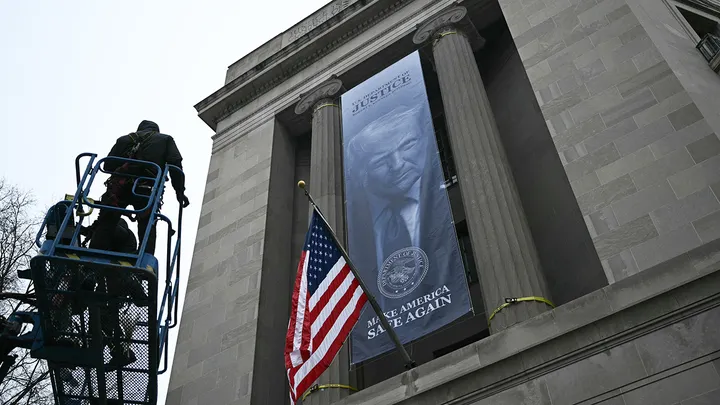
On 19 February 2026, a banner displaying the face of Trump and a slogan appeared over the entrance to the Department of Justice (DOJ) building in Washington D.C. It appears that he is emulating his good friend Kim Jong Un. “Big Brother is watching you.” (Picture from Brendan Smialowski for Getty Images)
The president that campaigned on putting America first and criticized his predecessors for their military involvement around the world is preparing to use the military for the second time against Iran. So far, in the first year of his second term he has used military force in seven countries and threatened it in two more. The House of Representatives and the Senate have yet to approve any of his military actions despite the fact that Article I Section 8 of the U.S. Constitution gives Congress the exclusive power to declare war. The War Powers Act of 1973 requires the president to notify Congress within 48 hours of deploying troops and limits their involvement to 60 days unless approved for longer by Congress. Trump refuses to meet even that bare minimum.
Trump thought he could bully the Iranians by massing the most combat power in the region since 2003 during the Second Gulf War. The Iranians have other ideas. Trump wants total elimination of their ability to stockpile “nuclear fuel” and they say it is for domestic power generation. Obama had a deal limiting the Iranians’ ability to process uranium which included on site inspections. Trump tore up that agreement in 2018 and is now asking for essentially the same thing as was previously settled. As always, he creates a problem, returns to the status quo ante, and then claims that he solved a crisis. Why would the Iranians or any other country trust anything that he promises?
Indeed, the U.K. (in particular Diego Garcia in the Indian Ocean), the UAE, and Saudi Arabia refuse to allow the U.S. to launch attacks from their countries against Iran. Others, such as Qatar, Egypt and other Middle East countries are extremely hesitant to allow it. Some are refusing to allow US military aircraft to fly over their territory which makes for some very long flights to reach targets in Iran.
This will not be Venezuela. Iranian air defenses are in disarray following last year’s attack on their nuclear facilities, but they still have a strong military capability.
The first step in military planning is to determine the desired end state. What do we want to see happen? How do we know we won and can go home? Everything else flows from that. So far the Trump regime has been unable to articulate their specific goals in attacking Iran. In recent weeks they have been all over the map as to what they intend to accomplish. Last night’s State Of The Union address to Congress would have been the logical opportunity to explain to the American public why we are going to send our sons and daughters, husbands and wives into harms way. He barely mentioned Iran and then in only very vague terms.
Therefore the mission is not clear to me and without a clear mission, it is difficult to plan. Is it to knock out all nuclear capabilities? Supposedly, we already did that. Special Envoy Steve Witkoff, Trump’s primary international negotiator for everything (Calling Marco Rubio! Anyone seen the Secretary of State actually doing anything having to do with diplomacy?) said last week that “they’re probably a week away from having industrial-grade bomb-making material. And that’s really dangerous. So they can’t have that.” Where that analysis came from, no one knows. Trump himself continues to say that last year’s bombing attack on Iran by the U.S. and Israel “totally obliterated” all of their capabilities. Additionally, it is known that the Iranians currently have no weapons program to build a delivery system for a nuclear weapon even if they wanted to make one.
Is the mission to knock out the Iranians ballistic missile capability? Their missiles certainly pose a threat to our friends and allies in the region. However, it would be next to impossible to destroy all of their missile capability in one attack. It could only be done through a sustained campaign. The missiles are stationed all around the country and some are mobile. During the course of our campaign the Iranians could use them to retaliate against U.S. bases in the region or to attack infrastructure valuable to our friends in the area. Last summer they launched missiles against our base in Qatar in retaliation, however they provided advanced warning and precautions were taken to limit their impact. There is no guarantee the Iranians would only go for a face saving measure the second time around.
Is the mission regime change? Trump continually talks about knocking out Iran’s Supreme Leader Ayatollah Ali Khamenei. Sometimes he talks about destroying the Iranian Revolutionary Guard Corps (IRGC), the roughly 175,000 member branch of their Armed Forces that protect the regime and that is the real power supporting the Ayatollah in the country. To attempt that would result in a very long campaign, the kind of “forever war” that Trump swore he would never instigate. As we learned the hard way in Iraq and elsewhere, the people may want a change in leadership, but they do not want it replaced by the U.S. We are not “liberators” in their eyes, we are invaders.
How will we accomplish any of those potential missions? With an air campaign only? Sending troops into the country? Iran is a very large land mass with rugged terrain. It has a large and diverse population. Any ground attacks would be very costly in lives and treasure. Whatever the reasons or methods — and the president should explain why it is suddenly necessary to do something we have not seriously contemplated for decades — there is always the danger of planes getting shot down, or having mechanical issues or a dozen other things that could go wrong resulting in the death or capture of Americans. “Just because” is not good enough.
As it stands now, our aims are not clear and we should never commit military force when we do not know what we want them to do. Reports from several reputable news organizations indicate that senior military officers in the Pentagon are reluctant to use force against Iran. They understand that it will be no easy task. In retaliation Iran will create mischief (terrorism and missile attacks) in the region. They will try to close the Strait of Hormuz through which twenty percent of the world’s oil flows on ships. (Oil is a fungible commodity with a world-wide market so the impact on the price of oil will be felt everywhere.)
There are other human and practical costs. One of the carriers on its way to the region is the USS Gerald R Ford (CVN-78) — the other one now on station is the USS Abraham Lincoln (CVN-72) – which has been deployed for eight months already, much longer than the traditional six month deployment. The Ford is the same carrier that was pulled away from the Mediterranean Sea last fall to go to the Caribbean Sea, and now it is back to where it started without going home. It is a practical matter that people can only be stretched so far — not to mention the impact on their families — and maintenance on ship systems and aircraft can only be postponed for a limited time before things start to break. Additionally, our military is running low on certain types of ammunition. Missiles cannot be built in a day, a week, or a month. Think in terms of years to rebuild the stockpiles. Some we have given to Ukraine and Israel. A lot is expended to shoot down drones and ballistic missiles, especially in the Red Sea, that are constantly being fired by the Houthis in Yemen, which are themselves proxies for Iran. Surface to air missiles on the ships and those utilized by Army forces throughout the region such as Terminal High Altitude Air Defense (THAAD) and Patriot ballistic missile defense systems are in short supply. Similarly, we have a finite number of Tomahawk surface to surface missiles.
There may be another reason that Trump is threatening Iran. Despite his best efforts, he cannot make questions concerning the Epstein files go away. The net is getting ever wider and coming closer to him each day. The Epstein Files are not going away. They are like his shadow. They follow him everywhere and he cannot get away from them. When the king’s brother gets arrested, along with the British Ambassador to the U.S. he knows more fallout is coming. He is getting desperate to distract and turn our attention elsewhere. Iran anyone?
Peace Or No Peace?
Posted: June 25, 2025 Filed under: Uncategorized | Tags: B-2 Bombers, Battle Damage Assessment, Congress, Defense Intelligence Agency, IAEA, Iran, Israel, Middle East, Politics, US Intelligence Community, War Powers Act 1 CommentIn many situations, two things can be true at the same time. Looking at the events unfolding over the last two weeks in the Middle East demonstrates how this premise applies.
Last Saturday, the United States bombed three locations in Iran that were known to be associated with Iran’s nuclear weapons program. The ability to strike with lethality and accuracy anywhere in the world was aptly demonstrated by the attacks on Fordo, Natanz, and Isfahan in Iran. 125 military aircraft were involved including refueling tankers, escort fighters and seven B-2 stealth bombers that dropped fourteen GBU-57 Massive Ordnance Penetrators (MOP) or “bunker busters” on targets. At the same time, U.S. Navy submarines launched about thirty precision guided Tomahawk missiles at Isfahan. No aircraft were lost. No Americans were killed or wounded. By every standard, there is no doubt that the American military pulled off a wildly successful surprise attack on their assigned targets. We should all be proud of their skill, persistence, fortitude and valor. It was a tactical success in every way. However, was the mission accomplished? Were the Iranian nuclear facilities destroyed and their nuclear weapons program halted or at least delayed for many years?
We do not know.
The president announced within hours of the attack that the Iranian facilities were “obliterated.” There is no way he could know that. Many in his cabinet use the same or similar words to continue to describe the success of the mission. They revile anyone that questions their conclusion by calling them un-American and disrespectful to the courageous airmen and sailors that conducted the attack. As is usually the case with this administration, they are more concerned with the drama and self-congratulations than they are with the facts, with which they often only have a passing familiarity.
General Dan Caine, the Chairman of the Joint Chiefs of Staff (CJCS) is more cautious, professional and deliberate in his descriptions. Until a complete account of the Battle Damage Assessment (BDA) can be made, we simply do not know the extent of the damage or even whether the targets of the bombing — enriched uranium and the centrifuges used to make it — were at the sites that we attacked. The attack was successful — bombs on target and everyone came home — but we do not know if the mission was successful — no more Iranian nuclear program. The only way to be absolutely sure is to inspect the sites on the ground. That is not going to happen. The bombing certainly crushed any hope of a short term resumption of discussions to allow inspectors, such as from the International Atomic Energy Association (IAEA) into the area. U.S. inspectors will not be able to go there, either. Of course there are numerous other ways to feel fairly confident of the results. Spies on the ground (it appears that the Israelis had numerous people in key places prior to their own attacks), intercepts of Iranian military and government communications discussing the damage that was caused and assessing their own ability to respond to the attack and other elements of intelligence trade craft that can give a fairly robust picture of what happened. That can take days or weeks before the Intelligence Community (IC) can say with confidence that they have a comfortable assessment.
With that in mind, the revelation yesterday on CNN, and soon widely reported elsewhere, that the Defense Intelligence Agency (DIA), the intelligence agency for the Pentagon, assesses that the Iranian nuclear program was only set back about three to six months rather than years or being “obliterated”. That report caused quite the uproar. For those reading the fine print, the DIA assessment was a preliminary report of “low confidence.” Such reports are often issued soon after an operation to give decisionmakers an outline of what may be needed in the near term should follow up actions be necessary.
There have been rumors/reports that the Iranians moved significant quantities of enriched uranium and centrifuges before the attack. It is thought to be enough to keep their program going. Similarly, although the Israelis killed several top Iranian nuclear scientists in their sleep, they cannot kill everyone and they cannot kill the knowledge of methods and practices that they have learned with their program thus far. Do not discount the possibility that the Iranians are also getting technical assistance, and perhaps even material, from their friends in North Korea and Russia.
Stopping Iran from having a nuclear program is not as easy as launching one bombing attack, no matter how audacious or successful that one attack may be. Wishing it so, shouting it so, demanding that the “scum” in the media stop asking how does the administration know, doesn’t make it go away. Saying that “nothing” can survive fourteen 30,000 pound bombs does not mean it happened. (May I remind everyone that the U.S. Northern Command (NORTHCOM) shares a headquarters with the North American Aerospace Command (NORAD) in Cheyenne Mountain near Colorado Springs Colorado. Completed in 1967, the command and control facility can withstand a nuclear attack. Surely the technology and know-how to build such a complex could be accomplished by other nations sometime in the ensuing 58 years.)
To me, a great big “tell” happened yesterday. The House and Senate were to receive briefings on the Iranian program and Saturday’s attack. When the news broke about the DIA assessment, the briefings were cancelled. One can only surmise that the administration knew that their brief would not hold up under questioning since the audience would be aware of the CNN report.
There are numerous additional questions surrounding the entire state of affairs. Director of National Intelligence (DNI) Tulsi Gabbard testified under oath before Congress that the Iranians did not have the capability to build a nuclear weapon (people also forget that it is not enough to have a nuclear capability — a country must be able to weaponize the material and, often forgotten in the discussions, have a means to deliver it against an adversary. Not an easy task.) Trump said she was “wrong.” Multiple times in the last few days he has made it clear that he does not believe in, or listen to, anyone that tells him something he does not want to hear, regardless of the sources or methods used. This is unbelievably dangerous. Vice President J.D. Vance on Sunday said that the president and his advisers “trust their instincts.” Holy cow. We entrust our security and safety to instincts rather than analysis and facts? I feel better already.
I also have every expectation that political appointees in the IC will start requiring intelligence reports to conform to Trump’s preconceptions or politically expedient explanations. They have already done so while rationalizing the use of the Alien Enemies Act of 1798 to round up immigrants. I am sure people will be fired at the DIA after the leak of their report yesterday.
There are, of course, issues surrounding this attack and the War Powers Resolution of 1973 (also called the War Powers Act). Many members of Congress are calling Trump’s decisions un-Constitutional because only Congress can declare war. The Resolution calls for the president to brief Congress within 48 hours of military action if he acts on his own. This administration is ignoring the law. (Again.) Traditionally, the administration briefs the Gang of Eight prior to undertaking operations such as the attack on Iran. They did not brief them. (The Gang of Eight are the leaders in the House and Senate of both political parties along with the Chair and Ranking Member of the House and Senate Intelligence Committees).
In reality, wars are only resolved through negotiations. We will see if the U.S., Israel and Iran can figure out a satisfactory settlement. I am skeptical. A cease-fire is a very tenuous thing. There is a long way to go before anything is settled. Israel still sees Iran as an existential threat and besides wanting to end Iran’s nuclear program they would also like to see the religious zealots ruling Iran disappear — regime change. Iran still has its government and is still determined to erase Israel from existence.
The Iranians responded to the U.S. attack by launching missiles against the U.S. air base near Doha Qatar. It was really just a sound and light show — the Qataris, U.S. and U.K. (at a minimum) were given a heads up and they shot down the incoming missiles with no deaths or injuries. Do not expect that face saving demonstration to be the end of it from the Iranian perspective. The Trump administration thinks in terms of news cycles and then it is on to the next shiny object. The Iranians (Persians) have a long and proud history and consider themselves to be the root of civilization in the region (Arabs are poor nomads with no culture, according to the Iranians). They will be taking the long view and have the patience to wait out their enemies. The only wild card is the internal politics of both Israel and Iran. Israeli Prime Minister Benjamin Netanyahu keeps himself in power (and possibly out of jail) by keeping the wars going in Gaza and elsewhere. Will he honor the cease-fire once the U.S. resupplies his military? (At the expense of Ukraine. We only have so much in our stockpiles.) Will the people of Iran leave their government in place or will they rise up and try to install a new generation of leaders? It is still a very volatile situation and will be for quite awhile.
So many questions right now. So few answers.
 Tom
Tom Into The Fray
Recent Comments