
Desperation Trumps Reality
Posted: June 15, 2026 Filed under: Uncategorized | Tags: Carl von Clausewitz, Iran, Iranian Revolutionary Guard Corp (IRGC), Israel, JCPOA, Middle East, MOU, Oil, Persian Gulf, Strait of Hormuz Leave a comment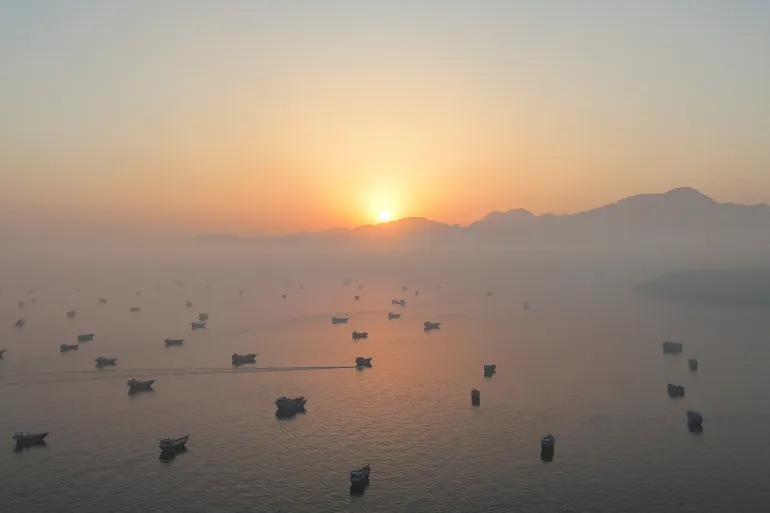
Vessels at anchor in the Strait of Hormuz. (Reuters)
Yesterday to celebrate his birthday, Trump declared that his war with Iran is over and that peace prevails. While details of an agreement are unclear — all of the parties involved have stated different conditions and no transcript yet exists — it appears that we have a “concept of a plan” in place that the Trump administration is calling a Memorandum of Understanding (MOU). It is not finalized as the MOU will not be signed until Friday. Everything stays in place at least until then. As the U.S. military command in charge — Central Command or CENTCOM — stated today, the U.S. naval blockade remains in place until the MOU is officially signed. This, despite Trump posting that “I hereby fully authorize the toll free opening of the Strait of Hormuz.” Of course, the Iranians might have a say in its reopening.
For insiders, look at insurance rates for ships in the Persian Gulf transiting the strait as an indicator of how things are proceeding. Businesses and insurance underwriters are not going to send their ships through without the knowledge that it is safe. Extravagant insurance rates means the strait is not safe. The more the rates approach pre-war costs — it will be a long time before they are the same — the more traffic will transit the strait.
As with most things involving Trump, he took a bad situation, put some Home Depot gold gilding on it, and sold it as a huge success. We have a long way to go before the situation is resolved. Supposedly, the MOU signed next Friday will lead to a renewed ceasefire that will open a sixty day window of negotiations. It is always a promising start when the shooting stops and people are not dying or getting maimed, but peace is hardly ensured. I suspect that most of the process involves Trump getting fed up with the war and just walking away while trying to put a happy face of victory on the debacle.
Clearly Trump failed to achieve any of the goals he set at the start of the war. Indeed, we are worse off now than we were at the start of the war. There is new leadership in charge in Iran that is more hardline than the one we killed off. Now the Iranian Revolutionary Guard Corp (IRGC) appears to be calling the shots and they are more confident in their ability to survive the U.S. military’s best efforts. Trump promised the people of Iran that he would help them throw off their oppressive government. In fact, they are under a more repressive regime and have suffered thousands of civilian casualties in the process. The elimination of Iranian missile and drone production is not mentioned in the MOU. Trump finally settled on dismantling the Iranian nuclear program as the basis of the war but the program remains. The Strait of Hormuz was open to free navigation and now it is not. Notice that Trump declared the “toll free” opening of the strait. Look for Iran to impose a tax, or a processing fee, or an administration fee or an environmental fee or some other fig leaf otherwise known as a toll. Even if they do not charge anything, Iran now knows that they can close the strait or restrict traffic or prohibit ships from designated countries from using it or control it in any way that they care to do so, with significant impact on the world economy. The U.S. did not reopen the strait and the Iranians are betting that the U.S. will not come back to do it in the future. At least not in the next two and a half years.
The mere fact that the administration is talking in vague generalities is a clue to how little has been achieved. Rather, it seems Trump was desperate to get out from under the quagmire he created in the Persian Gulf. I have seen nothing addressing Iran’s sponsorship of terrorism. It appears that sanctions against Iran will be lifted as part of the deal and that billions of dollars in frozen Iranian assets will be released. That unfortunate development is one that Trump is trying desperately to gloss over. He accused President Obama of giving the Iranians “pallets” of money under the JCPOA. It is expected that Trump’s deal will give the Iranians billions more. It is widely reported that Trump will free up twenty billion dollars in Iranian funds, dwarfing the roughly 400 million in frozen assets released under Obama in 2015 (with accrued interest since 1979 the total was about 1.5 billion dollars). Probably, three billion dollars has already been released through the United Arab Emirates (UAE) as Trump is desperate to keep his finger prints off of the cash. There is also talk of the U.S. paying reparations to Iran to help rebuild the infrastructure destroyed during the war. Notably, nowhere to date has there been any talk of inspectors monitoring or restricting the Iranian nuclear program. Without inspections, any paper agreement is meaningless.
Looking at the big picture, Iran achieved its strategic goals and the U.S. achieved none. Yes, Iran is battered and our military is significantly more powerful than Iran is, but as I have written many times in this space, that is not all there is to warfare. Strategy matters. Clear objectives matter. Matching ends, ways and means matters. Despite Secretary of Defense Pete Hegseth’s belief that blowing stuff up is fun and is all that matters, there is more to warfare than bombs. There is a reason that military strategists, including in senior U.S. war colleges, still study On War by Carl von Clausewitz. It is not just a cliche to repeat his fundamental precept that “war is the continuation of policy [politics] by other means.” Nations do not, or at least should not, go to war for the fun of it. The military is one tool to support diplomacy to achieve specific objectives. I dare say that Trump and Hegseth and the rest of Trump’s civilian advisors are too vain to believe that they have anything to learn from those that are professionals in the art of war. This is the result.
Iran’s power, finances and stature on the world stage are significantly enhanced. The U.S. is significantly diminished.
We will have to wait and see what actually takes place on Friday and what is accomplished during the negotiations. The wild card is Israel. Iran insists that Hezbollah in Lebanon is part of the agreement and that Iran will not abide by any agreement if Lebanon is not part of the settlement. Israel insists that their actions in Lebanon are distinct from those in Iran. (Israeli Prime Minister Benjamin Netanyahu is adamantly opposed to any agreement with Iran before their nuclear program is eliminated. Speculation is that he launched an attack into Lebanon just before the MOU was announced for one of two purposes. The benign explanation is that he wanted to emphasize that Israeli actions in Lebanon are not part of the agreement. The less kind explanation is that the attacks were an attempt to get Iran to withdraw from the agreement with the U.S. Netanyahu is in a political bind. He needs to exert his independence and maintain his sovereign responsibilities but Trump is publicly acting like he controls Netanyahu. Time will tell.)
Iran is a bad actor. They are the leading sponsors of terrorism around the world. The leaders of Iran are fanatics and there is every incentive to hold them in check and accountable. Reckless military actions were not the way to reel them in. I think that the waste of lives and treasure will haunt us well into the future. The Trump administration will try and paint a picture of total victory. It is not. We will soon see if this group of third rate actors in the administration have any ability to learn from their mistakes as there is already talk of going into Cuba. Maybe the spineless members of Congress that let Trump do whatever he wants will finally step up. I am not holding my breath waiting for them to get a backbone.
Iran’s Strategic Victory
Posted: May 29, 2026 Filed under: Uncategorized | Tags: Abraham Accords, Drone Warfare, Iran, Israel, JCPOA, Lebanon, Memorandum of Understanding, Middle East, Policy Strategy Mismatch, Russia, Strait of Hormuz Leave a comment
A billboard in downtown Tehran depicting Donald J. Trump with his lips stitched together in a symbolic illustration of the closed Strait of Hormuz. (Reuters)
For several days now, there have been rumors of a “deal” between Iran and the U.S. In diplomatic terms, there is no such thing as a deal. There are treaties, agreements, alliances, and a host of other official documents that exist under international law. In truth, the Trump administration calls the agreement a Memorandum of Understanding or MOU. A MOU — and this one is supposedly one page — is not how wars end. A MOU is more like a concept of a plan and in fact, this one calls for a continued ceasefire for sixty days while the actual terms are hammered out. One thing is for sure, Trump has no idea what he is doing and he is giving the word “deal” a bad connotation. Last Saturday Trump said they were close to an agreement. On Sunday he said that they were not close. On Monday we attacked targets in Iran, allegedly in self-defense, but contrary to the existing ceasefire. Then we learned that the negotiators have come to terms but as of this writing, neither the leadership in Iran nor Trump have agreed to it. Wednesday the two sides exchanged attacks.
It is hard to assess whether the U.S. achieved its strategic goals because they were never articulated, other than vague announcements that Iran must give up their “nuclear dust” (enriched uranium). Or was it his declaration that he would accept nothing less than Iran’s “unconditional surrender?” Or was it that he was going to select “acceptable” new leaders in Iran — regime change? Or was it to destroy all of their ballistic missiles? (Intelligence assessments made public indicate Iran has about 70% of their arsenal intact.) Or was it “a whole civilization will die tonight, never to be brought back again”? Or anything else that happens to pop into his head.
In my view, the Iranians scored a resounding strategic victory that puts the U.S. on its heels around the globe. Historically, this could be the turning point where the U.S. goes from being a global leader to becoming a regional power. It will be the end of American dominance enjoyed since the end of World War II. There are multiple reasons as to why we will look back on this war of choice as a disaster bigger than Viet Nam or Afghanistan.
What is in the agreement? As I write, that is unclear. Both the U.S. and Iran have publicly discussed different elements of the MOU and the parts do not often match. It appears that it will extend the current (almost) ceasefire for another sixty days. During those sixty days, talks would continue for a more permanent agreement. At some point, and right now it looks like after the sixty days, nuclear talks would begin as to the disposition of the Iranian program. There are very little specifics. The Strait of Hormuz, which was open before Trump initiated the conflict, would reopen. The U.S. blockade of the Gulf and Iranian ports would end. Additionally some sanctions against Iran would be lifted and some amount of frozen assets (pallets of money?) released. In other words, we will be worse off, Iran will be better off, after hostilities cease. President Obama’s Joint Comprehensive Plan of Action (JCPOA) hammered out with the P-5+1 (the five permanent members of the U.N Security Council plus Germany) and Iran to curtail Iran’s nuclear program was a much more fruitful and impactful agreement. Critically, that plan included intrusive inspectors to monitor compliance. Trump tore it up. The MOU makes no mention of inspectors which makes any discussion of the nuclear program meaningless unless inspectors are given unrestricted access.
As the talks progressed this week, out of nowhere, Trump invoked the Abraham Accords and demanded that all of the Muslim countries sign on as part of the MOU. The Abraham Accords are a series of agreements, brokered by the U.S. between Israel and Muslim and Arab majority states. Egypt and Jordan have had relations with Israel since 1979 and 1994 respectively. UAE, Bahrain, Morocco and Sudan have joined the Accords since 2020. Complicating the picture is Palestine. Saudi Arabia and other Gulf states plus Pakistan and others will not establish diplomatic relations with Israel until the Israelis commit to a two state solution for the Palestinians. The Israelis, or more specifically Benjamin Netanyahu, refuses. Analysts speculate that Trump threw in that proposal to try and salvage what is going to clearly be a major failure on his part if the MOU goes forward. Should he stick to that requirement, it will prevent agreement on the MOU.
Remember that Israel is conducting military operations in Lebanon against Hezbollah, a proxy of Iran’s. Iran declared that fighting in Lebanon must be included in any settlement or ceasefire. Israel declared that Lebanon and Iran are two distinct issues and that any agreement with Iran does not include Lebanon. This is but one of many complicating factors preventing a permanent agreement and thus the MOU. Additionally, Netanyahu is against any agreement that does not eliminate Iran’s nuclear programs upfront, before the war ends.
One of the biggest lessons learned is the changing nature of warfare. If nothing else, Ukraine and now Iran have demonstrated that a militarily inferior nation can hold out against a much larger and better equipped nation. One big reason is drones. Clearly a Tomahawk surface to surface missile is a more powerful weapon than a relatively cheap drone. But warfare in the modern era is not just about who has the biggest guns. It is economic warfare as well as combat. We have a finite number of expensive precision offensive munitions and our defenses are finite and expensive. Iran can quickly and cheaply churn out a nearly unlimited supply of drones. Are cheap drones sufficient for today’s warfare? No. But if the future of warfare is drones, then Hegseth’s and Trump’s infatuation with a manly non-woke military is a distraction from what really counts. Trump and Hegseth want to take us back to the 1990s with big platforms like the Trump battleship or the F-47 stealth fighter (Trump thinks it is named after him as the 47th president). Those programs cost tens of billions of dollars. One Trump battleship is estimated to cost at least 20 billion dollars (while we are going back to the future, why not propel the ship with big, beautiful coal which Trump seems to want to use to power everything). For example, one Tomahawk missile costs about 2 million dollars launched from a multi-billion dollar platform manned by hundreds of sailors which does not include other costs such as maintenance, fuel, logistics and so on. One Iranian Shaheed drone costs about twenty thousand dollars. Are they terribly sophisticated? No. But when fired by the hundreds coming from multiple directions, some are going to get through, no matter how sophisticated the air defense system is — and our sophisticated air defense systems also use very expensive radars and missiles.
The American military uses drones but they are big expensive ones with a long logistical tail. For example, a set of four MQ-9 Reaper drones (also known as the Predator B — a long range, long endurance, remotely piloted aircraft) plus the ground control station and satellite link systems, cost about $30 million dollars. We have lost several to the Houthis and Iranians as well in operational accidents. Each F-22 Raptor (the current all weather stealth fighter aircraft) costs about 150 million dollars. None of the aircraft have been built since 2011 with only 187 total put into service. However, looking at the total program cost per aircraft (which includes research, development, and start up costs) it comes out to about 340 million dollars per plane. It costs about 70,000 dollars per flight hour to use one. You get the idea, our modern arsenal is expensive. The Pentagon claims that the war against Iran cost taxpayers about 30 billion dollars to date. Most economists estimate that the actual figure is around one trillion dollars when adding up the cost of the operations in theater plus damage to bases and equipment plus the long term replenishment of depleted stockpiles and the personnel involved. So far we have lost thirteen service members killed in action and about five hundred wounded. None of that includes the impact on our domestic economy.
We must also remember that one of the keys to our economy and our role in it is freedom of the seas. Iran now knows that it can control the Strait of Hormuz regardless of any ceasefire or other agreement. That means they also control about 20% of the flow of the world’s oil, significant amounts of natural gas, fertilizer and other “must have” commodities. They will demand to be treated with respect or else they can threaten to disrupt the world’s economy and close it again. Or close it to those nations that are not friendly to them or otherwise refuse to meet Iranian demands. The rest of the world will have to deal with Iran or be prepared for threats to their economy. Iran is now a major player in the region and the world. Despite the Iranian navy “lying on the bottom” as Trump puts it, the U.S. could not keep the Strait open. We also were unable to provide the deterrence or protection we promised to our Gulf friends and allies in the region. Trump even threatened one of our strongest regional supporters. When asked this week about Oman working with Iran to control the Strait he said, “the Strait’s got to be open to everybody… nobody’s going to control it. We’re going to watch… over it… Oman will behave like everybody else or we’ll have to blow ‘em up.” Very reassuring.
Trump bullies and shouts, but in the end, what does he really talk about? Venezuela, Cuba, Greenland, Canada, Mexico, and other Western Hemisphere nations. He mocks NATO, our strongest allies ever, and refuses to commit to their defense. Where does that leave us? We are fast losing our status as a world power and are becoming a regional power. Russia, and especially China, are ready to fill the void.
All for what?
Our Alleged “Stable Genius”
Posted: April 29, 2026 Filed under: Uncategorized | Tags: Department of Defense, Donald Trump, IAEA, Iran, Iran Deal, Iran Nuclear Deal, Israel, JCPOA, Middle East, Strait of Hormuz, Truth Social Leave a comment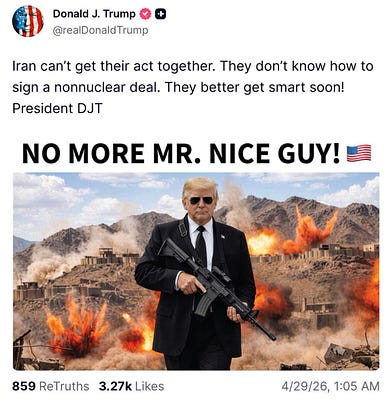
A Truth Social meme posted, when most of us were asleep, by the President. Of the United States. When I first saw it I thought it was a joke put up by a fake account. Sadly, it is real.
With all of the talk about ballrooms and sea shells on North Carolina beaches and the continued stonewalling about the Epstein files, one may forget that we are still at war with Iran. The Strait of Hormuz remains closed, gas is now averaging $4.23 a gallon nationally, farmers are having trouble finding fertilizer for the planting season and our Commander-in-Chief knows only how to use AI to try and make himself look tough. Emphasis on “try.” Trump thinks that he can bully Iran into giving up its “nuclear dust” (as he calls it, and I’m not really sure what he means but probably he means enriched uranium). This is the very same guy that claimed it was “obliterated” last summer. I could fill several pages in this space recounting all of the lies that he and his administration have told about this war of choice, but since most of them are preposterous and easily debunked, I won’t waste your time. Simply ask yourself if you, and indeed the world, are better off, safer and more financially secure as a result of this war than you were two months ago.
We still do not know what the reason for the attacks on Iran are all about. Our service men and women have performed professionally and with skill. They are tremendous. But what are they risking their lives to do? Tactical brilliance does not translate to strategic success without a well thought out rationale for war with clear goals set at the beginning. Trump and his man servant Hegseth continue to change their story with each passing day and cannot articulate any strategic goals, only tactical successes. Military planning is based on, and in this order, delineating the ends (strategic goal — when do you know you won?), ways (the operational use of force — attack from the air, the sea, direct assault, hit command and control?) and the means (tactical application of force — what armaments and forces are available?). All three must be in alignment.
Currently, we are in a stalemate with Iran. Both the Iranians and the Trump Administration think that they can wait out the other side and that they can force the other guy to give up. Among the many factors that this administration overlooked or underestimated is the steadfast will of the Iranian culture. Couple that with a government that does not answer to the population but is only interested in its own survival, and it gives the Iranians an advantage. They are suffering, without a doubt, but most regional experts assess that they can hold out much longer than expected. The rest of the world is already beginning to suffer and will be experiencing real economic and quality of life hardships in the very near future. It is unclear whether or not our friends and allies (a different topic as Trump works overtime to alienate every single one of them — except his best buddy Putin) can bring pressure to bear for Trump to settle with the Iranians.
As it stands now, and Trump could change it all in the next five minutes with a Truth Social post, the Iranians have offered to reopen the Strait and then come to the negotiating table to discuss other issues, such as what to do about their enriched uranium. In exchange, the U.S. must lift its blockade of Iran. Trump refuses to discuss it and is increasing the strength of the blockade and ordering the seizure of Iranian ships worldwide.
In recent days it became clear that the U.S. and our regional supporters suffered more damage than previously understood. It is estimated that the U.S. suffered about five billion dollars in damages to equipment such as missile defense radars in Qatar, Jordan and UAE, the Navy’s Fifth Fleet headquarters in Bahrain, air bases in Jordan, Kuwait and Saudi Arabia and numerous high end aircraft and drones, to name a few. All of the Gulf state countries plus Jordan suffered damage to their infrastructure and some oil and natural gas facilities. Of course most importantly, human beings were killed and injured including thirteen U.S. service members killed and around three hundred and fifty wounded.
Trump is in a bind. He has lost interest in the war but cannot look weak. If he withdraws U.S. forces without some concessions from the Iranians the world will consider it a defeat. If he stays indefinitely he looks weak because Iran gets stronger everyday and will have survived our best shot and lived to fight another day. Continuing direct combat operations weakens our ability to defend our interests in other hotspots around the world. The U.S. has already used up thousands of cruise missiles and air defense missiles that could take three to five years to replenish. According to the Department of Defense, the war cost us 25 billion dollars to date. Most analysts put the total costs at a much higher level, as much as 65 billion dollars. Today Hegseth testified before Congress that the DOD requested budget for the next fiscal year is 1.5 trillion dollars, a forty-four percent increase over the current budget.
To settle his war of choice, Trump must get serious about the negotiations. Sending two real estate tycoons to negotiate a meaningful settlement is ridiculous, not to mention that the last two times the Iranians met with these same individuals — thinking that they were making meaningful progress — their country was attacked. There can be no “take it or leave it” agreement forced on the Iranians. Bullying will not work — it only makes them more determined. It will take a team of experts and seasoned negotiators to spend a lot of time with great patience to reach a negotiated settlement. Trump should set the process in motion, shut up, and see what happens over time. Pakistan showed that it can be a helpful and effective mediator. Let them try.
In the end, Trump is likely to end up with an agreement that is barely as good as the one that the U.S. negotiated during the Obama Administration that Trump tore up. The 2015 Joint Comprehensive Plan of Action (JCPOA) between Iran and the “P-5+1” (the five permanent members of the U.N. Security Council US, UK, France, China, Russia, plus Germany along with the EU) limited Iran’s capability to enrich uranium. The agreement limited the number of Iranian centrifuges, the level of enrichment and the size of their stockpiles. As part of the agreement, intrusive monitoring was conducted by the International Atomic Energy Agency (IAEA). In exchange, Iran got some sanctions relief, some frozen assets were released and a timetable for other future provisions. Sanctions remained in place for Iran’s missile program, support for terrorist groups and efforts to improve Iran’s human rights record. It was not perfect but it was working, it was building trust for future agreements, and it kept Iran in relative check. Israel opposed the deal. It took twenty months of detailed negotiations using technical experts as well as diplomatic experts. The negotiations were slow going with ups and downs as each side sounded out the other and built trust. No such expertise accompanied Trump’s recent negotiating teams. I suppose that as a very stable genius he did not need any other experts working on the issues.
Trump is likely to declare victory once the Strait of Hormuz is reopened. The very Strait that was open to free flowing ship traffic before the war. He will continue to make noises about the Iranian nuclear program but will not seriously negotiate a settlement. The wild card in ending the war is Benjamin Netanyahu of Israel. He is determined to turn southern Lebanon into another Gaza strip by destroying it in his fight with Hezbollah. He is also not satisfied with the status quo in Iran. The next step may not be Trump’s to take. Remember that initially Secretary of State Marco Rubio stated that the U.S. attacked Iran because Israel was about to do so and since Iran would retaliate, the U.S. decided to strike first. One wonders who has their hand on the wheel driving us to who knows where.
 Tom
Tom

Recent Comments